
Written for an Audience of One
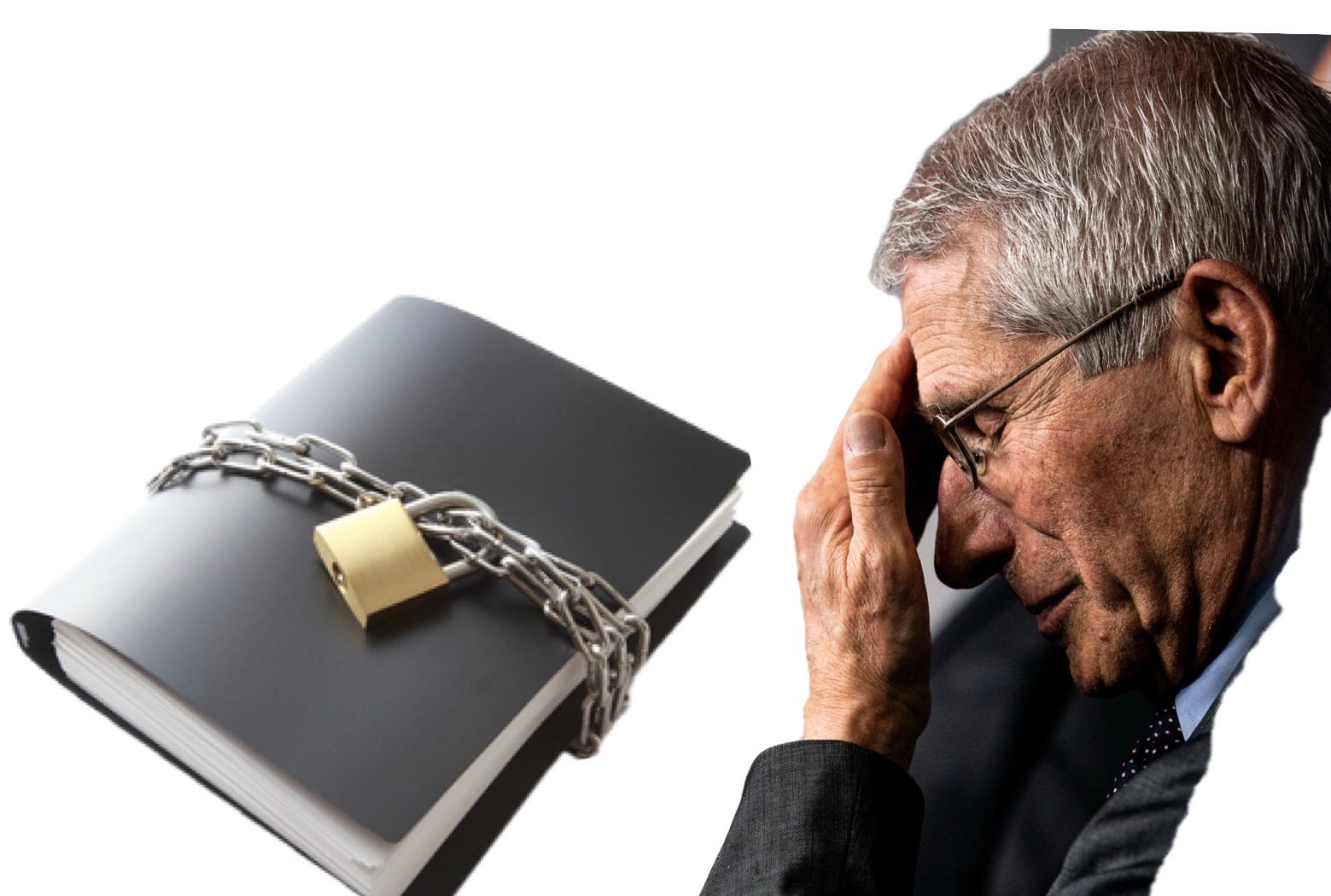
Fauci's diary wasn't a secret he kept. It was a record he never controlled.
Every few years, the private record of a powerful government official suddenly becomes public. Not because the official chose to publish it or because a memoir was due. The notes surface because they were preserved by a system the writer did not fully control — and because someone armed with a subpoena or a Freedom of Information Act request finally went looking.
The public then reads words never intended for the public.
The latest example is Anthony Fauci.
Most of you have read about the 1,100 pages of Fauci’s pandemic-era entries, covering December 2019 through the end of 2022. Health Secretary Robert F. Kennedy Jr. told FOX News that the files were found on scattered government servers. It took eight months, he said, to find all of it.
Diary is the wrong word for what has emerged.
A diary suggests a journal kept in a bedside drawer — something its author alone creates and possesses. Fauci’s record is different. He wrote candidly, sometimes daily, using government infrastructure. The survival of his entries was determined less by nostalgia than by federal retention rules.
That makes the question some critics have asked — why didn’t Fauci destroy his “diaries” once he saw how the political winds were blowing—something close to an unforced error. He never had that kind of custody over them.
What makes the entries valuable is not that they settle the arguments about COVID that have consumed Washington for six years. They do not. Their value is that they show what a senior official recorded when he believed the audience consisted of one person: himself.
Take the virus’s origin. On January 26, 2020 — weeks before the pandemic had a name most Americans recognized — Fauci wrote that “now we know the market was not the source, it was the amplifier” (referring to the Huanan Seafood Market in Wuhan, China, initially suspected as the outbreak’s point of origin). Days later, on a February 1 conference call with a dozen leading virologists, his own notes recorded that only two of the participants believed a natural origin was likely; Fauci wrote that “we could not let this go.” For months afterward, he told the public the opposite: that a natural spillover from a wet market was the likely origin, while treating the lab-leak hypothesis as a conspiracy theory unworthy of any serious discussion. He did not resolve this contradiction so much as outlast it; by the time he acknowledged in later testimony that the lab-leak hypothesis was not, in fact, a conspiracy theory, the diary had already exposed that he’d never fully believed the story he was telling.
The pattern repeats with the guidance that shaped daily American life longer than almost any other pandemic rule. Fauci did not need a private diary to reveal this one — he said it under oath. In 2024 closed-door testimony to the House COVID subcommittee, he acknowledged that the six-foot distancing rule “sort of just appeared” and wasn’t based on any controlled study. It is worth sitting with the sequence: a rule debated the way an on-air prescription is debated — earnestly, precisely, at six feet rather than three or ten — was never tested at all before it went out into the world and shaped the operation of American schools, offices, and courtrooms for two years. The diary entries are devoid of any scientific data or arguments supporting the six-foot rule.
Take the schools, too. Fauci has long rejected the idea that he personally drove pandemic-era closures. Asked directly by ABC’s Jonathan Karl in 2022, he insisted, “I had nothing to do with it,” and complained that critics ignore the transcript where he says otherwise. His diary tells a more complicated story. On March 15, 2020 — a day he marked “BIG DAY!” — he described pushing both California Governor Gavin Newsom and then–New York City Mayor Bill de Blasio toward school closures and broader shutdowns. In one entry from around that period, he recounted a call with Ann O’Leary, Newsom’s chief of staff, in which she credited Fauci’s television appearances with the governor’s decision to close the state’s schools, along with its bars and restaurants. Fauci recorded that account without disputing it.
Then there is his often-cringeworthy obsession with his own fame.
“For better or worse, I am becoming an international celebrity,” Fauci wrote in March 2020. He recorded the television appearances, the press coverage, the merchandise made in his name. He noted a call organized by Kim Kardashian that included actors, musicians and athletes. The entries are not necessarily sinister. They are something more embarrassing and revealing: the running astonishment of a government scientist watching himself become a global brand in real time.
His relationship with Donald Trump also shifted over the course of the diary, in ways the public record doesn’t fully capture. Early entries describe warmth — Trump seeking Fauci’s approval on camera during the first briefings, calling him the smartest man in the room. Later entries document a rupture with Chief of Staff Mark Meadows, whom Fauci accused of direct confrontation. The value here isn’t a quote — it’s the arc: a relationship that curdled in real time is recorded as it happened, rather than reconstructed afterward by either side looking to give it their own spin.
There are precedents for all of this. One that comes to mind is former Defense Secretary Donald Rumsfeld. He spent years dictating terse internal memoranda that his staff called “snowflakes.” They contained instructions, questions, complaints and doubts, usually in the brusque shorthand of a man who did not imagine that strangers would ever read them.
Rumsfeld released a carefully selected portion while promoting Known and Unknown, his 2011 memoir. The rest required a six-year Freedom of Information Act battle. After the National Security Archive sued the Pentagon in 2017, tens of thousands of pages started emerging.
One entry, written nearly two years into the wars in Afghanistan and Iraq, contained a startling admission: “I have no visibility into who the bad guys are.” Publicly, the administration continued projecting full confidence about the war effort. Privately, the defense secretary was acknowledging that the government could not reliably identify the enemy it was fighting.
Fauci and Rumsfeld are very different men, holding different offices and facing distinct crises. The same basic structure, however, is public certainty resting on top of a private record filled with doubts and contradictions. And in both cases, the unvarnished account became public only because it was extracted from government servers, not because either man wanted to share it.
When it comes to Fauci, the public is polarized. But his entires are worth reading without first deciding whether they prove sainthood or gross misconduct They show something official testimony and carefully edited memoirs rarely do: power before the copy desk arrives.
The striking thing is that senior officials keep writing candidly at all. They know about subpoenas. They know about congressional investigations and federal archives. They know that nearly every digital record can outlive both its original purpose and the political moment that produced it. Still, they write.
Perhaps that is vanity. Perhaps it is a need to preserve their own version of history before someone else writes it for them. Or perhaps anyone who spends years near the center of government — isolated, pressured, surrounded by people who want something from them — eventually needs an audience of one.
The mistake is believing that audience will stay one.


One point to make is that we tend to badly overestimate the extent to which senior government people are either in control or especially perceptive/wise.
Vanity, vanity. Has always been and always will.
I live my life by this rule about anything I write: If I write anything, to myself or to others, I operate under the possibility that it will be posted online for all to see by tea-time.