
When the Trade War Shows Up at Your Door
How a simple hair gel order — and a surprise $23 customs bill — reveals the hidden cost of Trump-era tariff changes on everyday online shoppers.
Although we’ve all heard a lot about tariffs this year, it’s hard to feel what they mean in day-to-day life until you crash into them yourself at checkout. You assume tariffs are something that happens far away, between governments and trade lawyers, not between you and your shampoo.
That’s what happened yesterday when
tried to restock a hair gel she loves from a small Australian company. She filled her cart, applied a Cyber Monday discount, and headed to checkout expecting a deal. Instead, the site suddenly told her it could not ship to her U.S. address.After a few emails with customer service, she learned why: under tariff changes introduced during the Trump administration, imports under $800 are no longer automatically exempt from customs duties. She could still get her hair gel — but only if she agreed to pay extra.
In the end, she paid about $23 more for the same product she had bought before, wiping out her savings. A quiet government policy change had just reached into her bathroom cabinet and rewritten the price of her favorite product.
Trisha had just bumped into a policy change most Americans didn’t see coming. And it prompted my curiosity—and this unplanned Just the Facts—about the quiet death of the under-$800 free pass.
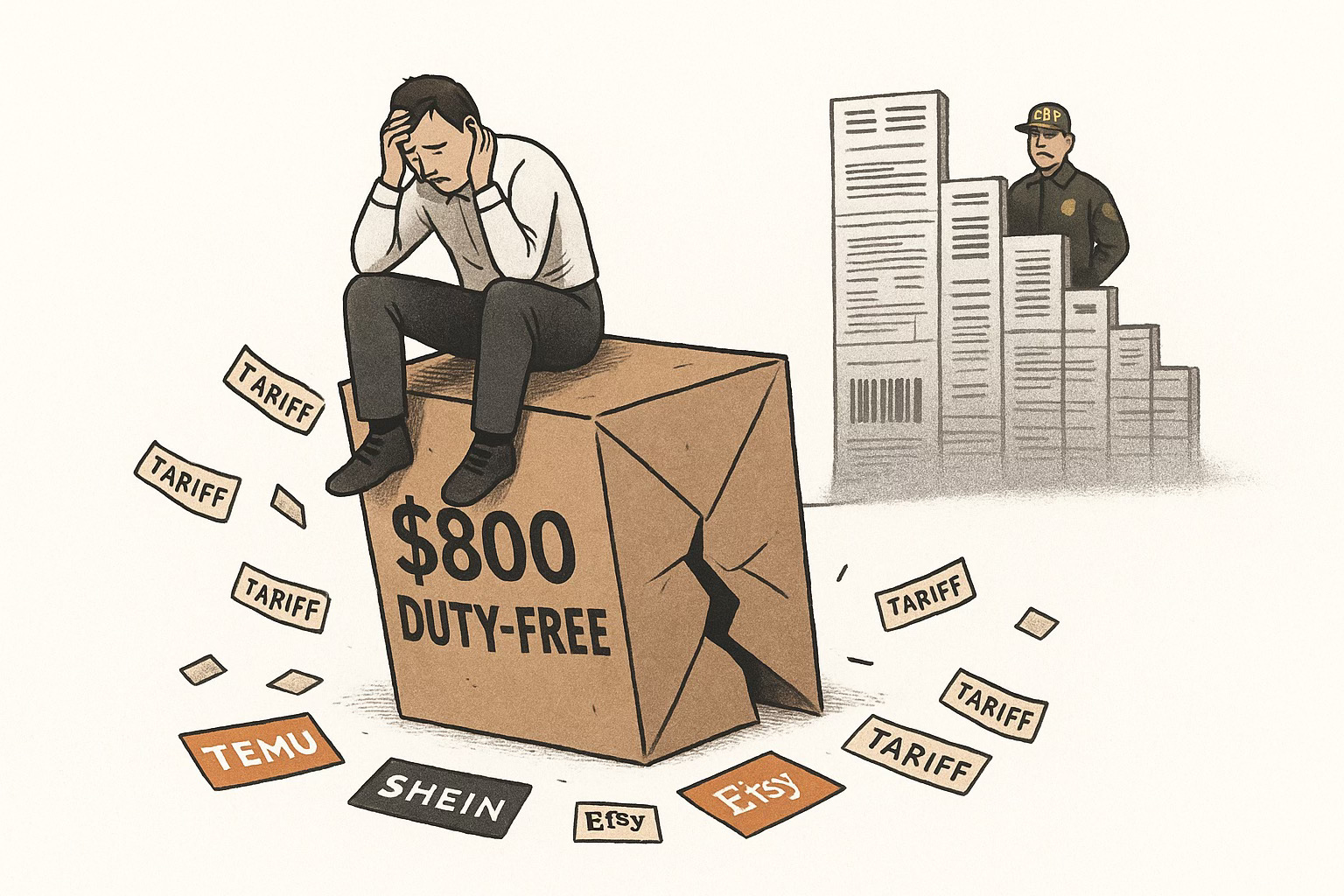
For years, U.S. shoppers buying from overseas enjoyed a generous carve-out: if the items in a package were worth $800 or less, they almost always came in duty-free. That rule, known in trade jargon as the de minimis exemption, turned the planet into one big mall. So long as you did not mind waiting for shipping, you could order a coat from Paris, fabrics from India, or hair gel from Australia, and never give a thought to customs.
That era is over. At least for the moment.
The Trump administration in May first removed that loophole for goods arriving from China. A few months later, in August, it disappeared for shipments from the rest of the world as well. Suddenly, millions of small packages — the kind that used to glide through unchecked — became taxable.
The change had rare bipartisan political support. Both Democrats and Republicans supported ending the break on low-value goods. Lawmakers argued that the exemption effectively gave big foreign exporters, particularly from China, a way to sidestep tariffs that American companies were required to pay. Security officials also warned that the same lightly scrutinized channels made it easier to sneak fentanyl and other contraband into America.
The result: ordinary shoppers like Trisha are now on the hook for duties for the first time — and the bills are often far higher than many expect.
How Foreign Sellers Are Rewriting the Rules
If you’re a retailer overseas, the new system forces a choice: who eats the tariff?
Some brands have decided to reorganize their entire logistics chain. Instead of shipping individual orders directly to American homes, they now send big batches of goods to the U.S., pay the tariffs at the border, and then distribute from warehouses on American soil. The duties get folded into the cost of doing business, and shoppers simply see a higher sticker price — but no alarming customs email from a courier later.
Other foreign sellers keep shipping individual packages from abroad but choose to pay the duty themselves. Again, they sometimes raise prices to cover the new cost, but the U.S. customer never has to go online to settle a customs bill before a driver will release the package.
And then there are the companies that make a different choice: they pass the cost directly to you.
That’s where the trouble often starts.
The Fine Print Trap
In theory, retailers could handle this transparently. Some online boutiques estimate duties right in the checkout flow. Consumers see the tariff amount and can decide whether the total is still worth placing the order.
The bigger shocks take place when that doesn’t happen — or when the warning is so vague that it might as well not exist.
The NY Times reported this week on one American shopper, Ms. Batten, who ordered a coat from Rain Couture, an Amsterdam-based fashion label. The coat was made in China, which meant it fell under the steepest U.S. textile tariffs. The company’s checkout page never clearly told U.S. customers how much they might owe. The fact that duties were the buyer’s responsibility was tucked away in boilerplate text on other parts of the site.
When the package hit the United States, the reality showed up not in her cart, but in a message from UPS. To get her coat, she had to pay a customs bill equal to nearly sixty percent of its value. UPS would not explain how it had calculated the amount, and the tangle of tariff categories that apply to clothing from China makes it almost impossible for an individual shopper to double-check.
She ended up paying the tariff instead of forfeiting the coat. Sometimes— particularly on niche hobbies, tiny parts, and specialized tools—the duty costs twice as much as the item.
This is the new limbo: too complex for consumers to navigate, too expensive for small sellers to swallow, and extremely profitable for whoever ends up collecting the duty plus their service fees.
Logistics Whiplash
Trade rules may change with a few lines of government text, but the real world must catch up in trucks, planes, and warehouses.
Before the de minimis overhaul, roughly four million small packages under the $800 threshold were entering the United States every day. Once the loophole was closed for all countries, the volume of those cheap, lightly taxed parcels plunged.
U.S. Customs and Border Protection has processed over seventy million shipments that would previously have qualified for the exemption since the changes took effect — an average of more than eight hundred thousand packages a day — and has assessed more than $400 million in duties.
Carriers like FedEx and UPS, postal services, and foreign sellers were forced to retool on the fly.
One of the sharpest disruptions hit the international postal network. Many overseas sellers use their national postal service — say, Canada Post — which then hands the package off to the U.S. Postal Service. The problem: USPS was never set up to collect customs duties on that kind of scale.
When the de minimis break disappeared, several foreign post offices simply stopped sending low-value packages to the U.S. until someone figured out how to handle the new duties.
Eventually, U.S. authorities allowed a small handful of qualified companies to step into the gap. These firms can calculate, collect, and remit customs duties on postal shipments before they enter the country. Now, packages coming through the postal network must have their duties paid in advance, which at least means Americans are less likely to be ambushed by a ransom-style bill.
Postal services in countries like Britain, Canada, and Ukraine now offer options for senders to prepay the U.S. duties. Even so, the flow of postal packages into the United States is still far below its former level.
The Trade War Came for Your Shopping Cart
There’s a political irony at the core of all this.
Tariffs were sold as a way to pressure foreign governments and shield domestic industries. Ending the de minimis exemption was framed as closing a loophole used by big overseas platforms and drug traffickers.
In practice, a significant share of the pain is landing on regular people doing regular things online: buying a winter coat, a weaving tool, or a favorite hair product from a small company overseas.
Sometimes the extra cost is a modest annoyance, like Trisha’s $23 Cyber Monday surprise. Other times it is an outright shock, like a duty bill that is twice the value of the item. And in all cases, the rules are confusing enough that buyers and sellers can’t easily tell when a mistake has been made — or how to fix it.
This is not just a question of trade policy. It is a question of consumer protection and transparency.
How to Protect Yourself as a Cross-Border Shopper
Until the dust settles — and it may not be for a while — American shoppers need to be savvier about buying from abroad. A few practical steps:
Look for clear duty disclosure at checkout.
If a foreign seller estimates and collects duties upfront, that is usually a good sign. You pay once and the package arrives without additional drama.Read the fine print — really.
Hunt for any language about taxes, customs, or duties. If a site says these are “the buyer’s responsibility” but offers no estimate, you are accepting a blank check.Prefer delivery-duties-paid (DDP) over duties-unpaid.
Some merchants or couriers explicitly advertise that duties are included. If the alternative is risking a surprise bill, a slightly higher price can be the safer option.Be especially cautious with items made in high-tariff countries.
Goods made in China, in particular certain categories like clothing and textiles, can face hefty rates. That doesn’t mean don’t buy — but go in with open eyes.For small foreign sellers you love, ask how they handle U.S. duties.
Many are just as confused as you are, and some are actively upgrading their systems. A quick email can save both of you headaches later.
When in doubt, consider a U.S.-based retailer or distributor.
That might mean your beloved Australian gel ships from a warehouse in New Jersey instead of Sydney. Less romantic, but far easier on your nerves.
The Policy Question Behind the Hair Gel
Trisha’s hair gel order is not just a quirky anecdote about customs rules. It is a window into how abstract policy changes reshape everyday life in subtle, often regressive ways.
When leaders promise that tariffs will hit foreign producers, not domestic consumers, it sounds clean and decisive. When both major parties agree on closing a “loophole,” it sounds like common sense.
But on the ground, that neat story frays. The global marketplace gets more fragmented. Small businesses scramble. Carriers build new fee structures. And consumers like Trisha discover that the real battlefield of trade wars is their own checkout screen.
So, the next time you marvel at a beautifully designed product from halfway around the world and hover over the buy button, remember there is now an invisible border checkpoint inside your shopping cart. Cross it only deliberately.


Tariff changes are not "bad" for the US economy. The free-trade globalist economy essentially wiped out America's middle class with the destruction of our manufacturing sector. The lure of cheap goods, both in terms of dollars and quality were the distraction that allowed this to occur. If we don't restore our manufacturing sector we will not be able to rebuild the middle class so we must choose - make it cost effective to manufacture goods at home so we can support people and restore the middle class, or ignore that reality because we want cheap things more than we want dignity and opportunity for others.
I have a high school classmate who is rabidly pro-Trump. And he is apoplectic over the Trump-era tariff changes. Because he understands exactly how bad they are for the US economy.