
When the Supreme Court Has to Ask What Sex Means
A three-hour Title IX argument revealed how far the law — and the culture — have drifted from biological reality.
The Supreme Court, Title IX, and the Question That Should Never Have Been Asked
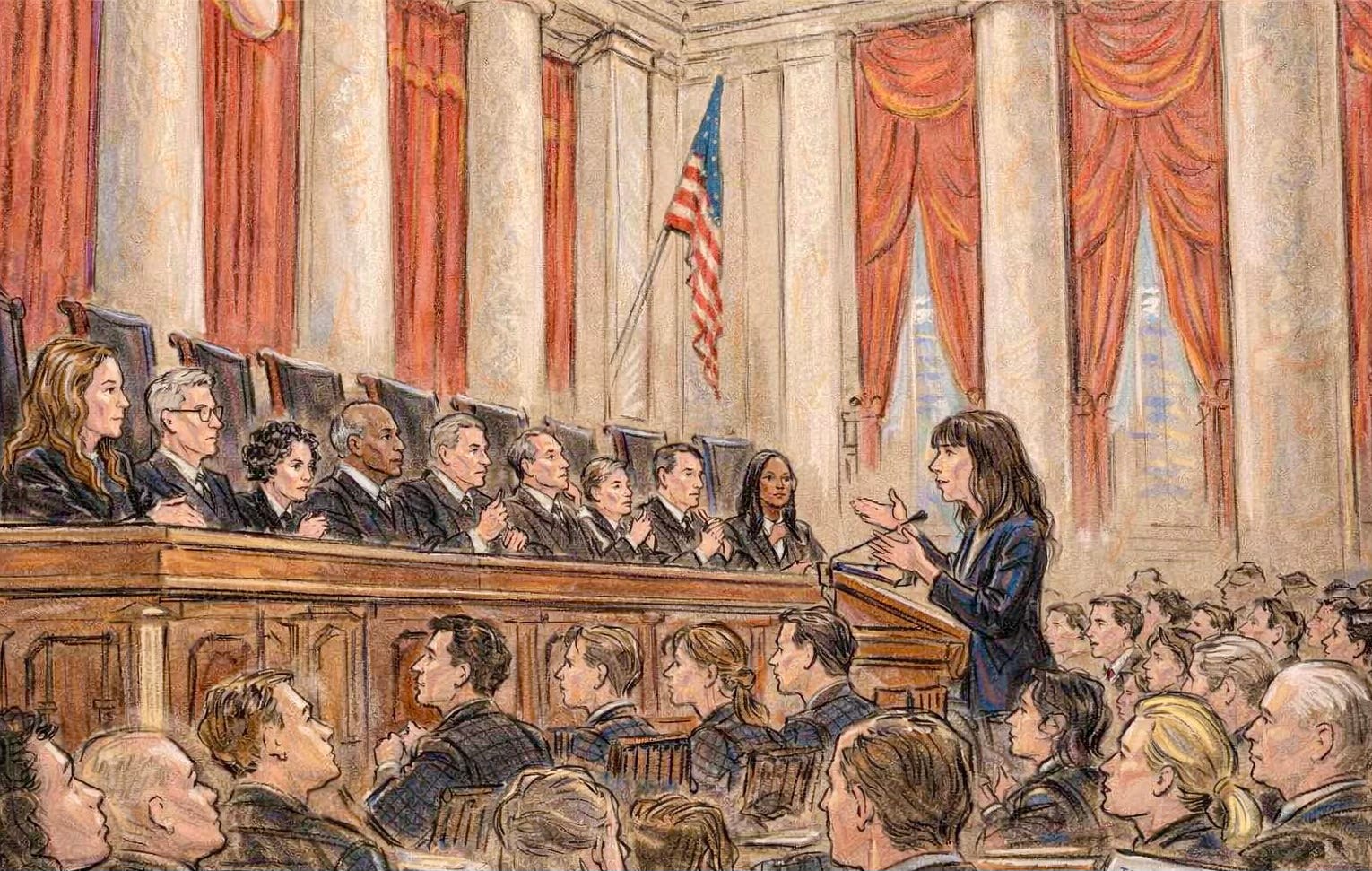
On Tuesday, I listened to more than three hours of Supreme Court argument on a question that would have seemed absurd when I was in law school — or when Title IX became law more than fifty years ago.
The question, stripped of euphemism, is this:
Can a state preserve separate sports teams for girls and women without violating the Constitution or federal civil rights law?
That this even needs answering tells us how far we have drifted — culturally, legally, and intellectually — from first principles.
What Title IX Was Supposed to Do
Title IX was passed in 1972 to remedy a simple and undeniable reality: women had been systematically excluded from equal opportunity in education. Athletics were not incidental to that mission; they were central to it.
Before Title IX, girls’ sports were often an afterthought — underfunded, underdeveloped, or nonexistent. The law worked because it recognized something obvious and grounded in biology: males and females are different in ways that matter in competitive sport. Equal opportunity required acknowledging those differences, not pretending they did not exist.
Sex-separated teams were not a concession. They were the solution.
For decades, this was not controversial. Boys and girls competed separately not out of prejudice, but because average differences in strength, speed, size, bone density, muscle mass, and cardiovascular capacity are real, measurable, and decisive.
None of that has changed.
What has changed is the claim that acknowledging those differences is now discriminatory.
Why These Cases Matter
The Court heard challenges to laws passed in West Virginia and Idaho — like laws now on the books in roughly half the states — that require girls’ and women’s sports to be reserved for biological females.
Two transgender-identifying athletes challenged those laws, arguing that excluding them from female teams violates both equal protection and Title IX itself. Their core claim is straightforward: preventing biological males from competing in women’s sports is unlawful sex discrimination.
The states argue the opposite — that Title IX depends on sex-based distinctions in athletics, and that erasing them undermines the very women the law was designed to protect.
As the arguments unfolded, one unavoidable question kept resurfacing:
If sex no longer has a stable meaning in law, what happens to women’s sports?
The Temptation of Narrow Exceptions
Several of the Court’s liberal justices appeared to search for a narrow escape hatch — a way to avoid a broad ruling by sending these cases back to lower courts for individualized review. The idea is that even if sex-based categories are generally permissible, particular athletes might deserve exceptions based on medical treatment or some perceived lack of advantage.
That approach may sound compassionate. It is also legally and practically unworkable.
Title IX was never built on individualized assessments of physiology. It was built on clear, enforceable rules that schools could apply consistently. Once schools are required to litigate biology athlete by athlete, fairness dissolves into subjectivity, lawsuits become endless, and girls’ sports exist only at the pleasure of the next legal challenge.
Hard cases are emotionally compelling. They are also how rules collapse.
What the Court Was Really Wrestling With
Several of the conservative justices returned to a basic point that has been oddly difficult to say out loud: federal law has always allowed separate teams for males and females to ensure fair competition. Why should the Court now impose a single national rule when states remain divided — and when the science itself resists abstraction?
That reframes the dispute. This is not about hostility toward transgender people. It is about whether courts should override biological reality in contexts where physical differences determine outcomes.
The justices also pressed on a question that increasingly has no answer in public discourse: what does sex mean in law? When sex becomes an open-ended concept untethered from biology, legal lines stop holding. At that point, it is not just women’s sports at risk, but sex-based protections across the legal system.
What Is at Stake
Outside the Court, protesters chanted slogans about ideology and biology. Inside, the language was more measured — but the conflict was the same.
Female athletes are watching closely. Many of them quietly. Some of them angrily. They understand what is on the line: scholarships, records, safety, and competitive integrity. These are not abstractions. They are the product of decades of progress under a law that worked precisely because it was grounded in reality.
The Court has touched this terrain before, in other contexts. But sports are different. Unlike bathrooms or pronouns, athletic competition produces winners and losers. Biology is not symbolic here. It is decisive.
A Hope — Not a Prediction
I have learned never to predict Supreme Court outcomes, especially in cases this charged. But I will say this: the most radical decision the Court could make right now would also be the most restrained.
To reaffirm that sex is a real and material category in law.
To recognize that Title IX’s success depends on that recognition.
And to state plainly that preserving women’s sports is not discrimination — it is the reason they exist.
One day, future generations may look back and ask how the Supreme Court ever had to debate whether sex is real.
My hope is that they will also see this moment as the beginning of a course correction.
Not because it was political.
But because truth still mattered.


Hope they do the right thing.
I, too, cannot believe we cannot agree on this.
And as a Democrat -utterly ashamed of my party.
I listened to the whole thing today, too. Ultimately, I found it very depressing, deeply maddening and scary. Yes, there were some good questions and some good points were able to be heard, however, I kept yelling to the live feed, ‘you mean boy, you mean male, YES, thats the point you ignorant Justice, HE is being excluded from girls sports BECAUSE HE IS NOT A GIRL.’ Ugh. It was exhausting. Almost all of the judges complied with the pronoun game. And finally, we kept hearing about Hecox and BPJ, the boys, —hardly ever about the girls. What about the girls? How do they feel? What about THEIR exclusion?
These people don’t give two figs about the women and girls affected by this poisonous cult ideology. This does not bode well for the future even if the ruling is in favor of protecting women. The fact that we are here means the liberals will comply with NO LAW and NO RULING, EVER.