


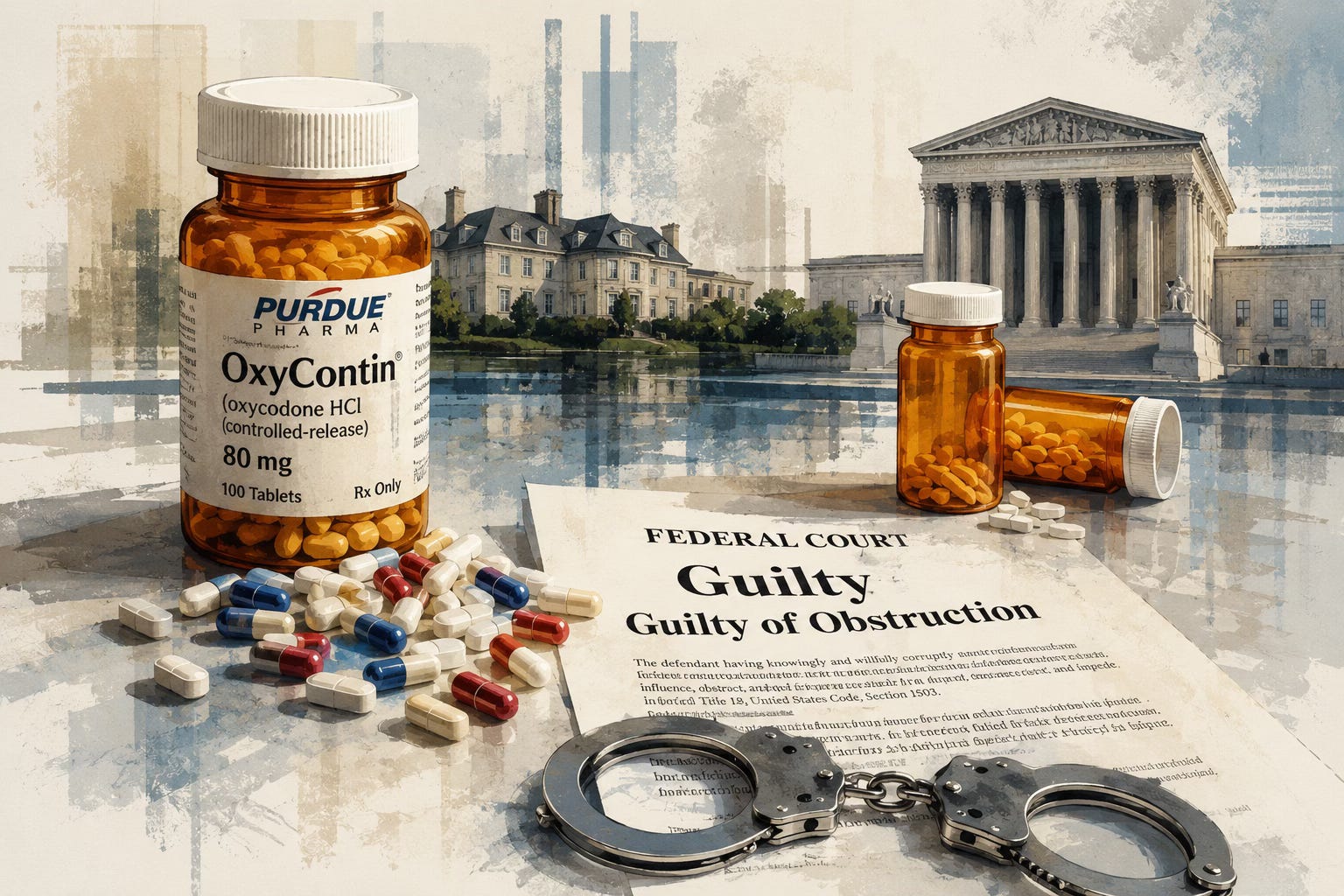
There are moments in a long-running public scandal when history seems to write the coda itself.
Last week, while much of the national press barely noticed, Joss Sackler, wife of former Purdue Pharma board member David Sackler, appeared in federal court in Miami and pleaded guilty to obstructing a federal grand jury investigation. She admitted deleting WhatsApp messages that would have shown she was the intended recipient of prescription painkillers seized by U.S. Customs and Border Protection at Miami International Airport in June 2024. Sackler was addicted at the time to the opioids that had helped ignite the deadliest prescription drug crisis in American history while simultaneously creating a multi-billion-dollar empire for the family into which she had married. She is scheduled for sentencing in July and faces a statutory maximum of 20 years, though the guidelines are expected to call for a far lighter sentence.
That would be a sad story in almost any family.
In this family, it is something more.
Her husband, David Sackler, is the son of Richard Sackler, the former Purdue president and chief executive, and he served on Purdue’s board before the company entered bankruptcy.
I have written extensively about the Sacklers, Purdue, and OxyContin, including in my book Pharma: Greed, Lies, and the Poisoning of America, and in follow-up reporting and commentary in the New York Times and here on Just the Facts. I argued then, and I believe now, that the people who directed Purdue deserved at the very least a criminal investigation commensurate with the scale of the lethal catastrophe they had sparked.
Instead, Purdue Pharma, the corporate entity, pleaded guilty in 2020 to federal conspiracy and fraud charges related to its business practices. It had pled guilty in 2007 to a felony charge of misbranding OxyContin with the intent to defraud or mislead. But no member of the Sackler family has ever been criminally charged for Purdue’s conduct.
That remains one of the great failures of accountability in modern American public health.
The opioid epidemic has killed on a scale that is often forgotten. The Associated Press, using federal data, reported that more than 900,000 deaths in the United States have been connected to opioid overdose since 1999. The early wave was driven by prescription opioids, led by OxyContin, and followed by heroin and then fentanyl.
Those numbers are not abstractions. They are parents who never came home. Children found dead in bedrooms. Veterans. Nurses. Construction workers. Teenagers. Grandmothers. People who were prescribed pills after surgery. People who were told their pain could be safely controlled. Patients who trusted doctors, who believed drug labels, who had faith in a system that had already been compromised. I have met and talked to many of the families of the victims. For every person who died from an opioid overdose, there are relatives and friends whose lives have forever been changed.
For years, many of those families fought the Sacklers in court, in bankruptcy proceedings, in the press, and in public memory. They demanded something more than money. They wanted admissions and accountability. Many wanted the Sackler name to stop floating above the wreckage, insulated by trusts, lawyers, philanthropy, and the antiseptic language of civil settlements.
Instead, what they finally received was a flawed multibillion-dollar bankruptcy deal. On May 1, 2026, a $7.4 billion national Purdue and Sackler settlement became legally effective. It is the messy and unsatisfying conclusion to a decade of litigation over Purdue’s and the Sacklers’ role in fueling the opioid crisis. The Sackler family owners are required to contribute at least $6.5 billion, Purdue is being replaced by Knoa Pharma, the Sacklers are barred from selling opioids in the United States, and more than 30 million documents related to Purdue’s opioid business are to be made public.
That is a tiny measure of accountability. But it is not the accountability for which the families fought.
It does not bring back the dead nor restore hollowed-out communities. It does not erase the years Purdue spent turning pain into profit. It does not answer the question that has haunted this story from the beginning: how can a company plead guilty to crimes of such consequence while the people who controlled and profited from it avoid criminal charges?
That is what makes the Joss Sackler case so grimly arresting.
It is not justice in any legal sense for the victims of OxyContin nor a substitute for the prosecutions that never came. It is not a reason to mock a person who says she suffered from addiction. Addiction is not a punchline or a moral failure.
But the symbolism is inescapable.
The epidemic that Purdue helped unleash did not stop at the gates of privilege. It did not care about the security guards, the private schools, the family offices, the wealth managers, the art collections, the high-end philanthropy, or the careful legal architecture built to preserve Sackler family fortunes. It did not care whether someone was sleeping under a highway overpass or living inside one of America’s most notorious fortunes.
It is a vivid reminder that addiction spares no one.
One of the reasons the Sacklers became a symbol of the opioid crisis was because they insisted, for so long, that the harms of OxyContin were someone else’s problem. Bad doctors. Needy patients. Criminal diversion. Personal weakness. Misuse and abuse. Anything but the predictable outcome of a business model that pushed a powerful opioid with catastrophic consequences.
Now, in a bitter historical turn, the opioid crisis has reached inside the family perimeter.
That does not make Joss Sackler responsible for Purdue’s decisions. Her lawyer is right that her case is legally separate from Purdue Pharma and other members of the Sackler family. That distinction matters. She pleaded guilty to her own conduct, not to Purdue’s.
But journalism is not only about legal distinctions. It is also about meaning. And the meaning here is unavoidable.
The family whose fortune was inseparable from OxyContin now has a member of its inner circle standing in federal court, acknowledging conduct tied to her own opioid addiction. That fact landed with force among the online communities of relatives and friends who lost loved ones to OxyContin and spent years demanding justice. For them, while it was not the justice they had sought, it seemed a kind of karmic reckoning.
I understand why.
For decades, America treated addiction as something that happened to other people. Purdue initially concentrated much of it Oxycontin marketing in the rural and blue-collar towns through Appalachia. Those were people who could be dismissed from a distance. And Purdue advanced the assumption that respectable medical treatment could not possibly create the kind of addiction associated with street drugs. That a pill prescribed by a doctor, promoted by a major pharmaceutical company, and wrapped in the language of pain relief must be safe enough.
That lie helped build a fortune and the wreckage is still with us.
The people who wanted criminal accountability for Purdue’s leaders did not get it. But the criminal justice system has now reached a woman who married into that same family, and it is a lesson that the forces unleashed by the family greed did not remain neatly contained. It exposes the fiction that wealth can build a wall high enough to keep consequence out.
I hope Joss Sackler has recovered. I mean that sincerely. Addiction is a disease, and recovery should be available to everyone, whether they live in a mansion or a shelter. But I also hope this story is not allowed to disappear as a strange footnote. It belongs in the larger record of the Sackler and Purdue saga because it reveals something essential about addiction and power. The opioid crisis was never only about drugs. It was about who gets believed. Millions of ordinary Americans learned that lesson the hardest way possible.
Now, in the family that set the fire, the story has come home.
Mr. Posner is right. "The epidemic that Purdue helped unleash did not stop at the gates of privilege. . . It is a vivid reminder that addiction spares no one."
I highly recommend PHARMA. I read it from cover to cover.
Amazing. Addiction has indeed come full circle. Reading PHARMA, you will be amazed by the pure unbridled profit driven motives of Perdue Pharmacy for Oxy.