
What New York’s Mayor Told Jewish New Yorkers on Day One
Stripping away protections against antisemitism was a deliberate opening act — and a warning of what lies ahead.
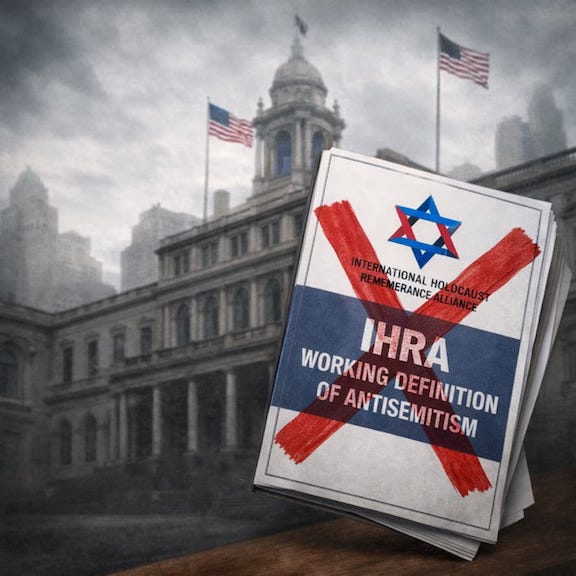
Within hours of taking office on New Year’s Day, New York City’s new mayor, Zohran Mamdani, revoked the city’s use of the International Holocaust Remembrance Alliance Working Definition of Antisemitism — a globally recognized framework designed to help governments and institutions identify and respond to anti-Jewish hatred. The decision was briefly announced and then quietly removed from official city channels. But its meaning was unmistakable.
This was not a procedural tweak or a symbolic housekeeping move. It was a deliberate Day One act, fully aligned with positions the mayor had articulated repeatedly during his campaign. Mamdani is a supporter of the Boycott, Divestment and Sanctions movement against Israel. He has refused to publicly affirm Israel’s right to exist as a Jewish state. And he has declined to condemn the phrase Globalize the Intifada — a slogan widely understood as a call to violence against Jews worldwide. Revoking the IHRA definition is not incidental to these views. It is central to them.
Some will argue that this is a narrow issue, relevant only to the Jewish community. That argument collapses on contact with reality. A mayor’s first actions reveal priorities and values. A Day One decision to dismantle internationally recognized protections against antisemitism should alarm anyone who believes minority rights, equal protection under the law, and historical literacy matter in a pluralistic city. For Jewish New Yorkers, the message was immediate — and chilling.
In 2022, we co-founded Antisemitism Watch, a nonprofit created in response to the sharp global rise in anti-Jewish hatred. Trisha Posner is Jewish. Gerald Posner is Catholic. You did not have to be Jewish to recognize what was happening: antisemitism was becoming normalized, reframed, and increasingly denied — especially when it appeared in forms that did not resemble the crude caricatures of the past. And that was before October 7. One of our core initiatives from the outset has been advocating for the adoption of the IHRA Working Definition of Antisemitism.
We support the IHRA framework because it addresses a basic and dangerous problem: antisemitism often goes unrecognized precisely because it adapts. It mutates. It adopts new language, new targets, and new justifications. The IHRA definition was developed to provide a shared vocabulary for recognizing antisemitism as it manifests today — in schools, workplaces, public institutions, political movements, and civic life.
The definition is frequently mischaracterized. It is not a speech code. It is not a law. It is not a disciplinary mandate. It is an educational and analytical tool — endorsed by 38 countries and referenced in U.S. federal policy since 2016 — designed to help institutions understand when conduct crosses the line from legitimate political expression into antisemitic behavior.
The IHRA definition addresses traditional forms of antisemitism, including calls for violence against Jews and holding Jews collectively responsible for real or imagined wrongdoing. It also recognizes contemporary manifestations, including when longstanding antisemitic ideas are repackaged through discourse about Israel. This includes denying the Jewish people alone the right to self-determination, holding Jews everywhere responsible for the actions of the Israeli government, or distorting Jewish history — including the Holocaust — through Israel-related analogies.
Critics often claim that the IHRA definition suppresses free speech or exists primarily to shield Israel from criticism. This is false. The definition is explicitly non-binding and does not override constitutional protections. In the United States, even antisemitic speech remains protected under the First Amendment. The IHRA framework does not punish speech; it clarifies context.
What goes largely unacknowledged is where the real chilling effect has fallen. In recent years, it has not silenced critics of Israel. It has silenced Jews. Jewish students, professionals, and activists increasingly feel pressured to hide their identity or are excluded from civic and progressive spaces because of their perceived connection to Israel. Without a shared framework for recognizing antisemitism, hostility toward Jews is routinely rebranded as legitimate political expression, leaving those targeted isolated, discredited, and unprotected.
The IHRA definition is careful and precise. It explicitly distinguishes between legitimate criticism of Israeli government policy and antisemitism. Harsh, pointed, even uncompromising criticism of Israel — comparable to that directed at other democracies — is not antisemitic. The framework focuses on patterns rather than opinions and insists that context matters. Its examples are illustrative, not automatic, and are meant to guide analysis, not dictate outcomes.
The European experience makes this unmistakably clear. The European Union has formally endorsed the IHRA Working Definition, and a majority of EU member states have adopted it — even as many of those same governments, and the EU itself, remain among the most outspoken critics of Israeli policy in the democratic world. Their adoption demonstrates, in practice, that there is no contradiction between robust criticism of Israel and the use of IHRA as an antisemitism framework.
Nor does the definition divert attention from other sources of antisemitism. On the contrary, it explicitly encompasses the ideologies responsible for the deadliest antisemitic attacks in recent decades, including white supremacy, religious extremism, and conspiracy theories portraying Jews as malevolent or omnipotent forces. These remain among the most dangerous threats facing Jewish communities globally.
The goal of the IHRA definition is not political. It is to provide a shared language for understanding antisemitism so Jewish communities can be protected in an era when that hatred is increasingly normalized, denied, or rationalized.
Revoking this framework on the first day of a mayoral administration is not a policy footnote. It is a declaration. Day One actions are chosen precisely because they define the tone of what follows. This decision signals how antisemitism will be understood, addressed, or dismissed in New York City over the next four years — and how seriously Jewish safety and belonging will be taken by the city’s leadership.
For Jewish New Yorkers, this was not merely a warning shot.
It was the opening move.


Any person who minimizes this first action is justifying it.