
The White House Dinner Exposed a Constitutional Time Bomb
America's presidential succession rules are one tragedy away from handing the presidency to the opposing party.
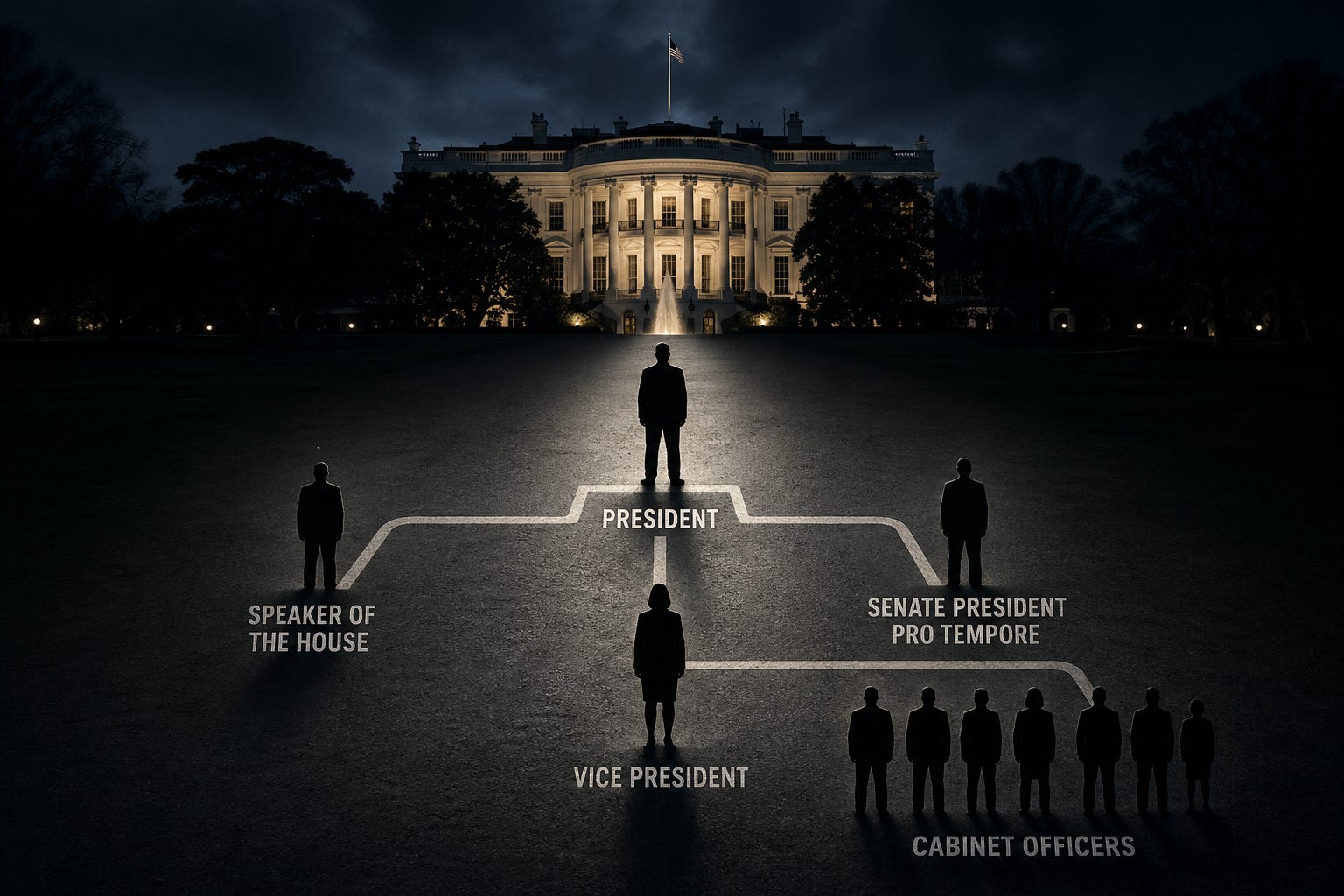
The near-miss at the White House Correspondents’ Dinner put a spotlight on a flaw in American government that has been hiding in plain sight. Seven of the top eight senior officials in the presidential line of succession attended that dinner. Had catastrophe struck the president, vice president and House speaker, the next man in line was 92-year-old Sen. Chuck Grassley, the president pro tempore of the Senate, at home in Iowa.
This is a constitutional roulette wheel, not a sensible continuity plan.
The current line of succession comes from the Presidential Succession Act of 1947. After Franklin Roosevelt died and Harry Truman became president, Truman urged Congress to revise the old succession statute. His argument was simple: If both the president and vice president were gone, the next successor should be an elected official rather than a Cabinet officer chosen by the president. Congress agreed, placing the speaker of the House after the vice president, then the Senate president pro tempore, followed by Cabinet secretaries in order of their departments’ creation.
That may have sounded democratic in 1947, but it is dangerous in the sharp partisan divide of 2026.
The modern presidency is not merely an office. It is an administration, a governing coalition, a national-security apparatus and an electoral mandate. If voters choose a president and vice president from one party, a mass-casualty attack should not switch control of the White House if the Speaker is from the opposing party. That would not reassure the country. It would compound the trauma with an abrupt and unelected change in government.
The examples are not hypothetical. If Donald Trump and Mike Pence had died while Nancy Pelosi was speaker, a progressive Democratic speaker could have inherited a Republican presidency. If Bill Clinton and Al Gore had been killed after the 1994 midterms, Newt Gingrich would have stood ahead of every Clinton Cabinet officer. George W. Bush and Dick Cheney faced the same problem after Democrats took the House in 2007, when Pelosi became speaker. Barack Obama and Joe Biden faced it after Republicans won the House in 2010. Joe Biden and Kamala Harris faced it after Republicans retook the House in 2022.
In each case, the succession statute invited the same destabilizing result: a catastrophic attack on one administration could install its political opposition.
The Senate president pro tempore is an even weaker link. The office usually goes to the longest-serving senator in the majority party. Longevity is not a national mandate. Nor is age a succession strategy. If Democrats regain the Senate, the office will likely go to Patty Murray of Washington. Chuck Schumer, also long serving, could also be tapped for that role. Neither are likely to restore calm by taking charge of the executive branch in the hours after a decapitation attack.
Congress should amend the 1947 law by removing the speaker and the Senate president pro tem from the presidential line of succession. After the vice president, succession should pass directly to eligible Cabinet officers, beginning with the secretary of state, then Treasury, Defense, the attorney general and the rest of the Cabinet in statutory order.
That approach has three advantages. First, it keeps executive power inside the administration elected by the country. Second, it reduces the risk of partisan inversion after a national tragedy. Third, it places the presidency in the hands of officials already running executive departments, receiving classified briefings and participating in national-security decision-making.
This is not a partisan reform. It would have protected Democratic administrations from Republican speakers and Republican administrations from Democratic speakers. It would not benefit Donald Trump alone, or any future Democratic president alone. It would benefit the constitutional order.
The United States has become far more polarized than the country that enacted the 1947 law. Pew Research has found that Democrats and Republicans in Congress are farther apart ideologically than at any point in the past half-century. A succession law written for an older political culture should not be allowed to govern a future national catastrophe.
The White House Correspondents’ Dinner should not be remembered as a staffing lapse. It should be treated as a warning. The presidency should not be transferable to a rival party by assassination, accident or negligence. Congress should fix the law before the law is tested.


As usual, Mr. Posner is right!