


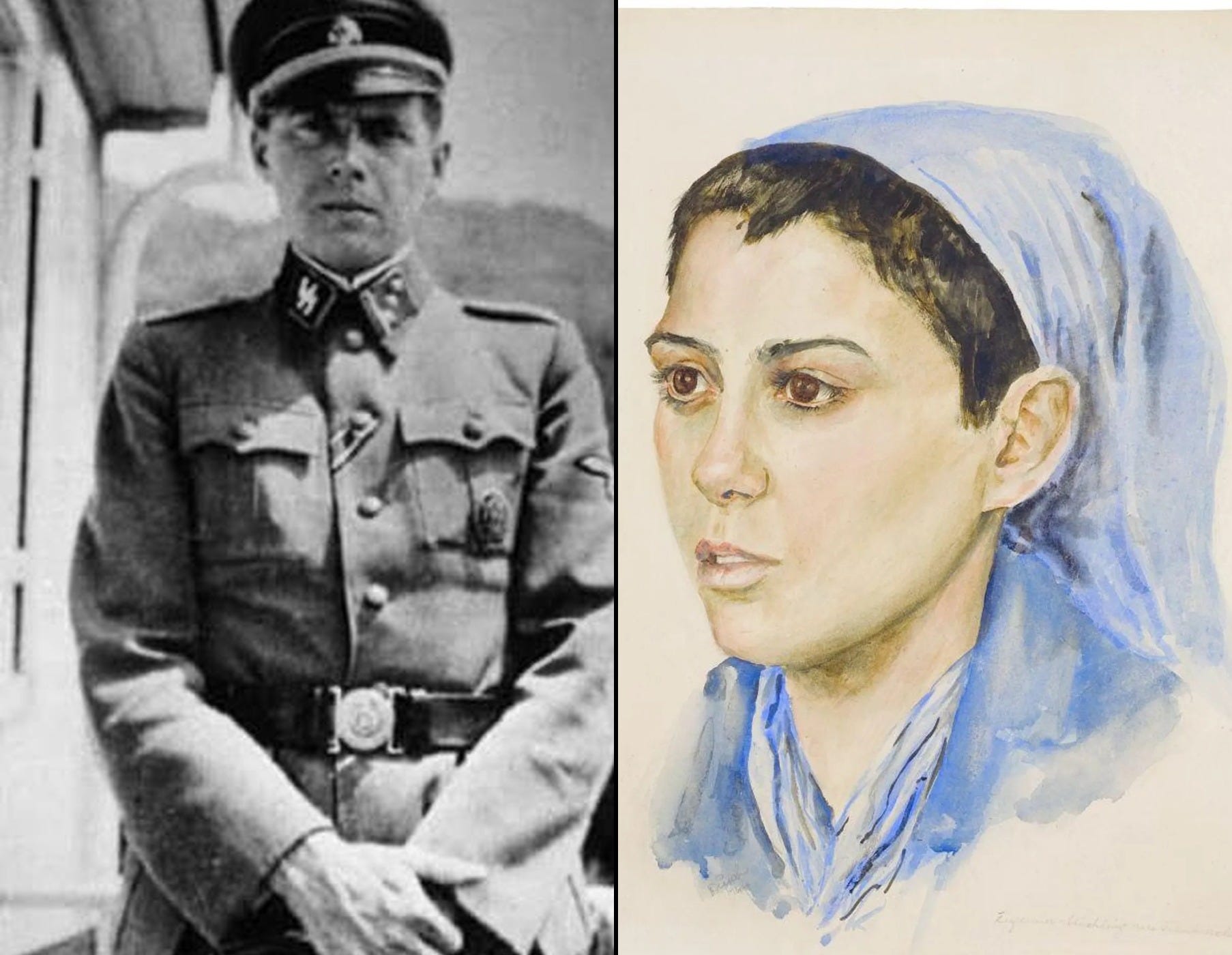
A shorter note today — not a full Just the Facts piece, just something on my mind after a weekend spent reading two new lawsuits that a lot of you, given how many of you follow my occasional reporting on Nazi-looted art, will find worth your time.
In my writing on Nazi-looted art and restitution — including my own decades-long search for the missing Raphael “Portrait of a Young Man,” looted by Hans Frank, the Nazi governor-general of occupied Poland who was hanged at Nuremberg — I have never come across a case as legally and morally difficult as the one just filed against the Auschwitz-Birkenau Memorial.
Actually, two lawsuits were filed this week in California, prompted by that state’s sweeping 2024 law designed to help families reclaim Nazi-looted art, along with the federal Holocaust Expropriated Art Recovery Act signed into law earlier this year. I have spent the weekend reading the lawsuits. The Babbitt family’s suit was filed just two days before the two-year window that law gave to bring these claims was set to close — a fight nearly six decades old that very nearly ran out the clock entirely.
One targets the Norton Simon Museum over a Cranach diptych looted by Hermann Göring — a case I consider straightforward: the museum should be ashamed of holding onto it as long as it has.
The other case, however, is the hard one. The daughters of an Auschwitz survivor, Dina Gottliebova Babbitt, are suing the Auschwitz Memorial for seven watercolors of Roma prisoners that their mother was forced to paint on the orders of Dr. Josef Mengele, the camp’s infamous Angel of Death (about whom I wrote a biography in 1986). Mengele evidently wanted the portraits as “evidence” for his pseudo-scientific research purporting to prove the racial inferiority of Roma and other groups, many of whom became the victims of his gruesome medical experiments. Babbitt completed the watercolors on the condition it might spare her and her mother from the gas chamber.
It is clear why it does not fit the usual restitution framework: normally, the law asks who the rightful owner was before the Nazis stole the works. But Babbitt was a concentration camp prisoner. She made them under threat of death.
I am a great admirer of the work the Auschwitz-Birkenau Memorial and Museum has done over the decades to preserve the camp and educate the world about what happened at the largest Nazi death camp. But its conduct in this one matter, stretching back more than sixty years, has been less than stellar.
The Museum did not simply find these watercolors on the site after liberation in 1945. It purchased six of the seven in 1963 — from whom, it has never fully disclosed — and by its own account, its acquisitions committee understood even then that the works had likely been painted by a camp prisoner. By 1969 at the latest, the museum had identified Babbitt was the artist after an official had matched the “Dinah 1944” signature on the watercolors to Babbitt’s own signature on illustrations she’d drawn for a 1946 book about Auschwitz.
In 1973, the Museum invited Babbitt back to “authenticate” her work; she went, believing they finally intended to return it. Instead, they interviewed her for two hours, showed her the paintings pulled from storage, and sent her home with nothing. In 1977 — years after it already knew who had painted them and under what circumstances — it went ahead and acquired a seventh watercolor from yet another anonymous person with no legitimate claim to sell it.
For years afterward, the Museum’s position was that the watercolors didn’t belong to Babbitt at all — but to Mengele. According to the family’s complaint, a museum official told her that, legally, “the only one who might have a claim on the paintings was Dr. Mengele, and he wasn’t likely to exercise it.” Babbitt had been, Museum officials said, “Dr. Mengele’s worker.” A Holocaust memorial telling a Jewish survivor that a Nazi war criminal held better title to her own artwork than she did is not one of its better moments.
Babbitt formally demanded their return in 1997. The Museum refused. Two years later she flew to Poland with her daughter, her attorney, and an NBC News crew, and personally asked the Museum to give the paintings back. The Museum publicly refused again, saying it had acquired them “legally and in good faith.”
Congress tried to help. In 2001, the Senate Foreign Relations Committee — chaired at the time by then-Senator Joe Biden — formally recognized Babbitt as the watercolors’ “rightful owner” and urged the President to intervene. In 2002, Congress went further, enacting legislation recognizing her “moral right” to the paintings and urging both the President and Polish authorities to secure their return. The Museum still refused.
In 2006, with Babbitt then 83 and in failing health, her daughter Michele Kane was already exploring a lawsuit. U.S. artists and curators had petitioned for the paintings’ return, and Nevada Congresswoman Shelley Berkley was pressing the State Department to intervene with the Polish government. None of it worked then, either. However, the Museum’s position at that time was not predicated on denying Babbitt’s authorship. The deputy director at the time, Teresa Świebocka, told The Guardian: “The museum has always respected her copyrights in connection with any publications.”
In 2009, shortly before she died, Babbitt was asked what she intended to do with the watercolors if they were ever returned. She said she would put them on permanent public display, to raise awareness of the Roma genocide — but that she’d first gather her family around them. “Everybody exists today because of these paintings,” she said, of her mother, her children, her grandchildren. She died that year, having spent her final years recreating her Auschwitz paintings from memory because the Museum would not return her originals. Her daughters have carried on the fight for another seventeen years — a formal pre-action letter in 2018, direct correspondence in 2023, and in May 2025, a letter to Polish Prime Minister Donald Tusk warning that litigation was, by then, the only option left.
The Museum’s position today has shifted again. Its current spokesman, Paweł Sawicki, told JTA last week: “The drawings of Roma victims made in the camp must remain in the Memorial as part of the documentation of the crimes of Mengele…they should be treated as unique documents related to the history of Auschwitz.” That’s a different argument than the one the Museum made for years — that Mengele, not Babbitt, was the rightful owner. Now the claim is that Babbitt, as a prisoner, never had ownership to begin with. Those aren’t the same argument, and it’s worth noting the Museum has now tried both.
The dispute has never really been about who made the paintings. It is about whether the physical objects should ever leave the site of the death camp in which they were forcibly created.
While I think the new California and federal restitution laws are good, this case is not a clean fit. My own view: the family should be able to reclaim legal title. That would vindicate the important principle that coerced labor does not simply become the property of the institution that coerced it. What they choose to do with that title should be entirely their own call. If the family decides the watercolors belong on permanent display at Auschwitz, that is a powerful place for the public to see them. But if they instead choose to send them on rotation through other museums and schools, that is equally their right. It is their prerogative, not the Museum’s. What strikes me most about this case is that the Auschwitz-Birkenau Memorial has spent decades hiding behind the technical language of ownership law, under the cloud of World War II and the Holocaust, to hold onto pieces that were never rightfully theirs to keep. It simply does not seem right.
Thanks Gerald. Fascinating case and appreciate you sharing. Agree that it follows the “just ain’t right” rule. They should give the paintings back and beg and plead for their display at Auschwitz but available for tour at other places that the family desires. There should be a happy medium here. The family could own them and then donate them for a nice sum and tax write off when appropriate.