
The Risks of Moral Absolutism in Democratic Politics
Why history warns that demonization is not argument—and how reckless analogies can accelerate toward violence
Before beginning: Through the end of this month, I will be in Phoenix recording three new courses (eight hours each) for the Peterson Academy. At a later Ask Me Anything, I’ll walk subscribers through the behind-the-scenes process of building those courses. Because of this schedule, it is unlikely I will publish another Substack post until the first week of February. In the meantime, I wanted to send out this brief, non-partisan reflection on rhetoric, history, and the risks of political escalation.
Public discourse in democratic societies depends on restraint as much as passion. When political disagreement is reframed as existential evil, the space for argument collapses—and history shows that violence often follows.
In a 2024 Wall Street Journal editorial, The Forgotten Lessons of Dallas 1963 and Memphis 1968, I examined how climates of extreme rhetorical demonization preceded the assassinations of John F. Kennedy and Martin Luther King Jr. In both cases, sustained portrayals of political figures as uniquely malevolent—beyond compromise or legitimacy—created an environment in which unstable individuals came to see violence not as criminal, but as corrective. The language did not pull the trigger, but it helped clear the psychological ground.
That lesson appears increasingly forgotten.
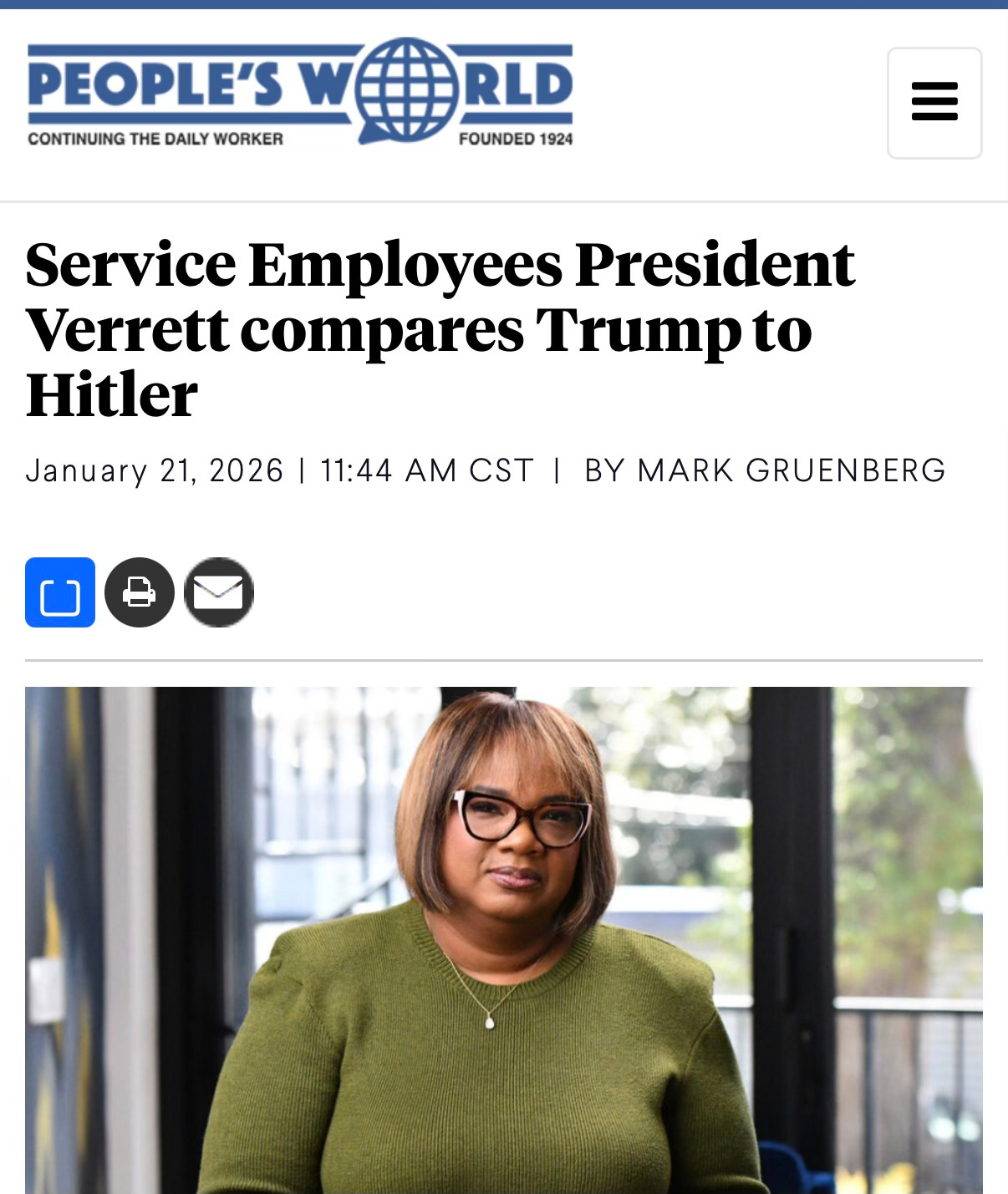
This week, April Verrett, the president of the Service Employees International Union—one of the largest labor unions in the United States, representing roughly two million members—used a speech at a Martin Luther King Jr. conference to compare Donald Trump to Adolf Hitler, Augusto Pinochet, Francisco Franco, Jair Bolsonaro, and the Ku Klux Klan. She described federal immigration enforcement as a “reign of terror” and suggested the president was a puppet of white supremacist forces he had “unleashed.”
One need not support Trump—or any of his policies—to recognize the danger inherent in such comparisons. The invocation of Hitler is not analytical; it is moral absolutism. It does not clarify political disagreement. It forecloses it. Historically, the Hitler analogy has served one function above all others: to justify extraordinary measures in the name of preventing catastrophe.
The problem is not merely exaggeration. It is moral acceleration. When political opponents are framed as genocidal tyrants, democratic processes begin to appear insufficient. Elections feel inadequate. Laws feel slow. Institutions feel complicit. And for a small but consequential number of people, violence begins to feel not only permissible, but necessary.
Martin Luther King Jr. warned repeatedly about the corrosive effects of dehumanizing language, even when deployed in the service of justice. He understood that ends do not sanctify means—and that rhetoric capable of mobilizing mass anger cannot be easily controlled once released.
We should be especially cautious when such language is used by institutional leaders commanding large audiences and moral authority. Words spoken from podiums do not remain abstract. They enter a volatile information ecosystem already saturated with grievance, misinformation, and performative outrage.
History does not suggest that inflammatory analogies strengthen democracy. It suggests the opposite.
Some readers ask, What if Trump really is Hitler—why can’t we say so? They miss the point entirely. Criticize political leaders on their merits, their policies, and their actions. Abandon the Hitler slurs. They are intellectually lazy, historically false, and morally offensive to the millions of innocent victims who paid the ultimate price under the real Hitler.
As I wrote in the Wall Street Journal:
“There is a price to reckless speech that portrays public figures as threats to the American way of life. It can be the spark that helps push an assassin to act. It is impossible to separate the violence of political assassinations in modern American history from the temperature of the times. It takes only a little fuel to push someone into the history books as an assassin.”
The lesson is neither partisan nor theoretical. It is empirical. And ignoring it has never ended well.


There is a complete disregard by "activists" for MLK's six principles of nonviolence. Clearly none of them have read Notes From a Birmingham Jail , or have any true understanding of his philosophy. I think if you were to present those principles in such a way that they were not recognized as coming from him , they would be rejected. The pathetic irony of using King to promote actions so removed from what he worked for.
Many Republicans including Donald Trump himself call political adversaries (Democrats, liberals, progressives) scum, traitors, or worse. Why are you not scolding them?