
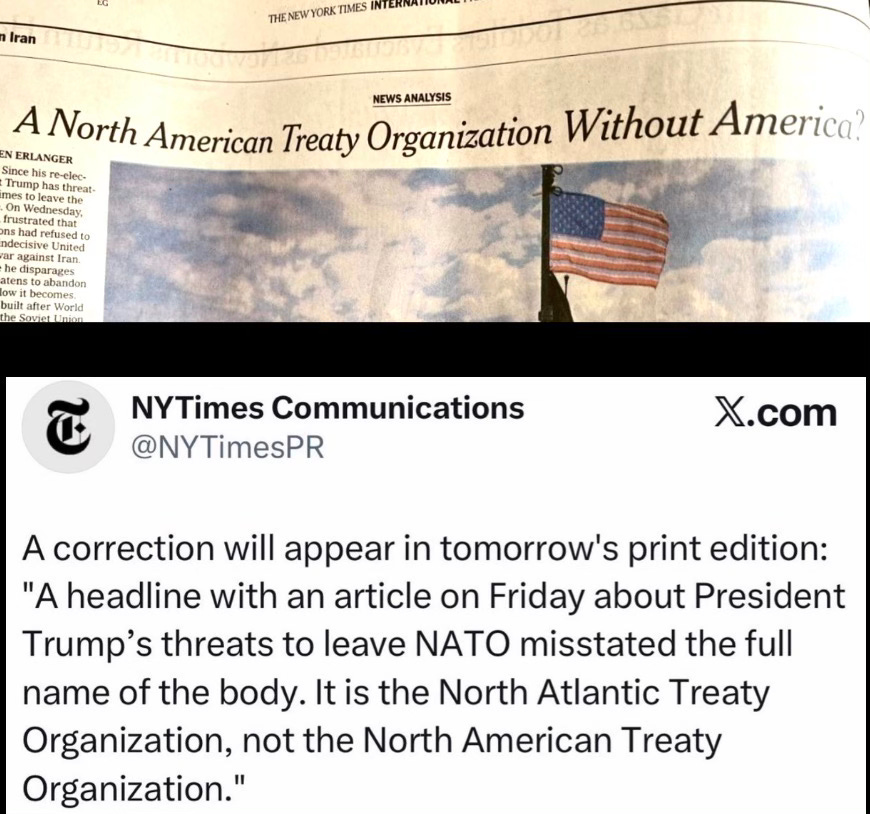
The NYT’s NATO Blunder Was More Than a Headline Error
A correction fixed the wording, but not what the mistake revealed: the erosion of standards inside even the most prestigious legacy newsrooms.
There are mistakes, and then there are mistakes that tell a much larger story.
The New York Times has corrected its embarrassing print headline that described NATO as the North AmericanTreaty Organization rather than the North Atlantic Treaty Organization.
Ordinarily, a correction would end the matter. News organizations are human enterprises. Errors happen, especially as copy desks are stretched and the pressure to publish quickly is relentless.
But this was not just a stray copyediting error. It deserves more than a shrug and a technical fix.
The problem here is not merely that someone in production failed to catch a glaringly mistaken headline. The problem is that the erroneous headline appears to reflect the underlying conceptual frame of the article itself.
That is what makes this episode so revealing.
The byline was by Steven Erlanger, one of the paper’s most experienced foreign correspondents, a deeply accomplished reporter with decades of coverage across Europe, diplomacy, war, and NATO. That pedigree is precisely why this episode lands so hard. If this had come from an inexperienced staffer on a chaotic breaking-news night, it would be easier to dismiss as an isolated blunder. But it did not. It appeared in a story by a veteran reporter, in the world’s most prestigious mainstream English-language newspaper, on a subject that sits squarely inside his expertise.
That is why the mistake detonated across social media and critics of the mainstream press cited it as a prime example of institutional decline. President Trump weighed in as well.
And the truth is that the incorrect wording does not feel random.
I have included a paywall free link so you can read the article yourself and decide if you agree. To me, the mistaken headline did not feel wholly disconnected from the story’s framing. The piece is built around the idea that without the United States, NATO becomes hollowed out, diminished, perhaps even unsustainable. That is an important argument, and one worth debating. But the framing is so heavily American-centered that the mistaken headline almost reads like a distilled version of the article’s worldview.
The headline stripped away the Atlantic idea and replaced it with an American one. It compresses the alliance into a narrower, more provincial concept. And in that sense, the headline was wrong in exactly the way the article was wrong.
That is why this matters.
For years I have written about the gradual erosion of standards in major mainstream outlets. Not because every reporter has become worse. Not because serious journalism has vanished. And certainly not because there are no great journalists left. There are. Erlanger himself has done important work over many years.
The deeper problem is institutional.
Too many legacy newsrooms have been hollowed out by cutbacks, speed, overproduction, thinner editing layers, and a culture that increasingly rewards constant throughput over depth, precision, and reflection. The public sees the occasional spectacular error and laughs at it. What fellow journalists should see is the invisible system failure behind it.
There was a time when a fundamental mistake like this would have been impossible at the New York Times and its top legacy competitors.
Even today, in streamlined operations, it should have been caught by the headline writer or the assigning editor. It should have been caught by anyone who saw the page in production. And if none of them caught it, that says something uncomfortable about how much expertise has been lost inside organizations that still trade on reputations built in another era.
That is the real story here.
Not that The New York Times ran a correction. Of course it did. Corrections are necessary and honorable when they are prompt and clear. But corrections do not erase reputational damage, especially when the error is so fundamental that millions of readers understandably ask how it got into print in the first place.
And, of course, it raises the uncomfortable question: if this slipped through, what else is slipping through?
That question is devastating for any news organization, but especially for one that still presents itself as the mainstream gold standard. Trust is not lost only through ideology or bias or overt factual misconduct. Sometimes it is lost through repeated evidence of institutional slackness and carelessness.
The social-media furor is not just mockery. It is a referendum on credibility.
Yes, some of the reaction is opportunistic. Partisan actors will always weaponize a blunder by a mainstream outlet. But the answer to that is not to minimize the mistake. The answer is to understand why it handed critics such an easy, irresistible opening.
Prestige does not exempt a newsroom from scrutiny. It heightens the obligation.
That is why this episode should not be brushed aside by the Times as one bad headline on one bad day. The issue is not merely one incorrect noun. The issue is the fraying of the editorial culture that once made such errors far less likely.
That should worry everyone who still cares about serious reporting.


The NYT covered up Stalin's purges in the 1930s. Moscow Bureau Chief Walter Duranty famously dismissed reports of the man-made famine in Ukraine—which killed millions—as exaggerated or false. Leftists who wanted to believe that the USSR was a successful socialist experiment looked the other way and were in denial. Similarily the paper was accused of relegating news of the Nazi genocide to the back pages. Despite publishing thousands of front-page stories on WWII, only a tiny fraction focused on the Holocaust, a failure the Times officially acknowledged in 1996. The NYT has promoted TDS since 2015. It promoted medical tyranny. It promoted the mass grave hoax in Canada. It is doing the same thing it did in the 30s: serving as propaganda for a Leftist worldview. I don't see how anyone can think of it as reputable. Bari Weiss wrote a scathing open letter about it that's quite good. The reporters who work there are not interested in the truth; they're there to push an agenda.
Another institutional failure on display. It's emblematic of the cascade of failures in all our truth-seeking institutions, and it starts with the poor education being served to our elites. None of the people who saw that headline pre-print saw anything wrong, and that tells us all we need to know. God help us when people with this level of historical illiteracy get into positions of power.