
The Nazi Party's Membership List Is Now a Search Box
It Only Took 32 Years — Since I First Wrote About It, and Asked for It
Somewhere in Germany this morning, someone typed a family name into a search box and learned, in about the time it takes to read this sentence, that a grandfather or a great-uncle had once carried a Nazi Party membership card. It is happening millions of times over. For eighty years the plain fact of who actually joined Hitler’s party lived in millions of paper cards that almost no one could reach. This year, at last, it became searchable online — and almost immediately a fight broke out over who is allowed to use it.
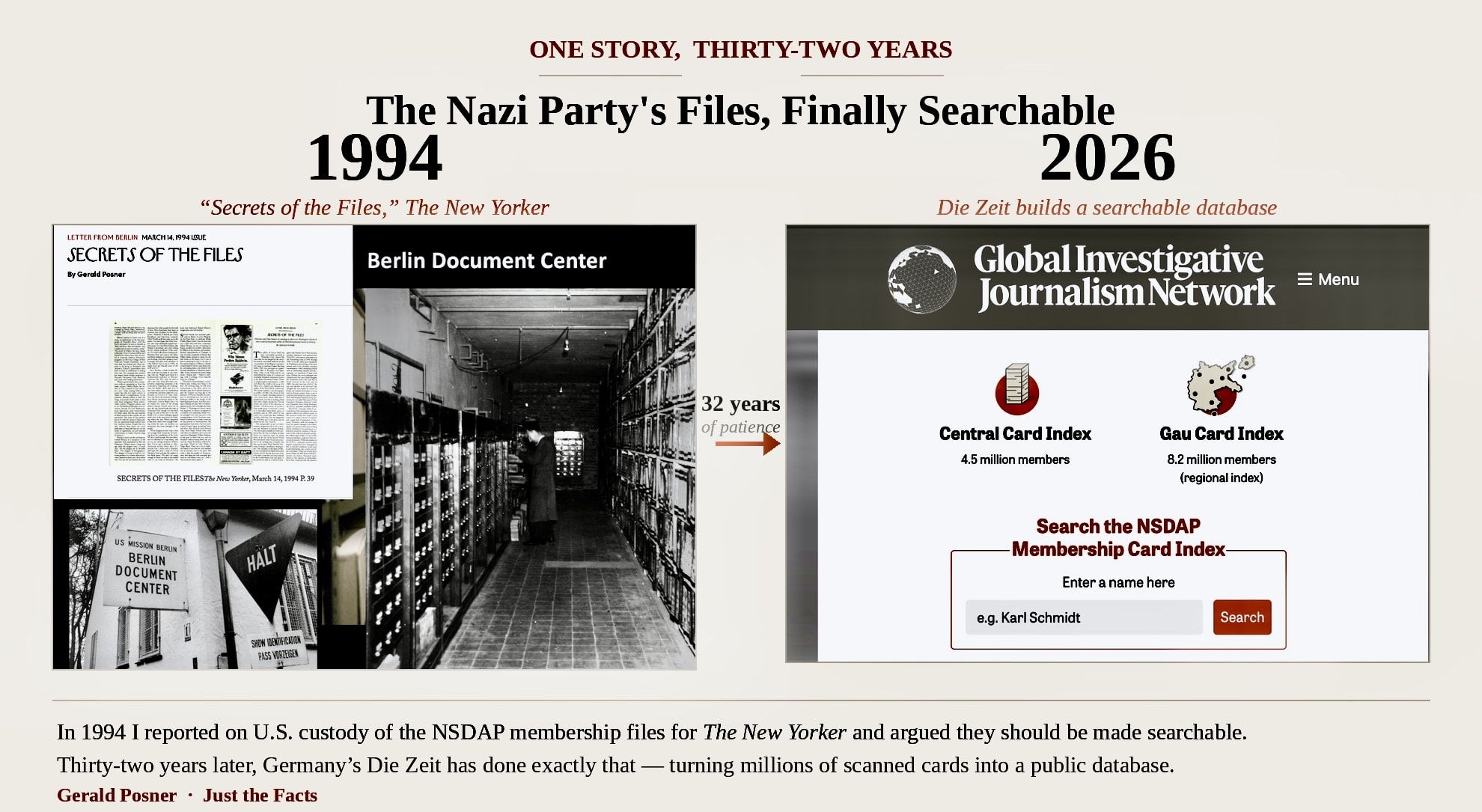
I have a particular reason to write about this now. In 1994 Trisha Posner and I spent time inside the Berlin Document Center vault where those cards were kept, and I reported on them for The New Yorker. I argued that a record this important should be open to everyone. It has taken thirty-two years for that to come close to happening — and in the end it took a German newspaper and artificial intelligence, not any government, to do it.
The piece I published then, “Secrets of the Files,” was about a decision that drew little notice in the United States: the American government had agreed to hand the original Nazi Party membership records — some eleven million cards, representing perhaps seven million members, about ninety per cent of everyone who ever joined — back to German custody. The U.S. Seventh Army had found the cards intact in April 1945, at a paper mill near Munich where the Nazis had sent them to be pulped. Ever since, they had been under American guard, in a Berlin bunker in the Zehlendorf district that had once been one of Hermann Göring’s wartime listening stations.
1994: a bunker and a reading room
The timing was not incidental. For nearly half a century the Americans had run the Berlin Document Center, and 1994 was the year that arrangement was ending. The center’s American director then was David Marwell, a historian who I had met when I was researching my biography of Nazi Dr. Josef Mengele in the early 1980s. Marwell, who happened to be Jewish, had been at the Justice Department’s Nazi-hunting unit. “I savor the irony that I am the custodian of these files,” he told me.
Past the blast doors and motion sensors, the eleven million membership cards still sat in the original wooden cabinets the Nazis had filed them in. I pulled open a drawer and found the Party card of Oskar Schindler, the industrialist Steven Spielberg had made famous for saving more than a thousand Jews from the death camps. Schindler had been a dues-paying member. The card I pulled out was a faded blue rectangle, Schindler’s application dated 1939. A few cabinets away was the file of Amon Goth, the camp commandant “Schindler’s List” had just made infamous. The whole place had that quality: the machinery of a genocide, filed as tidily as a tax office.
Downstairs, in a chamber the length of most of a football field, a crew was microfilming everything for the U.S. National Archives before the paper originals went to Germany. I wrote about the real worries at the time: that some cards, printed in dark ink on dark stock, were nearly impossible to read even in the original; that errors were creeping into a rushed copy; and that German privacy laws could wall the originals off from historians. The pace alone was a warning sign — thousands of pages a day, by hand, with no reliable way to confirm afterward whether a given file had been copied correctly, or copied at all. My argument was simple: this is a record that belongs to history, and it should be as open and searchable as possible.
In 1994, “searchable” meant a spool of microfilm and a reading room. That was the state of the art. What I was really arguing for was a future that didn’t yet exist.
The slow decades
For three decades after the files went back to Germany, they stayed anything but open. A request to Germany’s Federal Archives was slow going. Accessing the American microfilm copies meant a trip to Washington and hours at a machine. If you didn’t already know roughly where to look, you often didn’t find what you were after.
Even the moment that should have been a breakthrough came with friction. Earlier this year, when the National Archives began posting the records online, the material arrived scattered across thousands of PDF files — and public demand crashed the site more than once. The records were finally “online,” but they were still, in any practical sense, a haystack.
This is the part of the story that rarely makes it into a byline: the years in which nothing much happens, and a problem you documented simply sits there, waiting for the world to catch up.
2026: a search box
Then the German newspaper Die Zeit assigned a team of reporters and data scientists to the enormous task of running millions of scanned cards through AI and turning them into a searchable public database. What had been a haystack became a search box. That database has already drawn millions of searches, with Germans finding relatives whose party memberships had stayed buried for a lifetime.
A rival in German media, Der Spiegel, has since built its own AI-assisted search database on the same files.
This was, more or less, the future I’d wanted in 1994 — one name at a time, instantly. It just took thirty-two years, and a technology no one in that Berlin bunker could have imagined.
Almost closed — just a paywall away
My complaint with the Die Zeit and Der Spiegel databases is that they are available only to subscribers. That is unfortunate. I understand they spent a great deal of money and staff hours creating these tools, but it would be a real public service to make them available to all researchers and historians, at the very least, without a paywall. (Non-subscribers can sign up for a free trial to get around it, but that is not the same as open access.)
The free-access problem isn’t hypothetical — it has already been tried and lost. This spring in Germany the investigative outlet Correctiv and the magazine Katapult jointly published a free, openly accessible version, explicitly as an alternative to the paywalled offerings of the two big weeklies. It lasted two days before they took it down.
And here is the frustrating part. The German Federal Archives holds the higher-quality originals — in color, high resolution — but under German law, because some former party members may still be living, free online publication is not currently possible. The Bundesarchiv plans to put the full index online only once the protection periods expire: 100 years after a person’s birth, or 10 years after death.
None of that clock is new. Back in 1994 I reported that if a former member’s death couldn’t even be established, his file stayed sealed for a hundred and ten years from his birth. Three decades later, the same arithmetic is still the thing standing between the public and the best copy of these records. What technology solved, the law has not.
So the situation I flagged in 1994 has inverted in a strange way. The cards are now searchable by any German with a Die Zeit or Der Spiegel subscription, while the archive’s superior version remains available only through a formal application in Berlin-Lichterfelde.
All I did in The New Yorker was to identify the problem and then wait thirty-two years for someone with better tools to finish the job. That’s the trade in investigative journalism: you rarely get to close your own stories. You just have to be patient enough to see them closed.
This one is almost closed — just a paywall away.


I was in those Berlin Document Center reading rooms with you, and it has stayed with me for thirty-two years. There was almost no security. I asked a staff member whether they worried about researchers pocketing original cards — some would be worth real money to collectors. He said no. Their fear ran the other way: that someone would slip a forgery into the archive. The custodians were guarding against fake history back when faking it still took real effort. Strange that the same technology —AI—now closing your openness story is the one that makes their old fear effortless.