
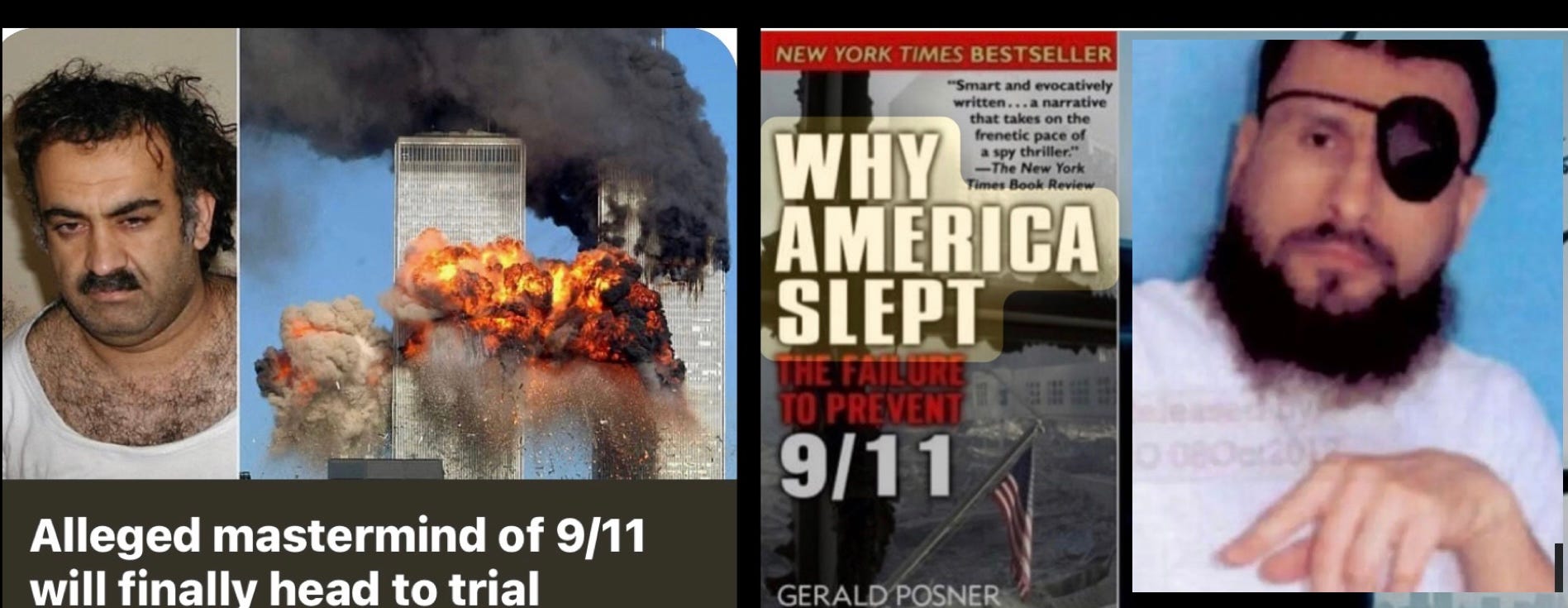
Many of you who read Just the Facts know my 2003 book, Why America Slept: The Failure to Prevent 9/11. It reached #2 on the New York Times hardcover nonfiction list that fall. Its final chapter, “The Interrogation,” broke the story of what Al Qaeda operative Abu Zubaydah told CIA interrogators shortly after his capture. There’s front-page news today that brought me back to it —and what the coverage is missing.
A military judge, Air Force Lt. Col. Michael Schrama, has set a June 5, 2028 trial date for 9/11 mastermind Khalid Sheikh Mohammed and three of his Guantánamo Bay co-defendants, Walid bin Attash, Ali Abdul Aziz Ali, and Mustafa al-Hawsawi. Schrama rejected prosecutors’ request to begin in January 2027, ruling that it left too little time to resolve the pending motions to suppress evidence derived from CIA interrogations. A trial date was set once before, for January 2021. It came and went. A fifth original co-defendant, Ramzi bin al-Shibh, was severed from the case in 2023 after a military medical panel found that his treatment in CIA custody had left him psychotic and unfit to stand trial.
Look at who isn’t on this list.
Abu Zubaydah.
Zubaydah was shot, wounded, and captured in Faisalabad, Pakistan, in March 2002, and then transferred among CIA black sites for more than four years before being sent to Guantánamo in September 2006.
In 2003, I broke major news from some of the earliest secret interrogations after his capture. The CIA, I reported, had run a false-flag operation on him. He was flown to a facility in Afghanistan dressed up to look like a Saudi detention site. Two Arab-American Special Forces personnel posed as Saudi interrogators. The idea was that he’d be terrified of what the Saudis might do to him. Instead — according to the intelligence sources who described the session to me — he seemed relieved. He named three Saudi princes and the chief of Pakistan’s air force, and recited their private cell phone numbers from memory. The numbers checked out.
Zubaydah said two of the four had known in advance that al-Qaeda was going to strike America — not the specific targets, just that something was coming.
When he later learned his interrogators were Americans, not Saudis, he recanted everything, insisting he had invented it all.
Washington passed what he’d said to Riyadh and Islamabad anyway. Both governments came back within days and said his charges were false.
Then this happened:
July 22, 2002 — Prince Ahmed bin Salman bin Abdulaziz, 43, a nephew of King Fahd and the owner of War Emblem, which had won the Kentucky Derby three months earlier, dies in a Riyadh hospital, of a cause variously reported as a heart attack or a blood clot.
July 23, 2002 — Prince Sultan bin Faisal bin Turki al-Saud, 41, dies in a one-car crash, on his way to Ahmed’s funeral.
Days later — Prince Fahd bin Turki bin Saud al-Kabir, 25, dies on a 55-mile drive east of Riyadh. The Royal Court’s official cause of death: “thirst.”
February 20, 2003 — Air Chief Marshal Mushaf Ali Mir dies when his recently inspected aircraft came apart in clear weather over Pakistan’s Northwest Frontier, killing his wife and most of his senior staff. Sabotage was suspected. No one has ever been arrested.
I’ve spent a career dismantling mystery-death lists. In Case Closed, my book on the JFK assassination, I wrote a separate appendix debunking the claim that 103 people connected to the case had died under suspicious circumstances. I know exactly how that genre works. Still, I have never been comfortable with the four deaths that overlap with Zubaydah’s interrogation disclosures.
After Why America Slept was published, the CIA told some reporters on background that my account was wrong. I insisted the CIA should release Zubaydah’s interrogation tapes.
In November 2005, the CIA secretly destroyed 92 videotapes of Zubaydah’s interrogations. That only became public in late 2007. It took until April 2010, when internal CIA emails were released under a Freedom of Information Act lawsuit, to learn that the destruction order came from Jose Rodriguez, then the head of the agency’s clandestine service, and that then-CIA Director Porter Goss agreed with the decision — though he wasn’t told in advance, and White House Counsel Harriet Miers was reportedly livid when she learned of it two days later. No one was ever prosecuted.
None of this gets litigated in 2028. Zubaydah has no trial date because Zubaydah has never been charged with a crime. The government’s term for him is a forever prisoner. The reason may be plainer than anyone wants to say: charge him, and in a courtroom he might be confronted with what he said in a fake “Saudi” jail cell in 2002.
It is only a couple of weeks until the 25th anniversary of the 9/11 terror attacks, and the full truth about what senior Saudis or Pakistanis may have known in advance is still elusive.


A nation of laws does not do this. Zubaydah must be tried, and the facts made public.
Ron Brown? Was his death accidental?