
The Mossad Dentist Narrative Is Going Viral — But Where’s the Evidence?
Extraordinary claims about secret medical implants demand extraordinary proof. So far, there is none.
As the American and Israeli military operation against the Iranian regime unfolds, social media has once again supplied a dramatic explanation for how a Day One precision strike decapitated the senior Iranian leadership.
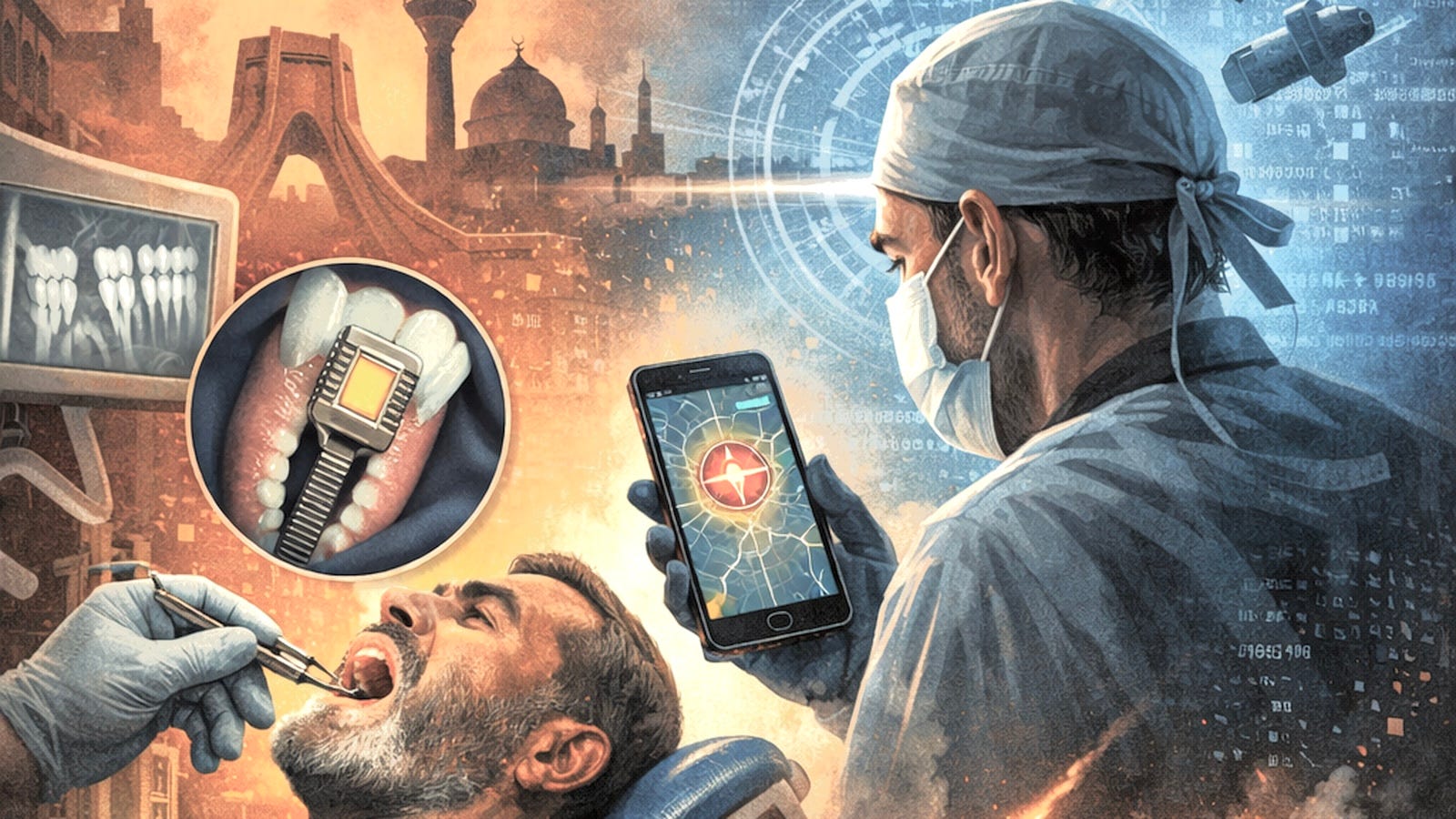
A viral post on X, viewed more than six million times, claims that over the past several years Mossad agents infiltrated Iran posing as dentists and gastroenterologists. According to the post, these undercover operatives implanted miniature tracking devices into elite Iranian military and political officials during routine procedures — embedding microchips inside dental fillings and during gastrointestinal treatments. When the latest attack begun, the story asserts, those implants revealed the exact location of hundreds of senior officials. That is how those strikes eliminated Ayatollah Khamenei and dozens of the regime’s top leaders.
It is an arresting narrative. The only thing missing is credible evidence.
I have spoken with two intelligence sources familiar with signals and targeting operations. Both flagged the same threshold issue: the claim runs headlong into physics before it ever reaches espionage tradecraft.
A device capable of transmitting real-time location data over operational distances must contain three non-negotiable components: a power source, a transmitter, and an antenna capable of pushing a signal through human tissue into the surrounding environment. Passive RFID chips exist, but they do not independently broadcast location. They require a nearby scanner and operate at very short range. They cannot transmit across cities, much less across a country.
Active GPS-enabled trackers require batteries. Batteries take space. They require replacement or recharging. A molar filling does not have sufficient volume to house even the tiniest battery, transmitter, and antenna capable of sustained long-range communication. Nor is the gastrointestinal tract a viable long-term host for sensitive electronics. Stomach acid, muscular contractions, and natural expulsion present obvious biological obstacles.
Any internally anchored device would introduce infection risk and would likely appear on routine medical imaging.
Implanting tracking devices inside hundreds of high-ranking officials over a period of years would require deep, sustained penetration of Iran’s medical and security systems, repeated access to sensitive individuals, flawless implementation procedures, and total immunity from detection, defection, internal leaks, or post-strike forensic discovery. The larger and more intricate an operation becomes, the harder it is to conceal indefinitely.
The claim also collapses under tradecraft scrutiny. Intelligence services tend to favor the least complex method to achieve their objective. In its 2025 operation against Iran, Israel tracked senior Iranian leaders by exploiting the digital metadata emitted by the mobile phones of their bodyguards and drivers. Iranian officials and senior commanders had already stopped using phones, realizing they provided Mossad with tracking capability. However, their security teams did not. Although guards and drivers were ordered to use walkie-talkies for communication, some continued carrying mobile devices — and, crucially, some used them actively, even posting at times to social media.
Every powered-on mobile device constantly emits location data, even without call content. In tightly secured environments, device clustering becomes especially revealing. When multiple security-linked numbers converge unexpectedly in a single location, that anomaly is detectable.
Identifying where senior figures are gathering would not require a mole in the room — only the digital exhaust from those standing outside it. In contemporary warfare, proximity equals exposure.
Israeli intelligence had previously mapped which numbers belonged to which security teams — through interception, cyber infiltration, or prior surveillance — and then tracked convergence patterns that allowed analysts to determine with a high degree of certainty when senior officials were physically together.
This method is technologically grounded, scalable, and consistent with publicly understood capabilities of advanced intelligence services.
The Mossad dentist narrative contains all the elements of viral wartime mythology. It merges technological anxiety with spy-thriller tropes. It flatters one side with superhuman capability and portrays the other as catastrophically penetrated. The answer in modern warfare is usually mundane but powerful — data analysis, metadata mapping, cyber access, communications interception.
But the mundane does not trend. Dentists with microchips do.
The truth is arguably more sobering.
Modern intelligence services do not require science fiction. This is not a Netflix plot. It is the architecture of twenty-first-century signals intelligence. The most effective tracking device is usually already powered on.
The reasons for my skepticism about the microchip implant story are evident. There is currently no credible reporting, forensic evidence, or other substantiation supporting the claim. The physics are highly implausible. The biological hurdles are significant. The operational complexity would be extreme compared with far simpler digital tracking methods that already exist and are known to be effective.
Still, good journalism demands intellectual humility. I have learned never to underestimate the innovation and brilliance of Mossad: its explosive pager operation against Hezbollah, which exploited a communications supply chain to devastating effect, and its precision elimination of Hamas leaders inside a Tehran building are evidence that the agency is constantly developing and deploying technology previously unheard of. Intelligence history contains genuine surprises, and capabilities are not always publicly visible. If credible evidence emerges demonstrating that such a microchip implantation program existed and functioned as described, it would represent a seminal technological breakthrough and a stunning operational achievement. It would deserve rigorous documentation and scrutiny.
Until any such evidence appears, the Mossad dentist story belongs not in the category of confirmed reporting, but in the realm of wartime folklore — compelling, widely shared, entertaining, but unsupported by facts.
If the facts change, so will the analysis. That is the standard. Until then, enjoy the story, but do not cite it as part of the narrative of the successful first wave of the military operation against the Iranian regime.


Even if this is not true, I wouldn't put it past the Mossad to do something like it.