
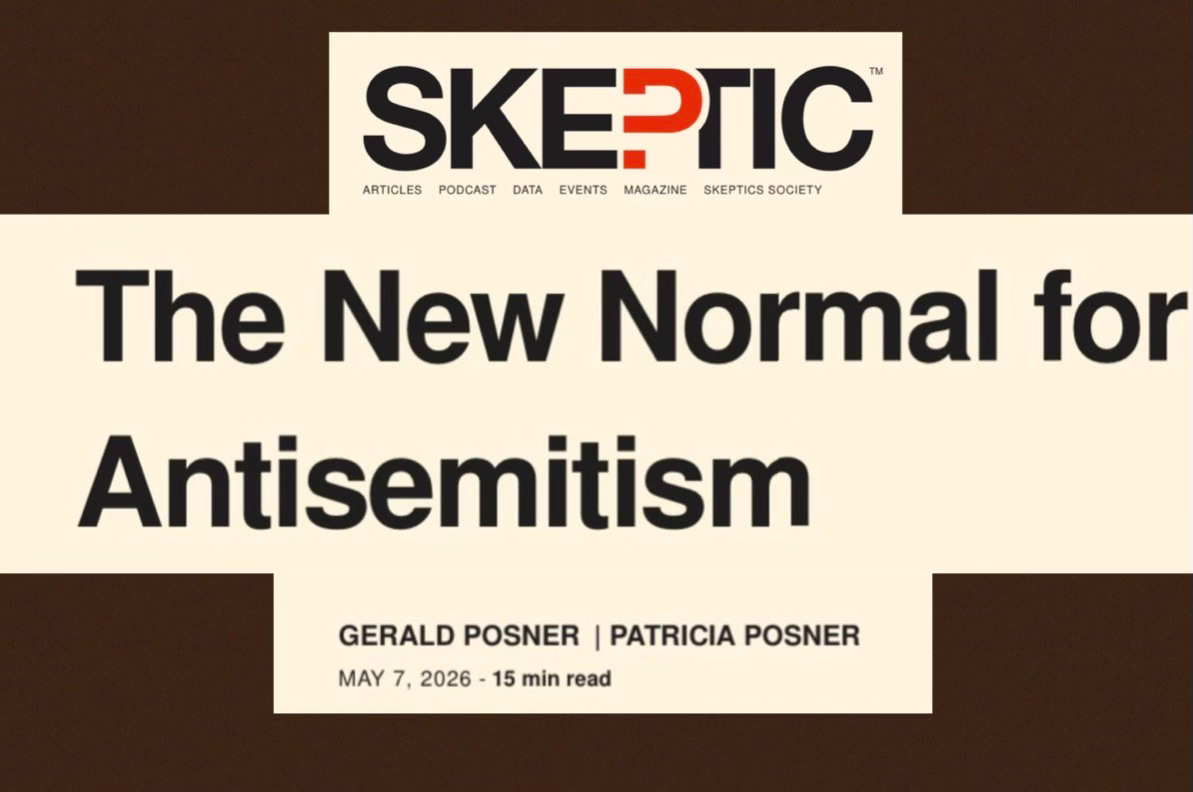
The Mask Has Come Off on Antisemitism
Trisha Posner and I have published a new essay in Skeptic examining what has changed about antisemitism since October 7.
It has not simply increased in volume—it has shed its inhibitions. The stigma has collapsed.
We write:
“Expressions that would have ended careers a decade ago now generate applause, clicks, and campaign donations. Language that would trigger immediate condemnation if directed at other minorities is routinely excused, contextualized, or ignored when directed at Jews. Hostility that once hid at the margins has migrated inward—into campuses, political platforms, cultural institutions, and digital ecosystems. The result is an old hatred on steroids—newly unmoored from consequence.”
The normalization has taken shape through two distinct but mutually reinforcing channels.
On the left: Israel is framed as inherently illegitimate — hostility becomes an ethical obligation. The line between Jews and Israelis keeps disappearing.
On the right: Jews reemerge as omnipotent puppet masters — orchestrating migration, finance, media, and foreign wars through familiar conspiracy tropes.
Different ideological paths to the same destination. And in too many spaces, there are professional and financial rewards for helping to normalize it.
Trisha and I cofounded an antisemitism watchdog in 2022, and since then we have watched these dynamics intensify. The real danger is the quiet acceptance and lack of accountability: what society is now willing to excuse.
Reversing it will take something in short supply— institutional courage.
We wanted to share the article here for readers who may not yet have seen it.
You can read the full essay in Skeptic here:
https://www.skeptic.com/article/new-normal-for-antisemitism/
As always, we welcome your thoughts and perspectives.
Gerald Posner
Trisha Posner
Antisemitism Watch


In this new world of hate with no tolerance and acceptance, antisemitism continues to be open and applauded at times. I think the statistics in NYC demonstrate that without question.
This is partly a response to many of the "ism" categories being overused.
While the issue is clearly real, some in each group have used the "you just don't like me because" to excuse bad behavior of their own and this is a rebound reaction.
For example, a person gets accused of an actual crime and they blame the accusation on a bias against their particular minority class in an attempt to deflect. Politicians in a variety of minority groups come to mind.
Eventually many people become numb to the claims and ignore the problem.
History has seen this cycle before.