
The Lawfare Campaign Against Miami Beach — A Test Case for American Free Speech
A city commissioner spent his own money to fight back against anti-Zionist extremists. Now a federal court filing calls that evidence of a civil rights violation.

There is a word for what is happening in Miami Beach right now. It is not “civil rights litigation.” It is not “accountability.” It is not even, in any meaningful sense, “free speech advocacy.”
The word is lawfare.
And if you believe in open political debate — regardless of where you stand on Israel, Gaza, or anything else — what is unfolding in South Florida should alarm you deeply.
Let’s Start With What Actually Happened
Last September, Jewish Voice for Peace South Florida filed a civil rights lawsuit against the City of Miami Beach, Mayor Steven Meiner, and Commissioner David Suarez, alleging that the city’s anti-protest ordinance was unconstitutionally designed to suppress pro-Palestinian speech. That case is still pending in the Southern District of Florida.
Now it has gotten more explosive.
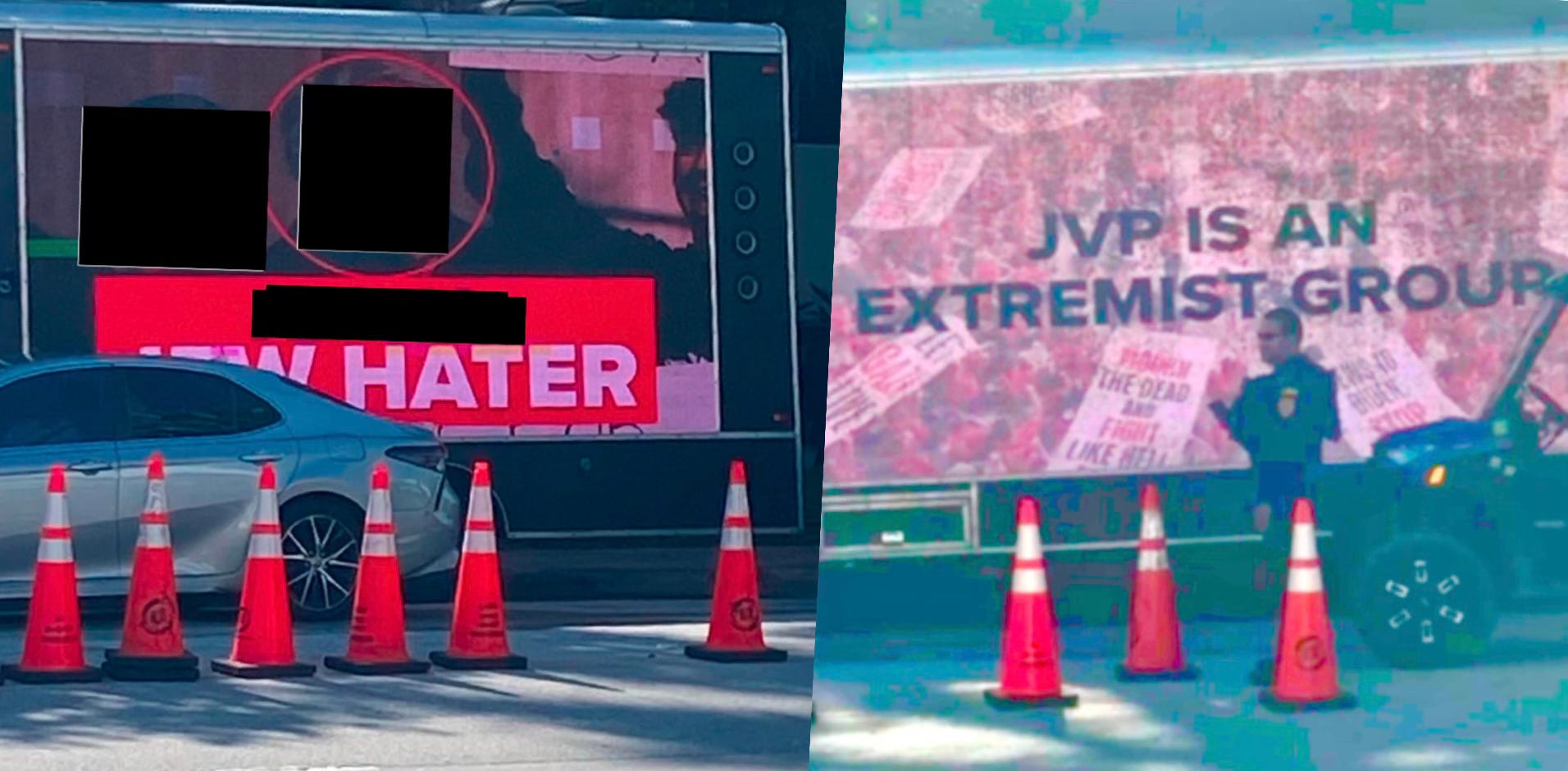
This past Wednesday, JVP’s attorneys filed a motion to compel discovery in that same lawsuit. Buried in the motion’s exhibits is a document that blows the case wide open in a new direction: a paid invoice showing that Commissioner David Suarez personally spent $4,000 of his own money to hire three mobile billboard trucks during the international art fair Art Basel in December 2025. The trucks circulated near the Miami Beach Convention Center displaying messages critical of Jewish Voice for Peace. The billboards called JVP an extremist group. They also displayed the names and photos of two JVP members — Alan Levine, one of the plaintiffs’ attorneys, and his wife Donna Nevel, one of the group’s most public Miami Beach advocates — alongside the words “JEW HATER.”
Those images are now federal court exhibits. The invoice, addressed to Suarez at his personal Gmail account, is in the court record. There is no dispute about what happened.
And JVP’s attorneys are now arguing that this episode — a sitting commissioner spending his own private money on political billboards targeting his political opponents — is direct evidence that the city’s reasonable protest limits were motivated not by public safety concerns but by unwarranted personal animus and hostility to JVP’s pro-Palestinian viewpoint.
Let that framing sink in.
What JVP Is — And What the Media Won’t Tell You
A local television station headlined its coverage of the latest filing: “Miami Beach commissioner accused of funding ‘Jew hater’ billboards targeting protesters.”
Notice the framing. The commissioner is “accused.” The activists are “protesters.” The words “Jew hater” are placed in quotation marks to signal outrage, not to accurately describe what the billboard said — which was that they were “Jew haters,”not that Suarez was one.
That is not journalism but narrative construction.
The Intercept — which aggressively amplified the most recent filing — was co-founded by Glenn Greenwald, whose record on Israel speaks for itself. The coverage reads less like reporting and more like an extended press releasefor the plaintiffs.
Here is what that coverage consistently omits:
Jewish Voice for Peace does not merely “criticize Israeli policy.” JVP opposes Zionism itself — period, full stop. Their own Instagram posts, which I reviewed, make the ideology unmistakable. Their affiliated “Global Jews for Palestine” network, active across 20 countries, posts openly about the mission to “resist Zionism and fight for Palestinian liberation at an international scale.” JVP South Florida has organized events calling ICE and the Israeli military twin “police states.” It has promoted roundtables headlined “Envisioning Return Amid Genocide” — featuring speakers Angela Davis and Rashid Khalidi, two of the most prominent anti-Zionist voices in American academia. It has demonstrated for the release of Mahmoud Khalil, the radical Columbia activist detained by ICE; rallied for the war crimes arrest of Israel’s Defense Minister; supported Greta Thunberg’s flotilla with goods for Gaza; and railed about Israel’s “ethnic cleansing campaign against the Palestinian people” and “engineered famine” in Gaza. It described the Everglades migrant detention facility as a “concentration camp.” On October 7, 2025, the second anniversary of the Hamas terror attack that massacred over 1,200 Israelis, JVP promoted in coordination with Al-Awda — the Palestine Right of Return Coalition — a night of “mourning, prayer, and remembrance of the loss the Palestinian people have faced in Gaza.” The event was titled “Two Years of Genocide.”
Their protest signs at Miami Beach demonstrations read: “Miami Beach Funds Genocide.” Their demands at Art Basel included stopping “South FL’s funding of apartheid.”
That is not a humanitarian organization caught in the crossfire of a political dispute. That is an ideological movement with a specific political objective: the delegitimization of Jewish statehood.
In Germany, the antisemitism commissioner for the state of Hesse has publicly called for banning the affiliated “Jewish Voice for a Just Peace” organization, accusing it of fueling antisemitic incitement. The Anti-Defamation League has sharply criticized JVP nationally for its support of BDS campaigns and its “increasingly radical” conflation of Zionism with racism. The nonprofit StandWithUs released a comprehensive January 2025 report documenting JVP’s collaboration with Samidoun — an organization sanctioned by the U.S. and Canada for funding the Popular Front for the Liberation of Palestine, a designated terrorist organization. The report found that JVP has hosted events featuring Rasmea Odeh, convicted for a PFLP bombing that killed two Jewish students in Jerusalem in 1969, and promoted Leila Khaled, a PFLP terrorist involved in multiple airplane hijackings. It noted that some JVP rabbinical council members denied the October 7 atrocities, with one arguing that “the IDF, not Hamas, killed most of the Israeli citizens.” The report’s conclusion: JVP is “a shield for hate, not a voice for peace.”
There is also this: in January 2025, JVP was ordered to pay $677,634 after a finding that the organization had defrauded the U.S. government in obtaining CARES Act pandemic relief funds. A voice for justice, indeed.
None of this strips JVP of constitutional protections. They have every right to organize, demonstrate, and file lawsuits. This is America.
But context matters — and that context is being systematically excluded from the coverage framing this dispute as a simple story of government oppression versus peaceful protesters.
The Men and Women on the Billboards — and What They Actually Believe
Alan Levine — one of the individuals named on Suarez’s billboard trucks — is not merely a passive protester caught off guard by a hostile commissioner. A Miami Beach resident, he is one of the attorneys listed on the latest filing in this very litigation (he is not admitted to the Florida bar but the court gave him temporary permission under the longstanding legal doctrine of pro hac vice). Levine is, in the most direct possible sense, a political and legal adversary of Suarez, actively engaged in ongoing courtroom warfare against him and his colleagues.
On the first anniversary of the October 7 Hamas attacks, Levine gave an interview in which he argued that October 7 was “inevitable” — that “if you imprison a couple of million people, at some point, they’re going to want to break out.” He said he would try to get people “to stop talking about October 7.” He said all “people of conscience” should be “appalled as I am,” not about the terror of October 7, but “what has happened since October 7.”
One year after the worst massacre of Jews since the Holocaust. He wanted people to stop talking about it.
David Suarez looked at that and decided to respond — forcefully, publicly, with his own money.
You may disagree with how he responded. You may find the billboards ugly or inflammatory. Those are legitimate opinions.
But calling it unlawful? Introducing it as evidence of unconstitutional animus in a federal civil rights case?
That is something else entirely.
Alan Levine told the press after this week’s filing, “There’s no insult in this community that is more deeply felt than being called antisemitic.” True enough — which makes it worth noting that JVP has hosted a convicted PFLP bomber and denied the October 7 atrocities. The most effective defense against the antisemitism charge is not to call it an insult. It is to not earn it.
The other individual named on Suarez’s trucks, Donna Nevel, is a co-director of PARCEO, an organization that develops educational curricula around anti-Zionist organizing and what it describes as “collective liberation.” Also a Miami Beach resident — making her one of Suarez’s own constituents — Nevel last September characterized Israel’s conduct in Gaza as a “horrifying genocide“ and a “starvation campaign against the entire population.” She is a committed ideological organizer with a clear political project. Suarez named her on a billboard. She had been naming herself, loudly and publicly, for years before he did.
In local press coverage of the latest court filing, Nevel said, “The commissioner has targeted me and called me a ‘Jew hater’ because I differ with his views on Israel.” That reveals her framing — she characterizes the billboard as Suarez targeting her for holding a different opinion on Israel. But her own previous statements reveal she is an anti-Zionist ideological organizer who has publicly branded Miami Beach a funder of genocide. “Differing views on Israel” is quite the euphemism.
The Pattern of Escalating Lawfare
This latest maneuver does not exist in isolation. It is the newest salvo in an escalating campaign against Miami Beach officials that has been building for over a year.
First came the September 2025 JVP lawsuit — the underlying and pending case — alleging the city’s anti-protest ordinance unconstitutionally targeted pro-Palestinian speech. The backstory matters: the ordinance was passed by the city commission in March 2024 in direct response to a JVP protest at the Convention Center during Art Basel 2023, at which demonstrators railed against what they called “Israel’s genocidal campaign against the Palestinian people of Gaza.” That original protest, that ordinance, and the police enforcement of it are the heart of the lawsuit.
Then came a separate federal complaint by Miami Beach resident Raquel Pacheco, alleging First Amendment retaliation after police knocked on her door following inflammatory social media posts targeting the mayor. That case raises genuinely different issues and will get its own scrutiny in court. But note part of the legal team that brought that lawsuit: Jenin Younes, National Legal Director of the American-Arab Anti-Discrimination Committee (slammed this past April by Congresswoman Rashida Tlaib for its poor handling of sexual harassment claims) — a different case, different lawyers, different facts, and yet another arrow fired from the same coordinated legal quiver.
And now, buried in a discovery motion in the original JVP case, comes the billboard truck revelation — being weaponized as evidence of Suarez’s personal “hostility” toward protected speech.
Viewed individually, each case involves distinct legal claims. Viewed collectively, they reveal something that I believe is unmistakable: a coordinated campaign of escalating litigation designed not merely to resolve favorably a legal dispute but to financially burden and publicly stigmatize Miami Beach officials who refuse to back down from outspoken pro-Israel positions.
The message is brutally clear: keep pushing back against us, and we will keep dragging you into court.
That is not democratic persuasion but rather exhaustion by attrition.
The First Amendment Cuts Both Ways — or It Cuts Nothing
I will say plainly what the media coverage is conspicuously avoiding:
David Suarez had every constitutional right to do what he did.
Americans retain the right to spend their own private money advocating political viewpoints. That principle is foundational to the First Amendment — established most explicitly by Buckley v. Valeo and reinforced through decades of Supreme Court jurisprudence. Political advocacy does not become unlawful because activists intensely dislike the message.
A word here for readers who may be wondering: if the First Amendment protects Suarez’s billboards, why does Miami Beach get to restrict where JVP demonstrates?
The answer is that those are two entirely different legal questions — and conflating them is precisely what JVP’s legal strategy depends on.
No government official has told JVP what it can or cannot say. Their speech — however incendiary, however one-sided, however much it enrages the mayor and the commissioner — is constitutionally protected. Full stop.
What local governments can do — what courts have consistently upheld — is impose content-neutral restrictions on the time, place, and manner of demonstrations, regardless of the message. A designated protest zone near a major public event is lawful if it applies equally to every demonstrator — pro-Israel, pro-Palestinian, anti-war, pro-life, anyone — and meets three tests: it must serve a significant governmental interest such as public safety or preventing obstruction; it must leave open ample alternative channels for protesters to reach their intended audience; and it must not be a blanket suppression of access.
That is the legal framework and it is a far cry from the simpler story being told in the press from the JVP viewpoint: that Miami Beach is simply suppressing protest. The question before the court is intent and application — not whether governments can ever regulate demonstrations. They can, they do, and the Supreme Court has said so repeatedly.
The organizations suing Miami Beach loudly proclaim their devotion to free speech and constitutional rights. They have organized around First Amendment principles. They have sued over speech restrictions. They have demanded the right to protest publicly — that is exactly what the Constitution protects.
And now they are arguing in federal court that a political opponent’s decision to spend his own money criticizing them is evidence of unconstitutional animus.
If Suarez’s billboards constitute evidence of unlawful hostility — what do we call years of demonstrations designed to disrupt major events, pressure politicians, and flood city commission meetings with confrontational rhetoric branding Miami Beach a funder of genocide and apartheid?
The answer, of course, is protected political activity.
For everyone.
Suarez Said It Best
After JVP filed its original lawsuit in September 2025, Commissioner Suarez rode up to their press conference on an electric scooter, declined to make remarks, and then issued a statement to the Miami Herald: “We are in a time where antisemitism is on the rise everywhere in the world. Miami Beach is and will continue to be a beacon for Jews to live and prosper safely and freely without persecution or intimidation.”
That is the statement of a man who is not backing down. Good.
What Miami Beach Is Really About
Miami Beach is one of the most heavily Jewish municipalities in America. Its mayor is an Orthodox Jew. Its city commission has been outspoken in defense of Israel during a period of rising global antisemitism and unremitting international pressure.
What activist organizations are discovering is that Miami Beach will not capitulate. The city will not pass resolutions condemning Israel. The mayor will not pretend that organizations calling for the elimination of Zionism are engaged in neutral humanitarian advocacy. The commissioner will not sit silently while his political adversaries brand themselves heroic dissenters and brand him a bigot.
And litigation expands.
Because when you cannot win the political argument, the next weapon is the courthouse. Lawfare.
The Dangerous Precedent
Here is the question underneath all of it that no one in the mainstream coverage is willing to ask directly:
If a commissioner’s decision to spend private funds on political billboards criticizing activists who are actively litigating against him can be introduced as evidence of unconstitutional animus in a federal civil rights case — where does that principle end?
Can protesters be sued for signs calling officials war criminals? Can organizers face legal liability for demonstrations designed to pressure and stigmatize? Can advocacy organizations be targeted for rhetoric that singles out political opponents by name?
Of course not. And they should not be.
But neither should David Suarez.
A democracy cannot function when aggressive political advocacy becomes actionable litigation whenever activists dislike the viewpoint being expressed. That standard, once normalized, will be used against every political movement. Eventually it will be turned against the left. Eventually against protesters. Eventually against everyone.
The First Amendment does not exist to protect speech that everyone agrees with. It exists precisely to protect speech that is unwelcome, controversial, even offensive to those it targets.
Those of us who believe that principle must mean it — including when the speech being defended belongs to a pro-Israel commissioner and a city government that is not apologizing for any of it.
Miami Beach is a test case. The outcome will matter far beyond South Florida.


Without commenting on the case itself, it's hardly a test case of anything if people aren't aware the case is even going on. My comment applies to news of interest relevant to everyone. Because legacy news has failed and our independent and subscription-based news and information channels now operate like a game of telephone, ie someone reads something somewhere and tells a friend or doesn't, our perceptions are only shadows of reality. How are we going to function as a country without consistency of access to information? It's a problem.