
The Iran MOU’s Three Quiet Problems
Down-blending you can reverse, a blockade you can’t rebuild, and a war ended by two of the three sides fighting it.
The Trump administration read the full text of the US-Iran memorandum of understanding to reporters Wednesday, ahead of a signing expected Friday. By now you’ve seen the summary a dozen times: ceasefire extended sixty days, blockade lifted, Strait of Hormuz reopened, sanctions relief on the table, a nuclear framework to be negotiated.
The summary isn’t wrong. It’s just not where the story is.
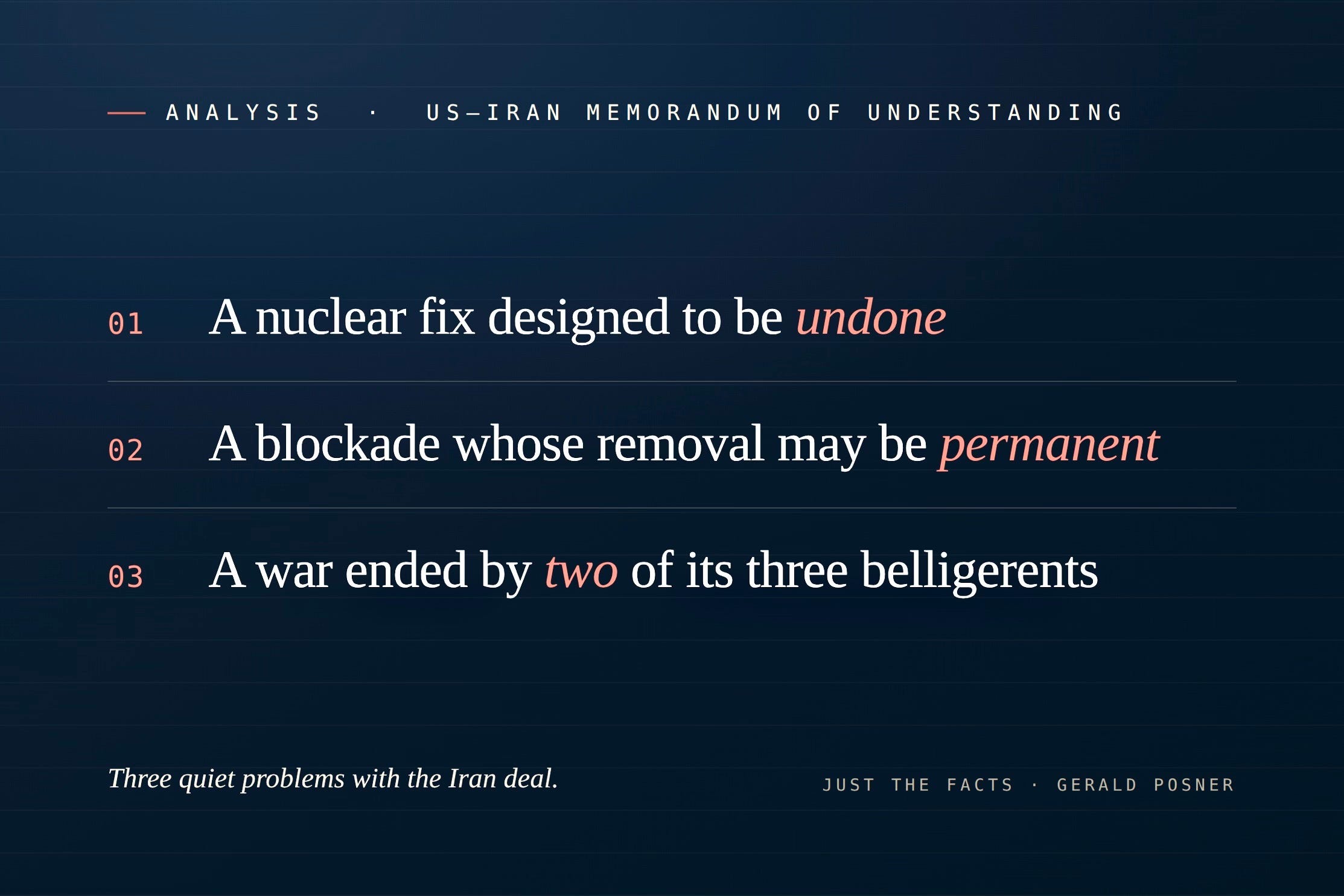
Read closely, three provisions don’t do what the celebratory coverage assumes — and each one matters more than the headline number attached to it. A nuclear fix that’s designed to be undone. A blockade whose removal may be permanent in a way the text obscures. And a war declared over by two of the three sides actually fighting it.
What’s concrete. The blockade language is specific and front-loaded: removal begins immediately, full termination within 30 days, naval traffic restored in proportion to pre-war volumes. Strait of Hormuz passage for commercial vessels is similarly immediate, though Iran’s “best efforts” framing on safe passage is the kind of phrase lawyers insert when they want credit without liability. The 60-day negotiating window for a final deal is clear and bounded, extendable only by mutual consent.
But “removal” may not be reversible the way the document implies. The MOU obligates the US to withdraw forces “from the proximity” of Iran within 30 days after a final deal — a different, far less certain clock than the blockade timeline itself. The more important point sits underneath the text entirely: the carrier groups, air assets, and regional basing posture assembled for this campaign represent a logistical and political commitment that doesn’t reconstitute on demand. Surge postures get drawn down because budgets, operational tempo, and domestic political appetite all push that direction once a shooting war ends. Rebuilding that footprint later requires the same triggering conditions — an active or imminent war — that a signed peace deal is specifically designed to foreclose. If the blockade’s deterrent value lay in the presence itself rather than the mere authority to reimpose it, “removal” may be functionally permanent in a way the document’s careful, reversible-sounding language doesn’t acknowledge.
What’s aspirational dressed as commitment. The $300 billion reconstruction figure is the headline number, but the MOU itself says only that the US “undertakes with regional partners to develop” a plan — the mechanism gets “finalized as part of a final deal within 60 days.” That’s not $300 billion committed; it’s $300 billion as a negotiating target, contingent on a deal that doesn’t yet exist. Sanctions language reads the same way: the document doesn’t terminate sanctions, it commits both sides to negotiating a termination schedule. The overall framework is clear that the ceasefire will be extended by sixty days, the Strait of Hormuz will be reopened in both directions, Iran will receive some sanctions relief, and negotiations will begin on restrictions on Iran’s nuclear program  — “some” sanctions relief, not the comprehensive rollback the topline figure implies.
The Qatar money trail — real, but easy to overstate. Separate from the MOU’s reconstruction figure, Israeli outlets reported in late May that Qatar approved a $6 billion line of credit for Iran, carved out of roughly $12 billion in Iranian funds frozen in Doha, nominally restricted to civilian goods, food, and medicine purchased through Qatari intermediaries — explicitly a workaround to the US blockade and sanctions regime. That structure — funds laundered through a “civilian use only” label and routed through a third country — is a known pattern; Qatar has played financial intermediary for Iran before. It also has its own motive independent of Washington: Doha has been a direct target of Iranian strikes this war and has reason to buy stability on its own terms.
What the sourcing does not yet establish is that this is a US-directed arrangement — Washington using Qatar as a deliberate proxy to move money to Tehran off its own ledger, kept clear of sanctions exposure by design. Qatar acting in its own interest as a battered, frequently-struck mediator is one story. The US covertly using Qatar to do what the MOU’s own sanctions language doesn’t yet permit is a different and more serious one. I am pursuing both. Only the first is documented.
The nuclear paragraph is the one to watch most closely. Iran reaffirms it won’t pursue nuclear weapons — a restatement, not a new concession. The disposition mechanism for the 60%-enriched stockpile defaults to on-site down-blending under IAEA supervision, but arms-control specialists have already flagged the catch: dilution on Iranian soil would let Tehran retain the material, at least temporarily, under U.S. or IAEA monitoring, and it remains unclear whether Iran would be allowed to keep the stockpile afterward for fuel fabrication . Down-blending is reversible. It buys time; it doesn’t eliminate capability. And nobody yet knows how much of the roughly 9,000 kilograms of enriched uranium survived the strikes that buried it under three sites  — so the mechanism’s real-world scope is unverified until inspectors get access.
The status-quo clause cuts both ways. Pending a final deal, Iran freezes its program where it stands and the US adds no new sanctions or forces. That’s a genuine de-escalation step — but “where it stands” includes whatever stockpile and infrastructure survived the bombing campaign, an amount that remains, by the IAEA’s own admission, undisclosed.
Israel signed nothing — and is being asked to live by it anyway. This may be the cleanest structural problem in the whole document. Netanyahu’s own office confirmed the dynamic: Trump briefed him by phone on the emerging MOU rather than Israel sitting at the table that produced it. Yet the text commits the US and Iran to “ensuring the territorial integrity and sovereignty of Lebanon” and to a ceasefire “on all fronts” — language that constrains Israeli military freedom of action in Lebanon, and sets expectations for Israeli conduct that Israel never negotiated. Trump’s own subsequent public friction with Netanyahu over the Lebanon offensive — telling him to be “more responsible” — is the tell. You don’t lean on an ally to fall in line with terms unless those terms were meant to bind them. Meanwhile Iran’s military command has already cited alleged Israeli ceasefire violations in Lebanon as grounds for “harsh response.” That’s not a footnote; it’s a structural flaw — a war-ending document signed by two of three relevant belligerents, asking the third to live by rules it didn’t write.
Bottom line. This is a ceasefire-extension document wearing the language of a peace deal. The war-termination and blockade provisions are real and immediate, and the blockade’s removal may matter more permanently than its 30-day clock suggests. The economic and sanctions provisions are promises to negotiate, not negotiated outcomes — and the parallel Qatar financing track deserves scrutiny on its own terms, not folded into the MOU’s bigger number. The nuclear paragraph defers the hardest question to a 60-day clock either side can walk away from. And the entire framework rests on the cooperation of a country that never sat down to write it. Worth remembering the next time someone tells you this is over.


This is Iran betting on the midterms. That being said, are we going to storm Iran? There ARE important things that have been accomplished, and since we live at a time when every act is really just a sound bite, not one thing lasts longer than the current news cycle. The president could help matters if he would shut his pie hole every so often. THAT is a move that would really confuse the enemy.
While I agree with your assessment, much of what you argue cuts both ways. The Mullahcrats have to at least pretend they're playing in the game for the next few months. If they decide to get too frisky...we'll just bring out the big stick once more. "Proximity" is a protean term: unless it gets defined, it can mean...nothing at all, since at the moment we're exercising our blockade from outside the Gulf.
And if Trump can get past the midterms without getting hammered...well.
Gas prices are down and the Democrats appear to have lost the redistricting wars. So GOP chances look pretty good right now.
And as far as Israel goes, my own view of this--based entirely on my assessment of both Israeli and American actions in the past, not on any actual inside info--is that it's a rope-a-dope, "good cop/bad cop" approach.
By excluding Israel from the negotiations, Trump gives them plausible deniability if they resume military action against Hezbollah or any other of their near-neighbor enemies.
Sure...there will be plenty of chin music on the Administration's part--to say nothing of Congress and the media--if so, but..."Gosh, boys, what can I do? They're a sovereign country and I can't dictate their actions, now can I?"
By the same token it gives us plausible deniability when--not if--Israel decides to go loud.
Trump's negotiations are the carrot. Israel's demonstrated capacity and willingness for knocking Mullahcrat dicks into the dirt is the stick.