


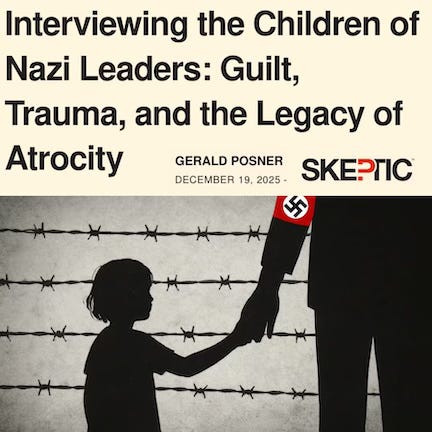
For years, I carried one question into rooms where most people would never be welcomed: what does it mean to grow up loving a parent whose name is synonymous with atrocity?
While researching Hitler’s Children, I interviewed sons and daughters of leaders of the Third Reich. What emerged was not a single story, but a spectrum—people who reject their parent’s legacy with moral ferocity, people who defend it to preserve their own identity, people split between documented horror and private memory, and those who try to transform inherited debt into public responsibility.
The psychology here is not abstract. Shame is identity-deep; guilt is action-based. Many of my interviewees described how a surname can shape romance, work, friendships, and even the decision about whether to have children. And it is not only a German story. The same family dynamics and moral accounting appear wherever societies confront mass violence, collective crimes, or political mythologies that collide with evidence.
I …
