
The $250 Bill Is a Bad Idea — No Matter Who's President
A 160-year ban broken. The official who objected removed. And a new windfall for the underground cash economy. The objections have nothing to do with which party is in the White House.
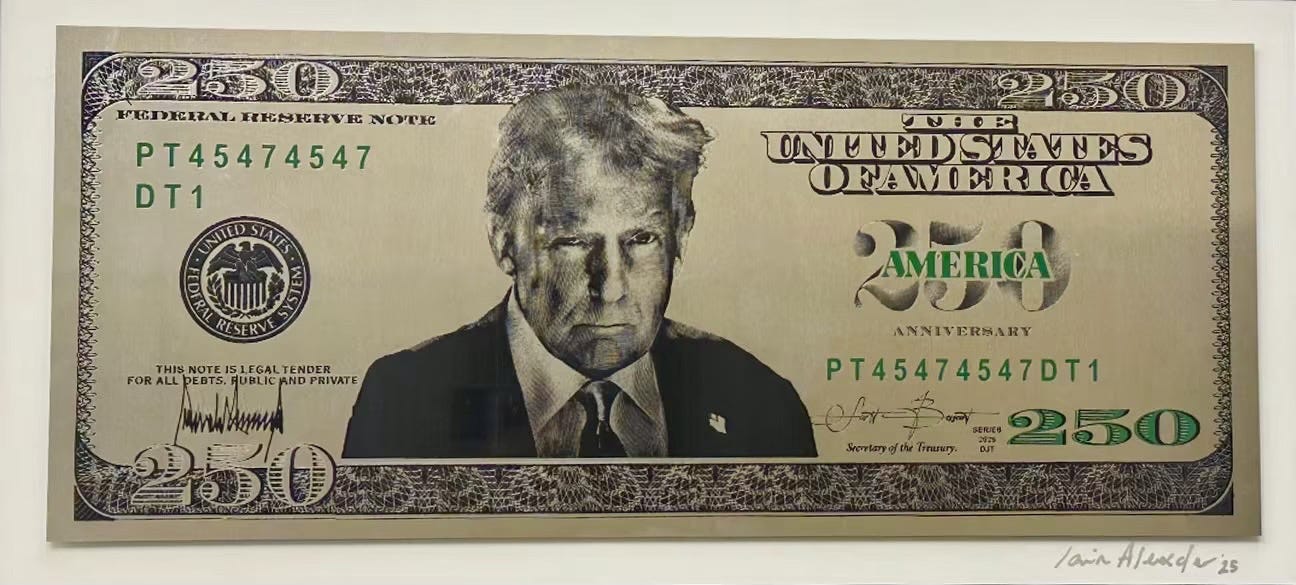
Treasury Secretary Scott Bessent stood at the White House podium this past Thursday and held up a mock design: a $250 bill bearing Donald Trump’s portrait. “I don’t think there’s anything untoward about it,” he said. The bill, he added, would honor the president serving during America’s 250th anniversary. Congress just needs to pass the legislation, and Treasury will print it.
Before going any further, let me be direct about something: this argument is not about Donald Trump. Supporters who admire him may find it entirely fitting that the president in office during America's 250th anniversary should appear on a new bill. Critics who oppose him may find the idea an affront. Both reactions are beside the point. My objection would be identical if the president were Biden, Obama, or any future Democrat or Republican. The problem is not whose face is on the bill. The problem is opening the door at all — because once it is open, every future president will be able to walk through it.
With that said, what has actually been happening inside the Bureau of Engraving and Printing over the past year is considerably more troubling than the headline.
According to reporting by the Washington Post, based on four current and former bureau employees, two Treasury Department political appointees — U.S. Treasurer Brandon Beach and his senior adviser Mike Brown — spent months last year repeatedly pressuring bureau staff to develop prototype designs for the bill, despite the fact that federal law explicitly forbids it. In August and September, Beach personally delivered mock-up designs to bureau staff, including one showing Trump's face centered between his own signature and Bessent's. The artist behind the design, British painter Iain Alexander, told the Post he had spoken directly with Trump about it — and that the president endorsed specific changes, including adding the colors of the American flag.
When the bureau’s director, Patty Solimene — a 24-year Army veteran and the agency’s first female head — pushed back, noting that the law prohibits this and that designing security features for any new bill takes years, she was removed from her position. Three words in her departure statement said everything: “Not my choice.”
The administration did not wait for Congress. It pressured career staff and removed the official who said no — all before a single vote has been cast on the legislation.
BREAKING 160 YEARS OF DEMOCRATIC TRADITION
The ban on living persons appearing on U.S. currency has been in place since 1866. It is not an accident or an archaic formality. It was written in direct response to a scandal uncannily similar to this one: a mid-level Treasury official named Spencer Clark put his own face on a 5-cent note, provoking outrage in Congress and the passage of what became known as the Thayer Amendment.
Congress understood what it meant when the machinery of money was turned into a personal monument. Currency is a civic document. Every American touches it, carries it, depends on it. Whose face appears on it is a statement about what — and who — the country belongs to.
The proposed legislation does not simply carve out a one-time commemorative exception. It amends the Federal Reserve Act to allow any living president to appear on currency going forward. That is a permanent structural change — one that would hold through every future administration, popular or otherwise. The president who benefits from that precedent next time may not be the one any given reader voted for. Once that door opens, it will not easily close.
THE MONEY LAUNDERING QUESTION NO ONE IS ASKING
There is a second issue receiving almost no coverage, and it deserves serious scrutiny: a $250 bill would be a significant asset to the underground cash economy.
The rest of the world has been moving in the opposite direction on high-denomination notes for exactly this reason. In 2016, the European Central Bank voted to discontinue the €500 note — then worth roughly $575 — explicitly because it “could facilitate illicit activities.” Europol documented the note turning up repeatedly in drug trafficking, money laundering, and terrorism financing investigations. Criminals reportedly traded the notes above face value in some underworld markets simply because of their portability.
That same year, a Harvard study — authored by Peter Sands, former CEO of Standard Chartered — called explicitly for phasing out the $100 bill alongside the €500 note, arguing that high-denomination bills “play little role in the functioning of the legitimate economy, yet a key role in the underground economy.” Canada had already pulled its $1,000 bill from circulation in 2000 for exactly the same reason.
Now the United States wants to introduce a $250 bill — 2.5 times the value of the current largest denomination — at a moment when anti-money laundering frameworks are supposed to be tightening. The administration has offered no analysis of what a new high-denomination bill would mean for financial crime enforcement. Nobody has asked for one.
WHAT THIS ADDS UP TO
Bessent’s word choice Thursday was telling. He said there was nothing “untoward” about the proposal. “Untoward” is a social category — it’s about appearances, optics, propriety. The questions raised here are not about optics.
They are about whether political appointees can pressure career staff to violate federal law and face no consequences. They are about whether the official who cited the law and was removed will be the last. They are about a 160-year guardrail against personalizing national currency being dismantled through an amendment to the Federal Reserve Act. And they are about whether the United States is about to give the underground cash economy its most portable instrument in decades — without a single hearing on the subject.
These objections do not belong to one party or one side of the debate over this president. They belong to anyone who thinks the rules that constrain power should apply regardless of who holds it.
Congress has not yet acted on the legislation. It should think carefully before it does. And the press should not let this one dissolve into the daily noise in the meantime.


According to Lumo, a currency design must pass an Advisory Review and then receive final approval from the SOT, who is currently prohibited by statute from providing approval if the deceased person requirement is not met.
Therefore it is not illegal to make designs, especially in the context that Congress may change its mind on the issue.
“Based on the legal framework governing U.S. currency, the critical step required for a design to become official is final approval by the Secretary of the Treasury, acting on the recommendation of the Citizens Coinage Advisory Committee (CCAC) for coins or the Citizens Coinage Advisory Committee and the Commission of Fine Arts for currency, followed by the production of the master die or plate at the Bureau of Engraving and Printing (for paper) or the U.S. Mint (for coins).
Here is the breakdown of the process:
Design Submission: The Treasury Department (specifically the Director of the Mint or the Director of the Bureau of Engraving and Printing) solicits or develops design concepts.
Advisory Review:
For coins, the Citizens Coinage Advisory Committee (CCAC) reviews designs and makes recommendations to the Secretary of the Treasury.
For paper currency, the Commission of Fine Arts and the Citizens Coinage Advisory Committee (which also advises on currency) review designs.
Secretary's Approval: The Secretary of the Treasury has the ultimate statutory authority to approve the final design. Under 31 U.S.C. § 5112 (coins) and 31 U.S.C. § 5114 (currency), the Secretary must approve the design before it can be produced.
Production Authorization: Once approved, the design is transferred to a master die (coins) or master intaglio plate (currency). The physical production of the currency cannot begin until this step is complete.
Crucial Legal Constraint: As we discussed regarding the Thayer Amendment (31 U.S.C. § 5114), a critical legal prerequisite for any design is that only the portrait of a deceased individual may appear on the currency. If a design includes a living person, it is statutorily prohibited and cannot be approved by the Secretary.
Therefore, the absolute critical step is the Secretary of the Treasury's formal approval, which serves as the legal gatekeeper ensuring the design complies with all statutes (including the prohibition on living portraits) before it enters the manufacturing phase.”
🙏🥺