
Should the Government Pay for Erectile Dysfunction Drugs for Convicted Sex Offenders?
What seems a preposterous question is an issue on which American lawmakers cannot agree
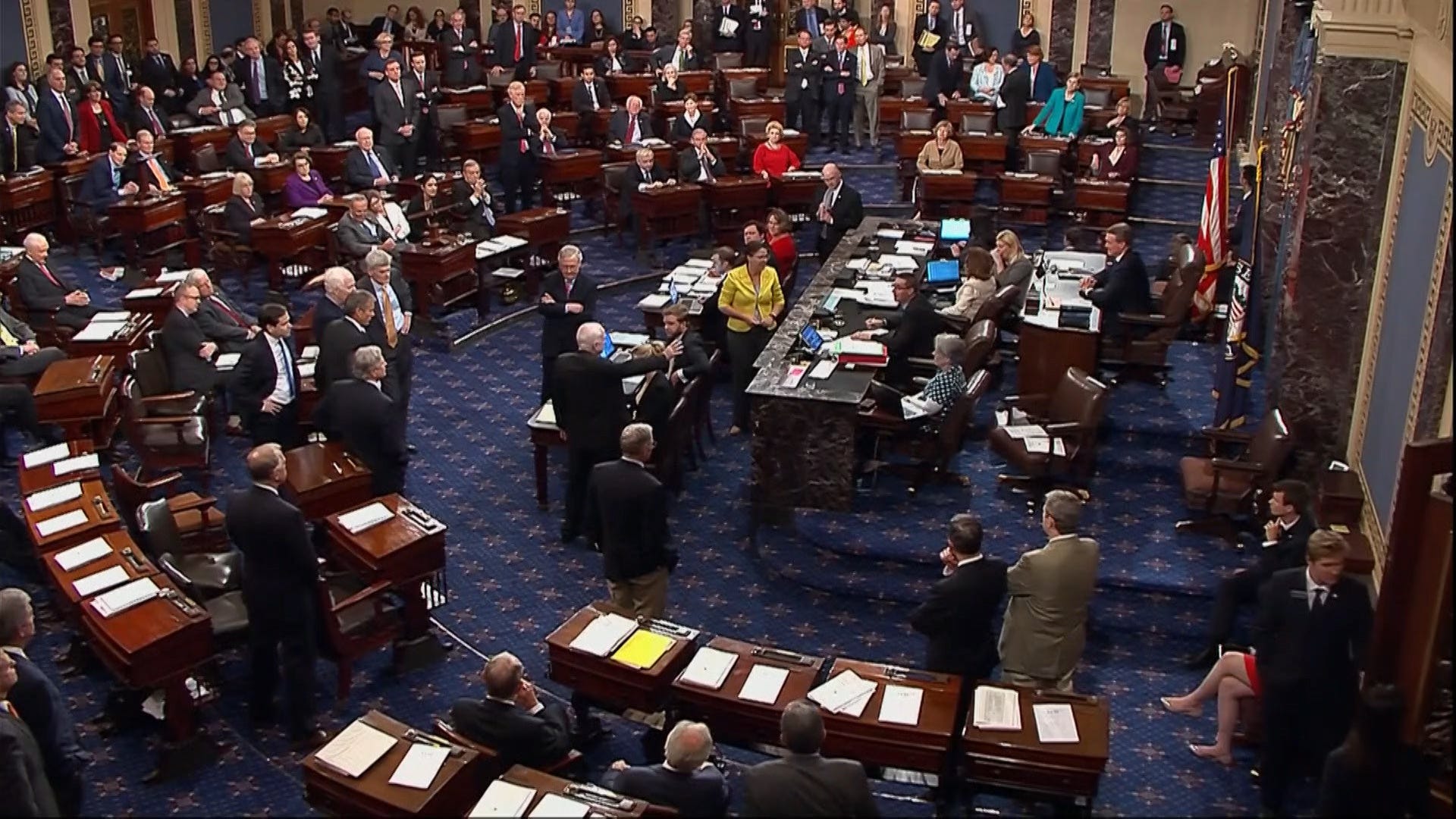
On this day in 2010, in the middle of the most consequential healthcare debate in a generation, the United States Senate took up a question so jarring it sounds almost fabricated:
Should the federal government pay for erectile dysfunction drugs for convicted sex offenders?
I did not stumble on this as a curiosity hunt. I found it the way many revealing details in Washington surface—buried deep in research. While working through pharmaceutical policy and reimbursement decisions, I encountered references to a little-remembered amendment offered during the Affordable Care Act debate. I went back and followed the Senate proceedings as they unfolded.
What emerged was not just an odd legislative footnote. It was a case study in political dysfunction—and the paralysis that grips Congress.
The amendment, introduced by Senator Tom Coburn, sought to bar federal funds from being used to pay for erectile dysfunction drugs for convicted criminals on sex offender registries. It looked like low-hanging fruit for bipartisan agreement.
Instead, it failed, 57–42, largely along party lines.
How was that possible?
The Debate No One Remembers
At the time, the country was consumed by a single question: would the Affordable Care Act pass at all? Every vote carried enormous weight. Every amendment was politically charged.
And then came this one.
Supporters argued that it addressed an obvious gap. Medicaid and other public programs cover FDA-approved drugs deemed medically necessary. Erectile dysfunction drugs fall within that category since they are approved for treating underlying vascular conditions. The Affordable Care Act did not distinguish between patients based on criminal history. As a result, there were documented cases—even in 2010— where taxpayer-funded programs paid for Viagra and other ED prescriptions for convicted sex offenders.
Opponents did not engage the substance so much as the strategy. They dismissed the amendment as a political maneuver, designed to force an uncomfortable vote and derail a fragile legislative coalition to pass the ACA.
So the Senate did what the Senate often does when confronted with a politically volatile issue tied to a massive bill: it voted it down and moved on. No resolution. No clarity. Just a recorded vote and silence. And in the midst of the debate over whether the ACA would get passed, that failed vote about ED drugs for sex offenders got surprisingly little media attention or public pushback.
What Happened Next
It is tempting to treat this as a bizarre relic of a heated legislative moment. That would miss the point.
The issue did not disappear. It was simply pushed out of Congress. Over time, the system adjusted—but not through law. Through bureaucratic administrative action.
Federal guidance clarified that states could restrict this type of coverage. Many states implemented prohibitions or verification systems designed to block or limit access. Medicaid programs introduced checks intended to prevent reimbursement in these cases.
A patchwork emerged—quietly, incrementally, and without a defining vote. But that patchwork has never fully worked.
Audits and investigations have shown that, despite formal prohibitions, Medicaid has still paid for erectile dysfunction drugs for individuals on sex offender registries. These cases are not the result of permissive laws. They stem from familiar bureaucratic weaknesses: gaps in cross-checking eligibility against sex offender registries, managed care loopholes, and prescription coding that obscures the intended use of a drug.
New York offers a clear example. The state has an explicit ban and a verification system designed to block such prescriptions. Yet a 2019 audit found that “lax oversight” allowed payments to continue. The problem was not policy—it was execution.
And because federal law generally requires coverage of FDA-approved drugs when medically necessary, a gray zone had emerged in the absences of Congressional action. Some prescriptions can be justified under alternative diagnoses, such as pulmonary hypertension, making enforcement inherently imperfect. Sex offenders often found physicians willing to dispense the drugs for other approved uses.
The Politics of Avoidance
What is most striking is not that the Senate could not agree.
It is that it chose not to.
This was not a complex actuarial question. It was not a matter requiring years of study. It was a narrow, definable issue that could have been resolved with clear statutory language.
Instead, it became a proxy battle.
One side used it to highlight perceived excesses in government spending and moral blind spots in healthcare policy. The other side dismissed it as a distraction from a much larger legislative goal. Neither side had a strong incentives to resolve it cleanly. So they didn’t.
It is fortunate—for politicians on both sides of the aisle—that the public memory of moments like this is so short. Because they expose something deeply uncomfortable: not just disagreement, but paralysis. Not just partisanship, but a reluctance to take ownership of even the most straightforward edge cases when they carry political risk.
The Larger Lesson
This is not really a story about one amendment. It is about how governance fails— even on questions that appear simple.
When confronted with a politically charged but solvable problem, Congress often fails to solve it. It defers it. It reframes it. It waits for it to dissipate—or to be handled elsewhere, out of view. That is playing out today over efforts to pass a clean amendment or bill that bans biological males from participating in female only sports.
None of this will come as any surprise to most Americans who realize the extent to which Congress is dysfunctional.
But this issue is a sharp reminder of the extent of the paralysis in Washington. What seems like a preposterous question turns out to reveal something more unsettling: the limits of political will in Washington.
And that, more than the amendment itself, is what is missing and has been forgotten.


This past election, Harris lost partly for approving transexual "gender-affirming" surgeryfor convicts and jailed illegal immigrants. The issue is still with us.
Tom Coburn! That’s a blast from the past. I met him once. A good doctor to have on the Hill, but it is so frustrating to hear of, yet another time, when our politicians do their job poorly.