
SCOOP: The Quiet U.S. Warning That Blocked Iran’s Nuclear Shortcut
How Washington warned North Korea—and quietly enlisted China—to block Tehran’s fastest path to a nuclear bomb after the 2025 strikes.
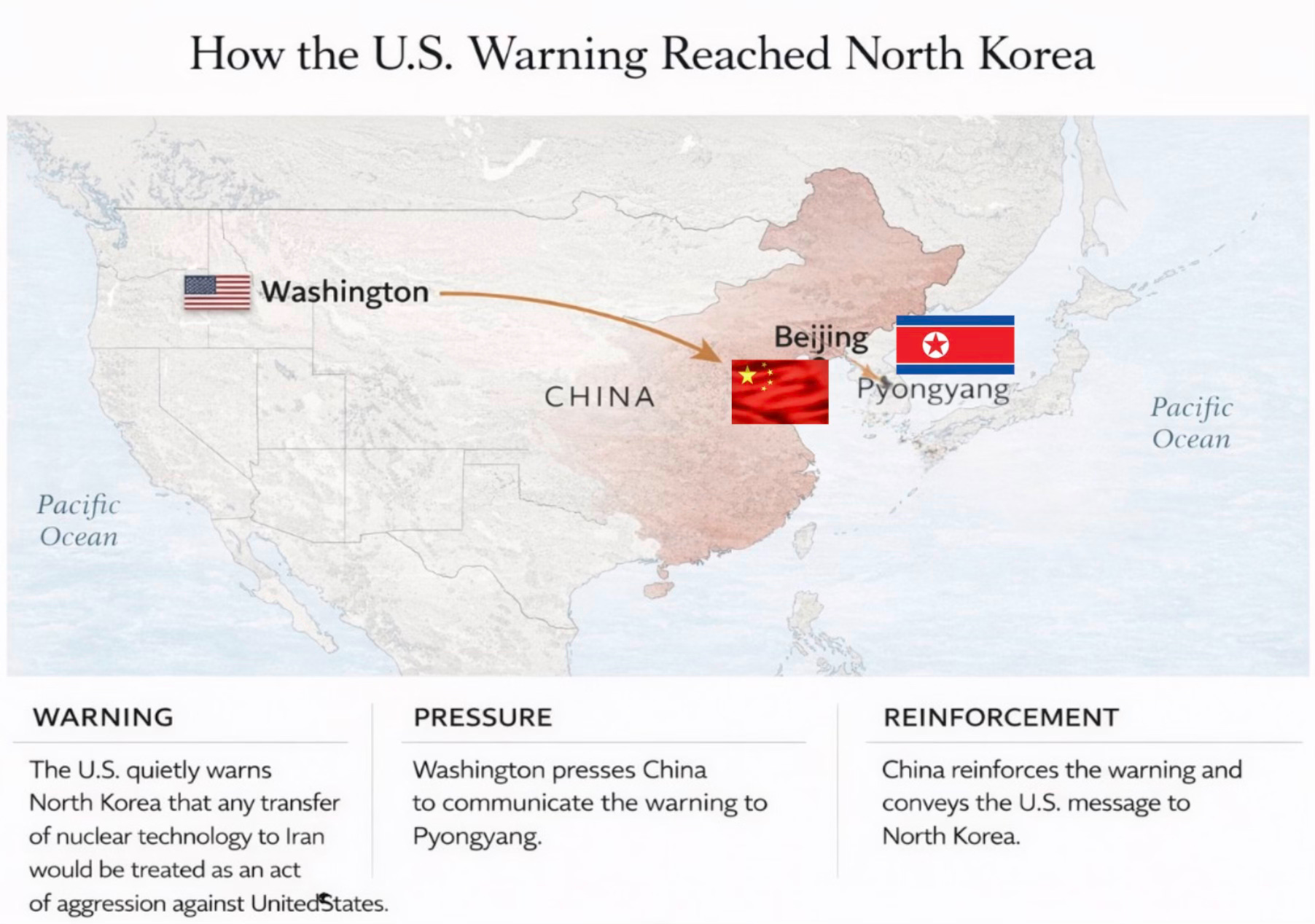
Last summer, as the world focused on Israeli and American air strikes against Iran’s nuclear facilities, Washington quietly sent a warning to North Korea: any transfer of nuclear technology—or an actual nuclear weapon—to Tehran would be treated as an act of aggression against the United States.
The message was delivered through diplomatic back channels and reinforced through Chinese intermediaries, according to U.S. sources familiar with the discussions. Their account of the warning has not previously been reported.
The warning reflected a concern inside Washington that the June 2025 strikes, while damaging Iran’s nuclear infrastructure, had not eliminated Tehran’s ability—or potential desire—to acquire nuclear weapons.
Inside Iran’s security establishment, the air strikes initially had the opposite effect Washington hoped for. Rather than ending the internal debate over pursuing nuclear weapons, the bombings strengthened the argument of hard-liners that Iran more than ever needed a nuclear deterrent.
In Washington, officials initially claimed the strikes had crippled Iran’s program for years. U.S. Secretary of State Marco Rubio pointed to the destruction of infrastructure at Isfahan used in the conversion of uranium compounds into metallic form, a key step in manufacturing nuclear weapons components. Pentagon officials suggested the attacks might delay Iran’s progress by roughly two years.
According to two U.S. sources familiar with internal discussions in Washington, those early estimates were quickly judged as optimistic.
Iran possesses a stockpile of roughly 460 kilos of uranium enriched to roughly 60 percent purity—material just below weapons-grade. If further enriched, it would provide enough fissile material for multiple weapons. Estimates from the United Nations and other international oversight organizations have suggested that Iran could produce anywhere from about 6 to 19 nuclear warheads. President Trump’s special envoy, Steve Witkoff, said that at the start of February negotiations in Geneva, Iranian officials boasted they possessed enough enriched uranium to produce 11 nuclear bombs..
U.S. intelligence believed that at least some—if not all—of Iran’s enriched stockpile was stored in canisters at facilities damaged during the June strikes. Recovering it would not be easy. Any scenario in which Iran tried to retrieve the material and move it to a covert enrichment site required time, infrastructure, and continued technical work, all of which would be immediately detected by the U.S. and Israel.
That raised another possibility that nuclear planners had occasionally considered: could Iran bypass the remaining technical hurdles by obtaining nuclear assistance—or even finished weapons—from abroad?
The country that most naturally surfaced in discussion after the June attacks was North Korea.
U.S. officials decided to close that potential door to a shortcut. Washington delivered a blunt message: any transfer of nuclear technology—or an actual nuclear weapon—from North Korea to Iran would be treated as a direct act of aggression against the United States.
A potential nuclear marketplace
Iran and North Korea have collaborated for decades on missile development. Both countries operate under heavy international sanctions and have built extensive procurement networks designed to bypass export controls. Their strategic relationship has often been described by intelligence officials as one of the most durable partnerships among states isolated from the Western system.
North Korea also possesses something Iran does not: a working nuclear arsenal.
Most estimates place Pyongyang’s stockpile somewhere between several dozen and about one hundred nuclear warheads. The country also continues to produce weapons-grade uranium at facilities believed to be capable of generating large quantities annually.
U.S. analysts had been tracking whether North Korea might supply Iran with key nuclear materials, specialized manufacturing equipment, or even the expertise needed to accelerate weapon design.
Selling a complete warhead was the most dramatic—and least likely—possibility. North Korean leader Kim Jong-un views each weapon as central to his regime’s survival.
But other forms of assistance were easier to imagine: highly enriched uranium, specialized metallurgy equipment, or nuclear scientists and engineers who could help replace Iranian experts killed during military operations last June.
Even partial assistance could significantly shorten Iran’s timeline to a weapon.
Washington’s quiet warning
The American warning was not delivered publicly. Instead, it was transmitted quietly through intermediaries to ensure that the message reached the leadership in Pyongyang without escalating tensions. And Washington enlisted an unusual partner to reinforce the warning: China.
Beijing remains North Korea’s most important political and economic backer. And while China often resists American pressure in other geopolitical arenas, it has little interest in seeing a nuclear arms transaction between Pyongyang and Tehran.
Such a transfer would risk dragging China—through its relationship with North Korea—further into the volatile politics of the Middle East. It could also accelerate nuclear proliferation across the region, potentially prompting Saudi Arabia, Turkey, or other states to pursue their own nuclear weapons programs.
According to individuals familiar with the discussions that followed, U.S. officials urged Chinese counterparts to quietly communicate to North Korea that any nuclear cooperation with Iran would cross a dangerous and irreversible threshold.
In effect, Washington sought to create a deterrent not just against Tehran—but against Pyongyang.
The shadow of past proliferation
The concern was not purely theoretical.
North Korea has previously exported nuclear technology abroad. In 2007, Israeli aircraft destroyed a nuclear reactor under construction in Syria that Western intelligence agencies believe was built with North Korean assistance.
That demonstrated that Pyongyang was willing to sell sensitive nuclear expertise if the political and financial incentives aligned.
More recently, North Korea has shown an increasing willingness to take geopolitical risks, including supplying ballistic missiles to Russia for use in Ukraine and sending troops to support Moscow’s frontline soldiers.
Would Pyongyang be willing to sell nuclear-related materials under the right conditions?
Iran could certainly pay. Oil remains one of Tehran’s most valuable strategic currencies. And there was a strategic benefit to Pyongyang; getting Iran past the hurdles to obtain nuclear weapons would shatter overnight years of U.S. diplomatic efforts.
Why the shortcut matters
From a purely technical standpoint, Iran does not necessarily need outside help to eventually build nuclear weapons. Its domestic program had advanced dramatically over the past two decades. But foreign assistance could change the timeline—and timelines are what shape strategic calculations in Washington, Jerusalem, and Tehran.
After last June’s military strikes against it, if Iran could shorten the path to a weapon from years to months—or even weeks—the entire regional balance would shift. That is why U.S. officials were determined to close off the possibility before it became a realistic option.
In the final analysis, the U.S. was not certain that Tehran was seeking help. But it wanted to shut the door to any possible North Korean-Iranian deal. “That option has been closed,” says a source familiar with the flurry of diplomatic messaging last summer. “The Iranians are on their own. No other country is going to bail out their nuclear dreams.”
For now, Washington believes it has closed the most dangerous shortcut in Iran’s nuclear calculations.


Outstanding reporting Gerald.
Excellent reporting Gerald. Putting together pieces of this jigsaw puzzle a nuclear armed Iran is the last thing any normal state would ever want. Their aim was to also to clearly bide their time stalling like they have in past negotiations. According to an interview with Mark Levin and Steve Witkoff after three negotiating sessions, they reported back to Trump that the Iranians are lying to us. There are deceptions all over the place. The Iranian team said they didn’t have authority - the negotiators didn't have the flexibility or delegated responsibility to make decisions on the spot. They were hiding the ball. They wouldn't give our team a written agreement that they could share with the president of the United States, the secretary of state, the secretary of defense, and our nuclear experts. Their position has never changed. They had an inalienable right, they told him, to their large stockpile of enriched material and would not give it up at the negotiating table what the Americans did not win in the 12-day war last June. So from the outset, the Iranians asserted that uranium enrichment was Iran's right, and they declared their large stockpile of enriched material was off the negotiating table. Now look at all the drone and ballistic missile attacks at Iran has launched against its neighbors. Sorry not sorry they are saying about that. Now imagine their coercion and willingness to use nuclear weapons. They love death more than life.