

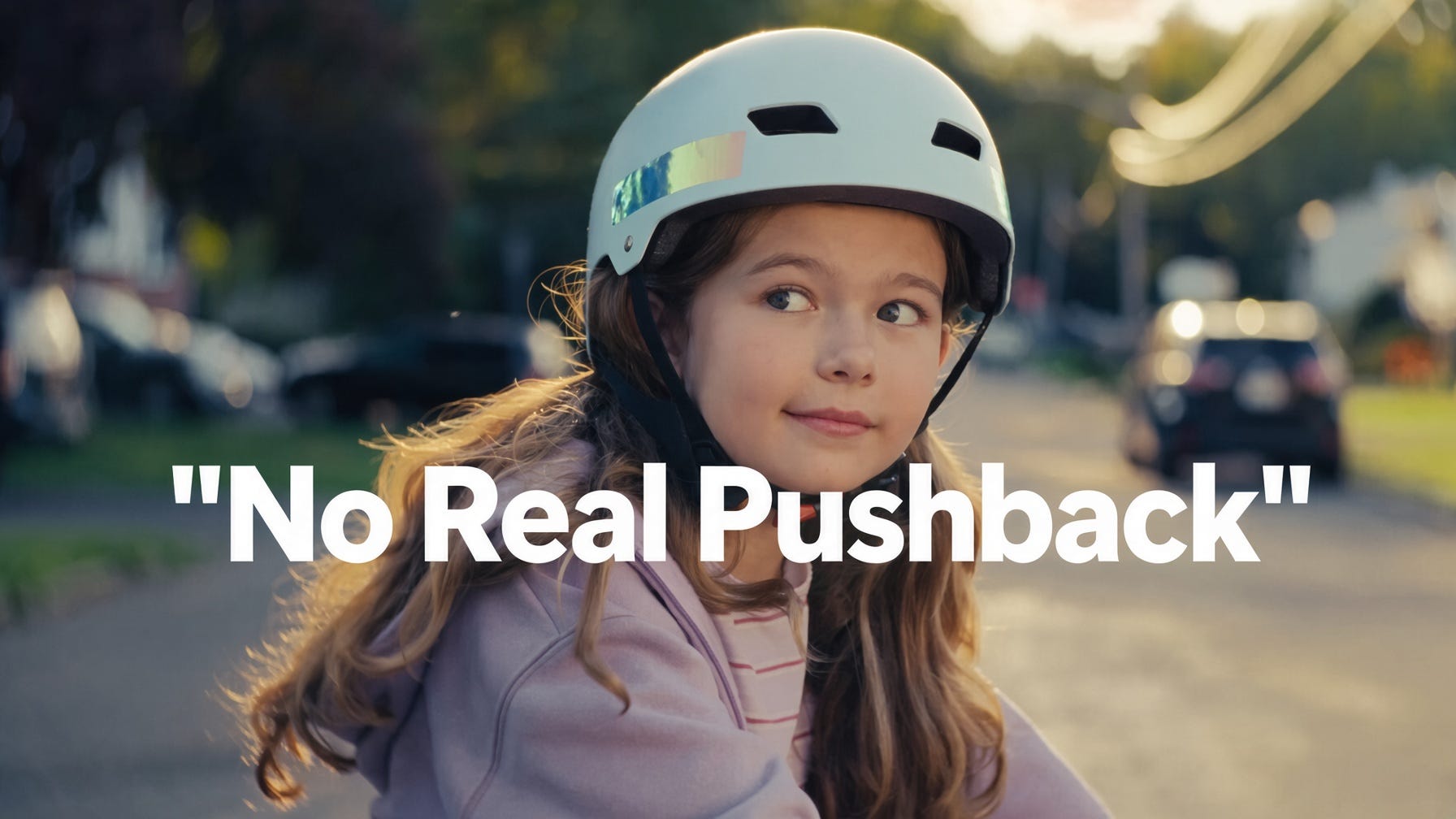
The slick anti-Israel ad that NBC ran during its Saturday Night Live Thanksgiving special received “no real pushback” before NBC gave it a green light to air, according to a person at the network in a position to know the clearance process. That person spoke to me on condition of anonymity because they were not authorized to discuss the matter.
That account is hard to square with what has been reported by the the Wall Street Journal’s Joe Flint, Deadline and others that senior management supposedly did not know about the ad until after it ran. It was also reported that the network is now reviewing how ads are approved. If no one pushed back, the ad didn’t slip through unnoticed. It was waved through.
What about the ad itself? On the night before Thanksgiving, NBC viewers watching the Saturday Night Live special saw a 30-second ad that starts with an American girl doing chores and saving $400 for a new bike. The film then cuts to a girl in Gaza, standing in rubble on crutches, missing a leg.
A narrator says:
“Every three seconds, our government sends $400 of taxpayer money to Israel to do this.”
For those who have not seen the ad, it is posted in full on a Substack note I wrote yesterday.
The ad was bought by the Institute for Middle East Understanding (IMEU) Policy Project, a 501(c)(4) "social welfare" group. It is an anti-Israel advocacy group whose “No More for Israel” campaign urges Americans to press Congress to oppose any military aid agreement with Israel.
When I first saw it, I wondered immediately how it got past NBC Standards.
What the ad leaves out
It offers no evidence of its own. It does not tell viewers who the girl is or what happened to her. It omits anything about the October 7, 2023, Hamas-led terror attack and it does not, of course, mention Hamas’s use of the Gazan population as human shields.
Only after the backlash did the sponsor fill in some of the blanks in an X post on Friday. It named the girl as 9-year-old Meral al-Babli, and said her leg was amputated after an Israeli bombing of her home that also killed her mother and grandmother. None of that was in the ad itself. She had been featured last year in Palestinian coverage. IMEU claimed the ad was accurate since the U.S.-supplied jets and tens of thousands of U.S.-funded bombs that are used in Israel’s war against Hamas in Gaza. IMEU also claimed the spot “passed NBC’s stringent fact-checking requirements.”
That X post proves less than it claims. That American weapons have been used in Gaza is not in dispute. Whether a U.S. weapon caused the injuries of the child is a different claim, and it is the one the ad makes explicitly.
What matters for NBC is what was in front of its reviewers before it aired. That is where I learned this morning about “no real pushback” comes into play.
The $400
The number cited in the ad needs context too.
It says— in the present tense—that the government “sends” $400 every three seconds. IMEU uses a historical average and presents it as a current rate. It does not say that in the ad, not even in small print at the bottom of the screen. That information is only something it puts on its own website. The “$400 every three seconds” is IMEU relying on $330 billion in inflation-adjusted aid to Israel since 1948, averaged over nearly 80 years. A CRS estimate cited by Jewish Insider puts the total actually at $298 billion.
IMEU does not cite the current real figure for aid to Israel because it is less than the $400 figure it wants to push. The 10-year military aid agreement provides $3.8 billion a year, including $500 million for missile defense. Spread evenly, that is about $362 every three seconds. In fiscal 2025, Israel received $3.31 billion in U.S. foreign aid, now down to $315 every three seconds.
Ukraine, the top recipient of U.S. aid, received in FY2025 $6.75 billion, about $642 every three seconds.
The ad chose a misleading framing and did not provide viewers any way to know that. If NBC asked for substantiation, did it ask how the $400 was calculated? NBC has failed to answer any of my queries as of the time of this writing.
NBC’s retreat
Although NBC executives leaked to TheWrap and others that senior management supposedly did not know about it until after it ran, and that NBCUniversal will review its ad approval process, no spokesperson said the ad broke any rule. TheWrap reported it was unclear whether more airings had been scheduled.
NBC does know how to publicly distance itself from an ad and it has done so before. In 2018, after a Trump campaign immigration ad ran during Sunday Night Football, an NBCUniversal spokesperson said on the record that after further review the network recognized the ad’s “insensitive nature” and would stop airing it.
The leaks from NBC seem like damage control more than a verifiable standards process. The omissions of October 7, of Hamas’s tactics, and of any evidence linking U.S. aid to the image shown do not seem to have troubled NBC before the ad aired. The outcry was why it backed away.
And “senior management didn’t know” is not an answer. It is a dodge of any accountability for those who might have waved the ad through the review process.
My source’s account makes that dodge harder to accept. If the ad drew “no real pushback,” the failure was not that it escaped the people at the top. It was that the people whose job is to question an ad like this did not do so.
NBC’s own rules
That question matters because NBC has specific guidelines.
NBC’s advertising standards portal says every ad airing on the broadcast network must be submitted for review. When applicable, NBC requests substantiation for all material claims. Its reviewers can approve a script, ask for more information, require changes, or reject a commercial as unacceptable for air.
Its published guidelines, which were updated in October, say NBCUniversal generally accepts issue ads from groups with differing viewpoints, provided their claims have a factual basis and fall within the bounds of reasonable debate. NBC may require substantiation. It reserves the right to reject graphic material and material that is “grossly offensive” on racial, religious or ethnic grounds.
I put questions to NBC asking who gave final approval and at what level? I also have asked whether NBC requested any substantiation for “to do this” and for the $400, and if so, what information it received from IMEU. At any point during the review process did reviewers know who the girl was, or how she was injured, before it aired?
As of this writing, NBC is silent.
I am not the only one asking. NBCUniversal had not immediately replied to requests for comment from the Jewish Telegraph Agency and Newsweek and other media. The Israeli-American Council said NBC must disclose how the ad met its own standards.
The public did NBC’s job
The backlash came fast. The ADL, B’nai B’rith International, the Israeli-American Council, the Simon Wiesenthal Center, the Union for Reform Judaism and the Orthodox Union all criticized the ad.
StandWithUs organized a letter campaign asking NBC to apologize, explain how the ad was approved and whether its claims were substantiated, and to adopt safeguards. Its CEO, Roz Rothstein, said nearly 10,000 people responded in less than 24 hours.
Ten thousand people should not have to write to a network to get it to ask the questions its standards department was supposed to ask before the ad aired.
Who paid, and why that should have raised flags
The IMEU Policy Project was formed in March 2024. Unlike a charity, a (c)(4) can lobby without limit on issues tied to its mission, and it does not have to publicly disclose its donors.
It is the advocacy arm of the Institute for Middle East Understanding, a 501(c)(3) founded in 2005. The two groups share an executive director, Margaret DeReus, a policy director and a mail-drop address in Tustin, California. In 2024, the parent charity gave the Policy Project a $250,000 grant and a $150,000 loan.
The parent charity has drawn support from major progressive foundations. The Rockefeller Brothers Fund made awards of $120,000 over two years in 2020, $225,000 over three years in 2022 and $180,000 over 24 months in 2025. The Foundation to Promote Open Society, part of George Soros’s Open Society Foundations, gave it $150,000 in 2016, $150,000 in 2019 and $200,000 in 2021.
I found no evidence that any of these grants paid specifically for this ad. Nor is there anything illegal about a (c)(4) keeping its donors private. That is how the law works.
But that is exactly why IMEU’s background should matter to NBC. When a network sells 30 seconds of prime time to a group that does not disclose who funds it, and the ad makes a sweeping factual charge about U.S. policy on a very controversial matter, the burden of proof should go up, not down. Standards should have asked who was really behind the ad purchase.
The warning NBC already had
NBC did not need to guess how an ad like this would land. It had a warning a month earlier.
In late October, during the Michigan Senate race, Rebellion PAC, a group co-founded by anti-Israel provocateur Cenk Uygur—Hasan Piker’s uncle— released an ad backing Democrat Abdul El-Sayed. A couple stands in a supermarket. They can’t afford a $7 carton of eggs because that money has to be set aside for “killing Palestinians.” The spot reused footage from an ad for Uygur’s short-lived 2024 Democratic primary campaign (he was born in Turkey and constitutionally ineligible for the presidency), with a new ending.
The reaction crossed party lines. ADL CEO Jonathan Greenblatt called it a “case study in antisemitism.” Rep. Haley Stevens, a Michigan Democrat who lost the primary to El-Sayed, demanded he reject it publicly. Sen. Elissa Slotkin, who had endorsed him, called it a “divisive stunt.” El-Sayed’s campaign said the ad was “not affiliated in any way” with it, and he later tried distancing himself without actually condemning it.
The differences matter, and I want to be precise about them. That was a campaign ad. It ran online, not on broadcast television, and its language was cruder.
But the device is the same. An ordinary American family goes without, and Israel is the reason. Stevens and others saw that device for what it was. If a $1,000 online ad set off that kind of reaction, NBC had every reason to look hard at a national prime-time spot built on the same idea.
Two tests of consistency
Here are two ads NBC should consider.
The first: a Russian-funded advocacy group buys 30 seconds showing Russian orphans and tells viewers that U.S. aid to Ukraine is to blame. Would NBC run it? Unlikely. And, if not, it should explain why it accepted this one. If it would, viewers deserve to know that too.
The second: AIPAC, the American pro-Israel lobby that has become a favorite villain for progressives, buys a spot. Its ad says that Qatar has spent billions on American schools and universities, then cuts to an Israeli victim of terrorism and asks, “What about this?”
Would NBC Standards approve that ad? Almost certainly not. Reviewers would ask, rightly, what connected Qatari money to that victim. That is the same question NBC has not said it asked about the girl in Gaza.
The other side
There is a fair argument on the other side, and it should be answered, not ignored.
NBC’s guidelines say it accepts issue ads from groups with differing viewpoints. Critics of U.S. military aid to Israel are entitled to make their case, including on broadcast television. The sponsor argues that tightening NBC’s review would “censor more factually true ads like ours.”
I agree with the first part. A group that wants Congress to cut aid to Israel can buy airtime to say so. The question is not whether that viewpoint gets on the air. It is whether NBC applies the same evidence standard to every advertiser. A claim that U.S. money did “this” to a particular child is a factual claim. By NBC’s own rules, a factual claim needs a factual basis. That standard should be the same for IMEU, for AIPAC, and for a Russian-funded group.
If NBC applied it here and decided the ad passed, it should show its work. If it didn’t apply it, then it should admit that too.
Who gave the green light?
This ad is a good example of why Israel has been losing the public relations battle since October 7. Its entrenched enemies are turning out polished propaganda that echoes the rise of the DSA and anti-Israel progressive Democrats. Ads like this can be wildly misleading, but nuance is not their business. Their power is to provoke and to move public opinion. In a culture where a 30-second TikTok clip can change how millions see an issue, do not underestimate a 30-second spot on NBC.
That is why the process matters more than the pullback. Quietly dropping the ad after the outcry does not tell anyone what went wrong. Until NBC answers some of the pending questions I and other journalists have asked, it will not suffice to say that “senior management didn’t know.” That is not accountability. And transparency about what went wrong at NBC with this ad is needed to quell the controversy. That someone inside NBC tells me that the ad got “no real pushback,” only adds to the necessity for the network come clean.
Gerald, come on. You aren't fooling anybody here.
What are you doing disabling Pangram again to conceal AI-written text?
When I copy/paste this piece into Pangram then this is what comes back:
Mostly Human-Written
AI 45%
AI-assisted 0%
Human 55%
I spent a lot of time testing the various LLMs last year to see if they could really help with writing. I did a whole series on it for months last year. And they can't. All they will do the more you use them is make your writing more boring and generic.
That’s all they do - they guess at what is most likely or most obvious.
All they’re good for for us as writer is research, brainstorming, and then feedback afterwards. And even at these tasks - they make a whole lot of mistakes and often what they offer is mostly worthless. I’ve spent tons of time feeding articles and essays and reporting and my whole corpus of writing for the last quarter century through the LLMs and most of what it has to say isn’t all that compelling or insightful. Sometimes we’ll get some useful ideas or insights. But mostly not.
And don’t live under the delusion that they’re going to get meaningfully better here. They can’t. The reasons they do this are because of their architecture. This is just how they are built - to predict the most likely next word. The technology is way more limited and weaker than most people realize. But those of us who have worked AI training gigs (as I have and am doing right now still) know the serious limitations and problems with this technology.
Be very skeptical of the LLMs, Gerald. Please stop trusting them to handle the weight of your byline.