
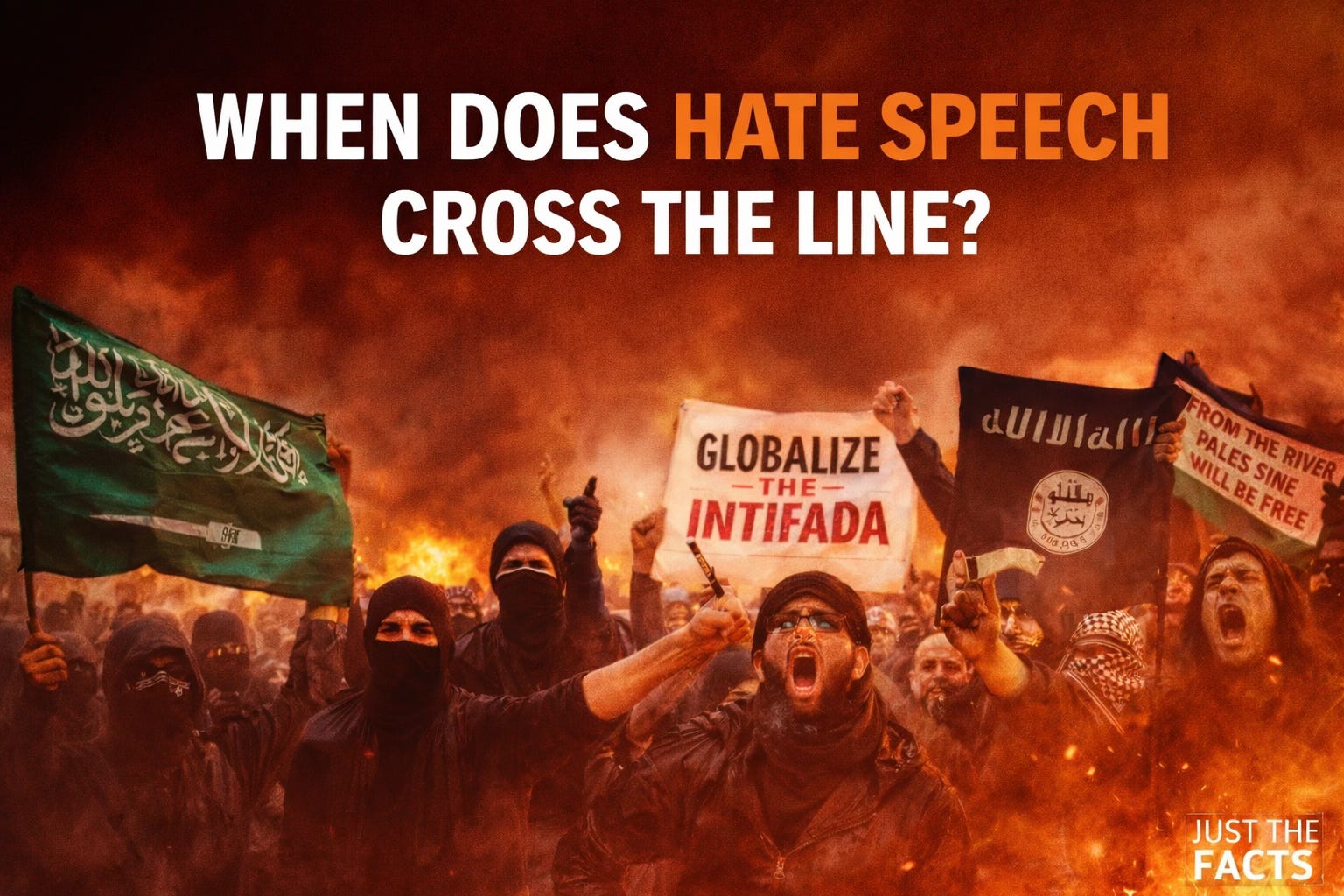
Hate Speech or Protected Speech? Bondi Changed the Rules.
Why New South Wales Is Right to Draw a Line on Incitement and Terror Symbols
Australia suffered a national trauma on December 15 when a father and son terrorist duo attacked a Hanukkah celebration on Bondi Beach that left 15 people dead and dozens wounded. It is a shame it took a slaughter to catalyze action. But this week the Premier and the Attorney General of New South Wales finally did what responsible government is supposed to do: confront the relationship between public incitement, public intimidation, and public violence.
What NSW is proposing
Premier Chris Minns says the government will move immediately on three fronts: outlawing terrorist symbols, targeting specific inciting chants as hate speech, and expanding police powers around face coverings at demonstrations. “They are not about suppressing views,” Minns said at a press conference, “they are about preventing intimidation, escalation and violence.”
On terrorist flags and symbols, Minns was explicit about what the legislation is designed to do: “On Monday we will introduce a series of measures that in many cases we believe will make a major difference for this state. First, the government will introduce new laws banning hateful symbols and giving police greater powers to remove face coverings during public assemblies and demonstrations. The government will examine additional measures to further crack down on hateful slogans.”
Attorney General Michael Daley underscored that the ban will be anchored to existing Commonwealth definitions and provided examples of the symbols and flags that would be banned: “Al Qaeda, Al Shabaab, Boko Haram, Hamas, Hezbollah, Islamic State.”
Then he framed the intent behind displaying those symbols in public: “The displaying of these symbols can only be done by someone who’s either deranged or has an intention to insult and intimidate and scare. And that is not on in New South Wales.” Underscoring this change in policy was that the father and son terrorists at Bondi Beach had two homemade ISIS flags, along with improvised explosive devices, in the car in which they drove to the attack.
As for chants, Minns drew a bright line between protest and incitement: “We’ll also make it very clear that horrific recent events have shown that the chant ‘Globalize the Intifada’ is hate speech and it encourages violence in our community. That chant will be banned, alongside other hateful comments and statements.”
On masks, Minns described the proposed change and why it matters: “The legislation will give police more powers to require someone suspected of committing an offense during a public assembly to remove face coverings.” He explained that the point is accountability for intimidation and racist conduct: “We will change the law so it can be for any offense, which is particularly important in the context of clamping down on hate speech, so that police can be in a position to identify who is responsible for offensive conduct, hateful slogans or racist behavior.”
Daley supplied the governing principle. He said, “governments have no more sacred duty than to keep their citizens safe,” and added that people “have a right to be living in a peaceful society and not be interfered with, not have to be subject to racism and hatred and violence.” He noted that when a small minority refuses to abide by those basic tenets of civil society, “what is left at our disposal is strong legislation backed up by the best police force in the world.”
The global warning signs have been flashing for years
Bondi did not happen in a vacuum. In recent years—and accelerating after the Hamas terror attack of October 7, 2023—Jewish communities have watched street rhetoric metastasize into something more sinister: an atmosphere where Jews are treated as legitimate targets and where the line between political protest and violent intimidation is deliberately blurred.
There are literally hundreds of examples in dozens of countries. Israeli soccer fans chased and beaten in Amsterdam; Israeli cruise passengers prevented from disembarking at the Greek island of Syros; a convoy of cars terrified a London Jewish neighborhood by shouting threats of rape against the daughters of Jewish families; or the depressingly familiar scenes on university campuses of harassment, exclusion, and hostility toward Jewish students.
This is what happens when the public square is allowed to normalize eliminationist rhetoric and terrorist iconography. It does not stay theoretical for long. When governments and institutions refuse to draw lines, the lines get drawn for them—by mobs and extremists.
I grew up with the American free-speech instinct. I still have it.
I do not pretend this is easy terrain. I was raised in my native San Francisco and shaped at UC Berkeley to believe that the answer to bad speech is more speech—and that in America, hate speech is often protected speech. That is broadly true. The First Amendment tradition in the United States is unusually expansive.
But even America recognizes limits: speech intended to produce imminent violence, and likely to do so, is not protected under the Brandenburg standard.
That distinction matters here. A society can simultaneously protect robust political argument—including harsh criticism of governments—and still refuse to tolerate incitement, intimidation, and public glorification of terrorist organizations. A democracy that cannot tell the difference is not practicing liberty; it is practicing denial.
Outside the United States, where there is no First Amendment, there is no excuse for pretending that calls to violence, terror propaganda, and masked intimidation are just another form of civic engagement.
A template for other countries and for universities
Let me be precise: the goal is not to criminalize disagreement nor to silence legitimate democratic debate. The goal is to stop a small violent minority from using public demonstrations as a vehicle for intimidation, recruitment, and threats.
NSW is showing a workable framework for democratic governments outside the United States: treat explicit incitement as a public-safety issue, not a rhetorical controversy; treat terrorist symbols as propaganda and intimidation, not politics; and limit the ability of agitators to hide behind anonymity when they are harassing others or breaking the law.
And private universities have even fewer excuses not to act. They can protect peaceful protest while still banning intimidation, masked harassment, and the celebration or legitimization of terrorist groups. Universities are not required to host an atmosphere of fear in the name of intellectual openness.
The world should not wait
In New York, for instance, mayor-elect Zohran Mamdani has declined to repudiate the phrase globalize the intifada—a phrase that, under what NSW is proposing, would soon be treated as illegal hate speech with real consequences. That gap matters, because slogans are not harmless when they are deployed as permission structures for violence.
NSW is moving in the opposite direction: toward clear lines, consequences, and clear public standards. It took Bondi to force the issue. The rest of the democratic world should not wait for its own Bondi.


Control immigration, not speech.
Yes control immigration. Those that are lucky to get in must assimilate. But neither AUS or the UK have first amendments so their approach to dealing with this problem will not work in the US. We’ll be watching to see how this works in each country - whether successful or abusive.