


Someone I’ve known for twenty years lives a couple of blocks away. I like him and run into him regularly in the neighborhood. He is not a partisan, he does not post about the Middle East, and he is not the sort of person who chants anything. The other day, he told me he respected my article in The Free Press, in which I said I’d leave my longtime publisher, Simon & Schuster, if it stood behind a virulently antisemitic Palestinian novelist. Then, out of the blue, he asked me a question in the tone people use when they already assume the answer.
“Do you think there’s a genocide in Gaza?”
No, I told him. By every metric that matters — legal, historical, statistical — there is not.
He looked at me the way you look at someone who has just told you the earth is flat. Then he explained why I was wrong. Netanyahu wants to eliminate the Palestinian people. Everybody knows that.
That was the whole of it. He did not cite a study or a court ruling, not even a casualty figure. Just a thing everybody knows. I have spent forty years as a reporter learning that “everybody knows” is where investigations begin, not where they end. I am also a lawyer by training, which means that when I look at the Genocide Convention, the tribunal judgments, and the legal threshold the word actually requires, I am not reading them as a journalist translating a foreign language. I know what the standard is, I know where it comes from, and I know how rarely — and how carefully — international courts have applied it.
A word about what this piece is and is not. I am not writing as an advocate, and this is not a polemic. I have no brief to defend and no side to win. This is not an attempt to rebut every argument made for the genocide charge, or to address every piece of evidence offered. It is a primer — the kind of thing you should read before you enter that argument, so that when you do, you know what the word requires, what the recognized cases look like, and what standard a competent court is required to apply. I call it as I see it. That has never made everyone happy. It is the only way I know how to work.
I left that neighborhood encounter thinking that what this argument needs is not another 12,000-word essay by a military historian or a dueling-statistics deep dive that nobody finishes. It needs a manual. Something short, plain, and honest.
That’s when I thought of an informal Genocide for Dummies.
The title will annoy some people, and I want to address that before they stop reading. Genocide is among the gravest words in the human vocabulary, and I am not using it lightly or ironically. I am saying that the word is now routinely used by people who cannot define it, at a threshold they have never examined — and that the most honest response is a plain-language explanation of what it requires.
I am old enough to remember how one of the great publishing franchises in American history began. In November 1991, a publisher called IDG released a book that bookstore owners were sure would insult the people buying it. DOS for Dummies, by a computer columnist named Dan Gookin, had a first print run of 7,500 copies. It sold more than a million in its first year and launched a series that has since produced well over 2,000 titles.
The premise was radical in its modesty. Take something intimidating and strip out the jargon so it can be explained to someone who knows nothing, all without treating them like they’re stupid.
Genocide is a word almost everyone now uses and almost no one can define. So, let’s do it the Gookin way.
What the Word Actually Means
Raphael Lemkin, the Polish Jewish lawyer who coined the term in 1944 after losing dozens of relatives in the Holocaust, built it as a prosecutor’s tool: precise, bounded, demanding. The word itself announced its purpose — genos, the Greek for tribe or race, fused with caedere, the Latin for killing. He would not recognize what has happened to it. Four years later, the UN adopted the Genocide Convention — and from the start, its drafters drew a clear boundary. The original Secretariat Draft — UN Doc. E/447, 1947 — explicitly noted that heavy civilian losses in war “do not as a rule constitute genocide.” That was the domain of the laws of war. The Genocide Convention addressed something different: the intentional destruction of a group as such.
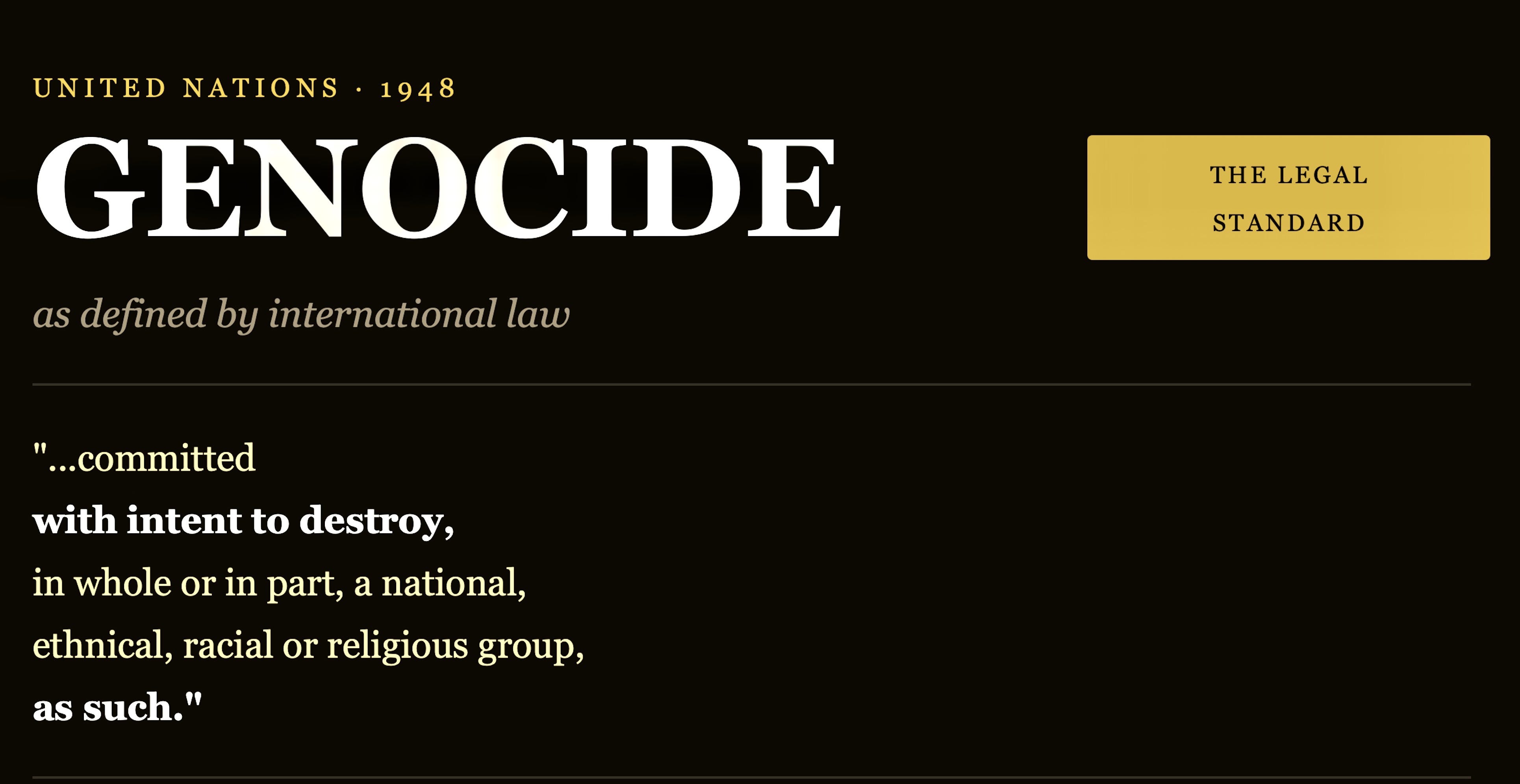
Article II is the whole ballgame — one sentence that has been parsed in courtrooms for seventy years. Genocide means any of five acts — killing members of a group, causing serious bodily or mental harm, inflicting conditions of life calculated to destroy the group, preventing births, forcibly transferring children — committed with intent to destroy, in whole or in part, a national, ethnical, racial or religious group, as such.
Everything hinges on those last words. Lawyers call it dolus specialis — special intent. The bottom line is that it is not enough to kill a great many people from one group. It is not enough to kill them carelessly, disproportionately, or unlawfully. You must kill them because of what they are, with the object of erasing the group.
And there is a second requirement people skip past, which is where nearly every public argument about Gaza goes off the rails. When intent is inferred from a pattern of conduct rather than proven by an order or a plan, the International Court of Justice has held — in Bosnia v. Serbia in 2007 and Croatia v. Serbia in 2015 — that the inference of genocidal intent must be the only reasonable inference available.
Not the most emotionally satisfying one. There is no vote for what majority prefers. It must be the only one available. If another reasonable explanation for the pattern exists, the charge fails. That is not an Israeli talking point. It is black-letter international law, and it exists for a reason: to keep the gravest crime in the legal canon from collapsing into a synonym for “war I find abhorrent.”
The Real Ones
Cases that define the legal boundary are fewer than most people assume. They are instructive not only what is on the list, but for why.
The Holocaust. Six million Jews. Roughly two-thirds of European Jewry. An industrial apparatus built for no purpose other than killing — death camps, timetables, rail schedules ultimately diverted from a war Germany was losing to keep the transports running. The killing was not a means to a military end. The killing was the end.
Rwanda, 1994. Between 500,000 and one million dead in a hundred days. Most credible estimates put the share of Rwanda’s Tutsi population killed at somewhere around two-thirds to three-quarters. Neighbors with machetes. Radio broadcasts calling Tutsis inyenzi — cockroaches. It produced the first conviction for genocide ever handed down by an international tribunal: Jean-Paul Akayesu, the mayor of Taba commune, in 1998 — a case that also established, for the first time, that rape and sexual violence could constitute acts of genocide.
Srebrenica, 1995. Around 8,000 Bosnian Muslim men and boys, murdered in a matter of days. Note the number. It is a fraction of Gaza’s toll. And the International Criminal Tribunal for the former Yugoslavia found it was unambiguously genocide, a ruling later confirmed by the International Court of Justice. That was because Bosnian Serb forces separated a group by ethnicity and sex, removed them from a captive civilian population that was otherwise bused away, and executed them as such. Small numbers, unmistakable intent. That’s the lesson worth holding onto: the case turns on what was intended, not on how many died.
Cambodia. Here is where it gets instructive. The Khmer Rouge killed roughly two million people — nearly a quarter of the country. The Killing Fields are shorthand for atrocity itself. And when the UN-backed tribunal finally rendered judgment in 2018, upheld on appeal in 2022, the genocide convictions covered only the Cham Muslims and the ethnic Vietnamese. The vast majority of the dead — Cambodians killed by Cambodians — were victims of crimes against humanity and extermination. Not, legally, genocide.
Many people have trouble digesting that. Two million dead, a quarter of a nation, and the tribunal still declined to call the bulk of it genocide, because the Khmer Rouge were destroying a class and a political order, not a protected group as such.
That distinction is not a technicality. The Genocide Convention’s drafters considered including political groups in the definition and deliberately left them out. Destroying a party or a class is not genocide. The law is narrow on purpose, and Cambodia is what that narrowness looks like in practice: the worst killing of its era, and most of it fell outside the word.
Sudan, the case my neighbor half-remembered — is the contested one. Colin Powell called Darfur genocide in 2004. A UN commission the following year found crimes against humanity but not genocidal intent. The International Criminal Court later charged Omar al-Bashir, Sudan’s long-serving dictator — the first sitting head of state it ever charged with genocide, in warrants issued in 2009 and 2010. The ICC does not try people in absentia, and when al-Bashir subsequently visited several ICC member states, no one arrested him. He has been held in Sudanese custody since 2019 on domestic corruption charges. When Sudan’s civil war erupted in April 2023, Bashir left Kober prison — the army said he had been transferred to a military hospital before the fighting; some accused the military of releasing him deliberately. He was subsequently held at a military base and later transferred to Merowe, a town on the Nile some 330 kilometers from Khartoum, for medical treatment. His precise status and whereabouts as of this writing cannot be independently confirmed. The ICC case has never gone to trial.
Darfur belongs in the argument column, not the settled one — and it cuts both ways, because the absence of a verdict there reflects the Court’s enforcement weakness, not an acquittal.
Now Apply the Test to Gaza
Gaza’s prewar population was roughly 2.2 million, up about 70 percent from the 1.3 million who lived there in 2005, when Israel removed all Jewish settlers, withdrew its troops, and transferred internal administration to Palestinian control. That sits awkwardly beside the “seventy-five years of genocide” claim that often travels with the “open-air concentration camp” framing. A population undergoing continuous extermination does not grow by 70 percent.
I use that figure carefully, because it answers only the cumulative, “seventy-five years of genocide” version of the claim, and not the argument about this war. So let’s take this war on its own terms.
As of 2026, the Gaza health ministry’s reported death toll since October 7, 2023, was in the low seventy-thousands. An Israeli military official reportedly acknowledged a figure of roughly 70,000 in January. A peer-reviewed mortality survey — the Gaza Mortality Survey, led by Professor Michael Spagat of Royal Holloway, University of London, and published in The Lancet Global Health in February 2026 — estimated 75,200 violent deaths between October 7, 2023 and January 5, 2025, along with some 16,300 non-violent and excess deaths from the collapse of the health system. The health ministry’s running total as of early 2026 stood in the low seventy-thousands.
Take the highest number. That is roughly 3.4 percent of the prewar population, over more than two years.
Rwanda’s killers murdered on the order of 70 percent of the country’s Tutsi population in about a hundred days. That is not a rhetorical flourish; it is arithmetic, and it is the difference between a war and an extermination.
There is also the question of capacity. Israel possesses one of the most powerful air forces in the region. A state intent on destroying a population of 2.2 million would not need two and a half years to kill three percent of them.
Israel says it killed about 20,000 Hamas combatants. Discount that claim as much as you like — the same independent survey that validated the health ministry’s numbers found that women, children and the elderly accounted for 56 percent of violent deaths. That means something close to 44 percent are military-age men — a category that is not automatically synonymous with combatant — but in a territory governed by an armed Islamist movement that recruits from exactly that demographic.. That ratio is grim. It is also not the demographic fingerprint of a campaign to erase a people. When the object is the group as such, the dead look like the group — all of it, in proportion. Here they do not.
Then look at conduct, which is where the “only reasonable inference” standard bites. Evacuation warnings. Aid corridors, however inadequate. Humanitarian pauses negotiated in 2024 specifically to vaccinate hundreds of thousands of Gazan children against polio. Repeated ceasefires. Hostage exchanges negotiated with the very people you are supposedly exterminating. And a ceasefire in place since October 2025, with Gaza’s population still there.
Genocides do not stop voluntarily. They end when someone stops them and they do not pause to negotiate with the people they intend to erase.
The Enemy Has a Name
There is a question the statistics above cannot answer on their own, and almost nobody thinks to ask it: who, exactly, is Israel at war with?
Genocide requires intent to destroy a protected group as such — national, ethnic, racial, religious. Not a government or army or a political movement. That is why the Khmer Rouge, who killed a quarter of Cambodia, were convicted of genocide only as to the Cham and the Vietnamese. So, the threshold question in Gaza is whether the belligerent Israel is fighting is Hamas or the Palestinian people. Most of Israel’s own conduct supports the former inference.
Start with the most obvious fact, which is so obvious that it disappears. Israel negotiates with Hamas—repeatedly, publicly, through Qatari and Egyptian mediators—over ceasefires and hostage exchanges and the return of bodies. There is a ceasefire in force as I write this. Nobody negotiates a truce with a people it intends to erase, because the point of erasure is that there will be no one left to negotiate with. The Wehrmacht did not broker prisoner exchanges with the Jews of Warsaw. The Interahamwe did not sign agreements with the Tutsi. In every case on the recognized list, the perpetrator’s relationship with the victim group was total and one-directional. Here it is bilateral, mediated, and ongoing.
Second, South Africa, which brought the genocide case against Israel before the ICJ in December 2023, identifies “Palestinians” in Gaza as a substantial part of the broader Palestinian national, racial and ethnic group that extends far beyond Gaza. Roughly two million Arab citizens live inside Israel, vote in its elections, sit in its parliament, and have served on its Supreme Court. Some three million Palestinians live in the West Bank. If the intent were to destroy Palestinians as such, one might expect the campaign to reach the group wherever it is found. That is what happened in the actual genocides: the Nazis pursued Jews across a continent, into countries they did not govern; the Hutu Power militias hunted Tutsi from one prefecture to the next.
The Genocide Convention says, “in whole or in part,” and tribunals have held that a geographically limited portion of a group can qualify — Srebrenica was one town. The absence of any campaign against Palestinians in Haifa or Nazareth therefore does not by itself defeat the charge. It does, however, make the claim considerably harder. Why would a state supposedly bent on destroying a people be content to concentrate its military actions only where Hamas governed and attacked from? Under the ICJ’s test, that alternative cannot simply be wished away.
Third, some Palestinians in Gaza publicly make the distinction themselves. In March 2025, hundreds took to the streets of Beit Lahia and Deir al-Balah in the largest anti-Hamas demonstrations since the war began. One protester told CNN that he was oppressed by both the occupation army and Hamas, and that Hamas launched October 7 while Gazans paid the price. Reporting through 2024 and 2025 documented widening anger at a movement that fought from tunnels while civilians absorbed the response.
Those protests do not tell us what all Gazans think, and the victims’ perceptions do not determine the perpetrator’s intent. They establish something narrower: some Gazans distinguish Hamas from Israel’s war against Hamas even while condemning Israel’s occupation and attacks. That distinction is consistent with the alternative inference that Israel’s object was to defeat Hamas, not to destroy Palestinians as such.
The ICC warrants against Netanyahu and his then–defense minister Yoav Gallant allege that Israel’s conduct during the offensive constituted war crimes and crimes against humanity, including starvation as a method of warfare, murder, persecution, and other inhumane acts. But assuming for the sake of argument that what is alleged in the ICC warrants was correct, look at what they do not say. The prosecutor assessed the same evidence everyone else has examined, before the same court that would have to sustain the charge, and he did not charge genocide. He is far from anyone’s idea of an Israeli apologist, and yet he had the option.
This is the distinction the chant of genocide obliterates. There is an enormous legal and moral difference between a state that fights a war brutally, and one that sets out to eliminate a people. The first describes a great many wars, including wars fought by countries whose citizens are now doing the chanting. The second describes a small handful of adjudicated cases in the modern era, and Gaza does not fit their pattern.
The Battle of Mosul in 2016 and 2017 produced devastation — a city largely destroyed, thousands of civilians killed, an enemy entrenched in residential blocks — and no serious legal analysis called it genocide. The difference was not the destruction. It was the enemy.
Fighting Hamas in Gaza kills Palestinians. That is a fact, and I am not going to soften it with a euphemism. But killing Palestinians while fighting Hamas and killing Palestinians in order to destroy Palestinians are different acts with different names, and the entire architecture of international criminal law rests on keeping them apart.
The Body That Said Otherwise
If you have heard one authority cited for the proposition that Israel is committing genocide, it is this one, and it is worth knowing exactly what it is.
The Independent International Commission of Inquiry on the Occupied Palestinian Territory, including East Jerusalem, and Israel was created by the UN Human Rights Council in 2021. It has three members. It was not a court. It could not convict anyone, subpoena anyone, or compel the production of a document. It investigated and issued reports. Its chair was Navi Pillay, the South African jurist who served as a judge on the International Criminal Tribunal for Rwanda — she sat on the trial chamber that convicted Akayesu in 1998. All three commissioners announced their resignations in July 2025, citing age and other commitments; their departures took effect in October and November. (The reconstituted panel has since reiterated the genocide conclusion in a June 2026 report. The same structural problems — low fact-finding threshold, no Israeli participation, contested or compromised membership — apply to the new panel too).
The Commission’s credibility had already taken hits before its final finding landed. Commissioner Miloon Kothari sparked widespread condemnation in 2022 when he claimed that social media was “controlled largely by the Jewish lobby” and questioned why Israel was allowed to be a UN member at all — invoking one of the oldest antisemitic tropes in circulation. Pillay defended his comments and dismissed antisemitism concerns as a diversion. I raise this not to invalidate the Commission’s legal analysis — a flawed messenger can still carry a valid argument — but because it bears on the question of whether a panel constituted this way, applying a criminal-law test at a fact-finding threshold, without any Israeli participation, and with this track record, deserves to be reported as having rendered something close to a verdict. It did not. It rendered a finding, from a compromised body, that a court has not yet been asked to confirm.
On September 16, 2025, the Commission issued a seventy-two-page legal analysis concluding that Israeli authorities and security forces had committed four of the five genocidal acts in Article II: killing; causing serious bodily or mental harm; deliberately inflicting conditions of life calculated to bring about physical destruction; and imposing measures intended to prevent births. It treated statements by senior Israeli officials as direct evidence of genocidal intent. Israel, which refuses the Commission access, called the findings scandalous and false.
Here is the part that people quoting this report usually leave out: genocide accusations were circulating within twenty-four hours of the first Israeli air strikes, before the IDF set foot in Gaza. A timestamp does not disprove a genocide. But it raises a legitimate question about epistemics, about how much evidence some accusers believed necessary before reaching the gravest conclusion available.
There are three places where the report fails to carry the weight now being loaded onto it.
The first is the burden of proof. The Commission’s own stated threshold is “reasonable grounds to conclude,” the lower standard used by human rights fact-finding bodies. It is not a criminal-trial standard of proof beyond a reasonable doubt. Nor is it the ICJ’s standard for state responsibility, which requires that allegations of exceptional gravity be proved by evidence that is fully conclusive. What you have, then, is a criminal-law definition applied at a fact-finding threshold, with the result reported in the press as though a court had ruled. It has not.
The second is that there was no adversarial testing of the evidence. The “only reasonable inference” rule is most rigorously applied when a chamber weighs a claimant’s evidence against a respondent’s, with cross-examination and a defense case. The whole function of the rule is to force a tribunal to consider the explanation the accused offers and then reject it on the record. The Commission had no Israeli submissions. Israel’s refusal to participate was its own choice, and it does not erase the evidence the Commission gathered. But it does mean that a test designed to eliminate reasonable alternatives was conducted without the accused presenting them. That is a structural limitation, not a partisan objection.
Critics of the report press this into a sharper claim: that across seventy-two pages the Commission never seriously reckons with the fact that the Israeli army was fighting a force of roughly thirty thousand operating from a fortified network of hundreds of kilometers of secret tunnels built deliberately beneath hospitals, schools and residential blocks. The report describes the civilian devastation in exhaustive detail; it does not test the military explanation against that context with comparable rigor. That matters because the deliberate use of civilian infrastructure as shield military operations is itself a war crime under Additional Protocol I to the Geneva Conventions — meaning the Commission was analyzing the consequences of one unlawful act without accounting for the unlawful act that preceded it. The Commission’s failure to engage it is not a minor procedural gap; it is a structural omission in a document purporting to apply the “only reasonable inference” standard.
The third is what the Commission infers about intent. The “only reasonable inference” rule applies only when intent is being inferred from conduct. The ICJ said so in Croatia v. Serbia: the pattern-of-conduct analysis is what a court turns to in the absence of direct proof of intent, such as the expression of a policy to that effect. The Commission’s position is that the statements by senior Israeli officials supply the direct evidence. Two days after the October 7 terror attack, Defense Minister Yoav Gallant said: “I have ordered a complete siege on the Gaza Strip. There will be no electricity, no food, no fuel, everything is closed. We are fighting human animals and we are acting accordingly.”
The dispute is over what that statement meant. Was Gallant calling for a merciless war on Hamas, to eliminate the Islamic terror group once and for all? The grammatical antecedent in his sentence is Hamas. The Commission of Inquiry, Amnesty, and South Africa instead said he meant it about Palestinians collectively. It treated that ministerial rhetoric—only 48 hours after the Hamas terror attack—as direct evidence of state policy of genocide. The Commission turned the idea that Israel was fighting an enemy that behaved like animals into Israel fighting a population it regards as animals.
Beyond Gallant’s statement, the Commission cited Netanyahu’s invocation of Amalek — “Remember what Amalek did to you, says our Holy Bible. And we do remember” — repeated in a letter to soldiers days later. The biblical story concludes with God’s command to spare no one. But Netanyahu was invoking a 3,000-year-old tradition of comparing an existential enemy to Amalek, not issuing an operational order. The full speech explicitly identifies Hamas as the target. The verse appears in the permanent exhibition at Yad Vashem, Israel's Holocaust memorial, and on a Holocaust memorial in The Hague — in both contexts a warning of vigilance, not a command.
The Commission treats both Netanyahu’s and Gallant’s statements as direct evidence of an expressed state policy of destruction — adopted, transmitted through a chain of command, translated into operational orders. That leap is not supported by the operational record, which is the better evidence of what a government intended: the many evacuation warnings and humanitarian corridors, facilitated aid deliveries and medical evacuations, pauses in fighting to give children the polio vaccine, the ceasefires, the hostage negotiations. A West Point urban warfare scholar embedded with the IDF four times, reported watching missions delayed or canceled because children were detected nearby — a pattern inconsistent with exterminatory intent.
Some warnings were late or inadequate. But orders that were issued and carried out still matter. Rhetoric is not an operational order. If it were, half the governments on earth would be in the dock.
Tunnels and human shields explain why a hospital gets struck. They do not explain restricting food. The charge that Israel used starvation as a method of warfare — pursued by the ICC prosecutor, cited by the Commission, and reported by international aid organizations whose impartiality has been extensively contested — is a serious one that military necessity does not answer. Even if that charge is sustained by a competent tribunal, it will represent a genuine crime. What it will not represent, absent specific intent to destroy Palestinians as a group, is genocide. Those are different charges with different names, and collapsing them does not make the smaller one bigger. It makes the larger one meaningless.
One of the Commission’s most cited examples is the December 2023 shelling of Gaza’s main fertility clinic, the Al-Basma IVF Centre, which reportedly destroyed about 4,000 embryos. Israel has not confirmed that it struck the facility. For the attack to constitute genocide under Article II(d), the facility would have to have been targeted as part of an intent to prevent births within the group (Palestinians). The Commission inferred that intent from the effect. But without evidence about target selection, an errant shell in an urban battlefield during heavy ground fighting remains every bit as reasonable an alternative—and under Bosnia v. Serbia, a reasonable alternative is all it takes for the inference to fail. Effect alone cannot establish the required intent.
A reconstituted panel has since reiterated the genocide conclusion in a June 2026 report. The same structural problems — low fact-finding threshold, no Israeli participation, contested or compromised membership — apply to the new panel too.
The Rest of the Case
I think the Commission weighed its evidence with its conclusion already in hand. But its conclusion has also been reached independently by Amnesty International, B’Tselem, a majority of the genocide scholars who voted — and serious people, including some Israeli Holocaust historians.
Among the scholars who changed their minds publicly is Omer Bartov, an Israeli-American Holocaust historian at Brown University, who declared in a July 2025 New York Times op-ed that he saw genocide in Gaza. Bartov’s piece drew a direct rebuttal from John Spencer, chair of urban warfare studies at West Point’s Modern War Institute, who has been embedded with the IDF in Gaza four times. Spencer’s answer to Bartov’s title — “I’m a Genocide Scholar. I Know It When I See It” — was “I’m a War Scholar. There Is No Genocide in Gaza.” Spencer’s credibility rests not on legal analysis but on direct observation: he reviewed IDF orders, watched the targeting process, and saw missions delayed or canceled because children were nearby. His conclusion was that nothing he observed resembled genocidal intent.
The often-cited IAGS resolution was widely reported as representing "86 percent of genocide scholars." The actual picture is significantly narrower. Of the association's approximately 500 members, 28 percent voted; of those voters, 86 percent supported the resolution. That works out to roughly one quarter of the full membership actively endorsing the finding. The threshold required to hold the vote was just 20 percent of members in good standing — a status achieved simply by paying annual dues. Mia Bloom, a professor at Georgia State University who describes herself as a founding member of what became IAGS, said the resolution did not reflect the majority of genocide scholars and that membership was no longer limited to serious scholars of genocide.
The membership numbers bear that out: IAGS’s directory stood at roughly 150 members in October 2023, tripling to around 440 by the time the resolution passed. Nearly 200 genocide, Holocaust, and legal scholars — including former U.S. Justice Department war crimes prosecutor Eli Rosenbaum — signed a letter demanding retraction on the ground that the resolution never seriously established special intent and never engaged the alternative explanation the law requires the claimant to eliminate. Across three pages, Hamas appears only in two brief subordinate clauses.
That means “the experts have ruled” is carrying far more weight than it can bear. When a fact-finding body applies a criminal-law definition at a fact-finding threshold with no defense in the room, and a scholarly association passes a resolution supported by roughly a quarter of its full membership, you do not have a verdict. You have a prosecutorial brief, contested by serious people, awaiting a tribunal that has not yet ruled and will not for years.
And the tribunal everyone invokes has not decided anything on the merits. The ICJ’s January 2024 order was provisional — an interim safeguard issued long before the court has weighed the full evidence on either side. In the months that followed, the order was almost universally reported as finding a “plausible case of genocide.” It did not. In a BBC HARDtalk interview on April 25, 2024, the court’s then-president Joan Donoghue — an American lawyer who presided over the South Africa hearings — corrected that reading directly. “It did not decide,” she told interviewer Stephen Sackur, “and this is something where I’m correcting something that’s often said in the media — it did not decide that the claim of genocide was plausible.” What the court found, she explained, was that Palestinians had a plausible right to be protected from genocide, and that South Africa had standing to present that claim. “The shorthand that often appears — that there’s a plausible case of genocide — isn’t what the court decided.”
Donoghue’s clarification landed like a grenade. Those who had built arguments on “the ICJ found genocide plausible” scrambled to explain that she was wrong about her own court’s ruling — a remarkable position. Kenneth Roth, former director of Human Rights Watch, argued on X that a plausible right to protection from genocide necessarily implies plausible genocidal acts, and that Donoghue’s clarification was therefore “revisionist.” It is the argument of a man telling the presiding judge she misread her own order.
Something else worth noting before the ICJ renders judgment: several countries that have intervened in support of South Africa's case have asked the court to loosen the standard — an implicit concession that under Bosnia v. Serbia, as currently applied, the case against Israel is unlikely to prevail. Brazil wants a novel "balanced approach" to genocidal intent. Belize argues there is "no requirement" that a state act exclusively with genocidal intent. Chile prefers "a fluid concept of intent" based on holistic evidence. The consequences would extend well beyond this case. The ICJ is considering the standard question in Gambia v. Myanmar, and that whatever threshold the court sets there becomes the new global floor. At least 90 countries have enacted universal jurisdiction over genocide. A lower standard does not protect one population. It changes the rules for every state, every official, and every future case — including against the United States and its allies.
In May 2026, the court set South Africa’s reply for November 22, 2027, and Israel’s rejoinder for May 22, 2029. Bosnia v. Serbia took fourteen years from filing to judgment. A verdict in the Gaza case this decade is highly unlikely.
The Cost of Getting It Wrong
Words are instruments. Lemkin created this one in 1944 to do a specific job, and it only works if it stays sharp.
If genocide means any war with terrible civilian casualties alone, then it means nothing, and the next time a group is marked for erasure — and there will be a next time — the alarm will already be worn out from overuse. That is not a semantic concern. That is the mechanism by which “never again” fails.
So here is my falsifiable standard, offered to my neighbor and to anyone else. Show me direct evidence of intent to destroy Palestinians as such — whether through explicit statements of policy, a pattern of conduct from which destruction is the only reasonable inference surviving contact with the alternative explanation, or both. Show me that the alternative explanation — a brutal war against an armed enemy embedded in a civilian population — has been considered and eliminated rather than simply wished away. Show me a competent tribunal that has weighed adversarial evidence, with a defense in the room, and returned that verdict.
Bring me those and I will write the correction myself, under my own name.
Until then, understand what you are doing when you repeat the word as though it were a talisman that turns Israelis into modern-day Nazis. You are not making an argument. You are casting a spell — and hoping that if enough people say the word, it will become true.
It doesn’t work that way. It never has.
But let's not be coy. The Palestinians have been waging a war of genocide on the Jews for more than 75 years. They are only capable of doing it in relatively small attacks on innocent children and unarmed adults and, of course, with their crude rockets. The attack on the kibbutzes on 10/7 is probably the most that they could ever pull off and of course, it was committed on innocent, mostly unarmed teenagers and young adults. Vicious, horrifying, and depraved, it's still about the most they could do.
On the other hand, the IDF is committing a "genocide" on Hamas and justly, so. It's more than clear that virulent, colonialist islamism will never tolerate a Jewish state in the Jewish homeland. It's the same with our grandfathers clearing out the last of the Nazis in Europe. Necessary for civilization to resume.
“the experts have ruled” = "the science is settled"
For me, the ultimate test of definitions is Indonesia. Somewhere between 500,000 and 1,000,000 communists and other leftists were killed from 1966-1967. I studied the entire English-language historiography that was available, and if communists and leftists were considered an ethnic group, the killings would absolutely be considered genocide. BUT! Even a ridiculous genocide "scholar" like Michael Mann admits the difficulty of defining the mass murders of a million people this way, preferring the term "politicide" instead. That's because in a nation of thousands of ethnicities, no single group contained all the communists.
So my very first test for anyone who says that Gaza is a genocide is to ask them to explain how the deaths of one million Indonesians is not considered a genocide while the deaths of 20,000 civilians in Gaza somehow qualifies for the title. So far, not one self-styled "genocide scholar" on X has been able to explain it. Hardly anyone I ask has ever even heard about the mass killings in Indonesia. You would think the global left would talk about it more, but they do not, and that is because the whole thing started with communists killing people.
They don't want to talk about it because the left comes across as guilty and deserving, even if the response was disproportionate. Weird how that doesn't work with Hamas. I guess Suharto could get away with it because he wasn't Jewish?