
Explosive Archives Confirm the Nazi Origins of Palestinian Terror Finance
Files unearthed in Belgrade highlight the breadth of the Nazi–Muslim partnership and its modern-day consequences
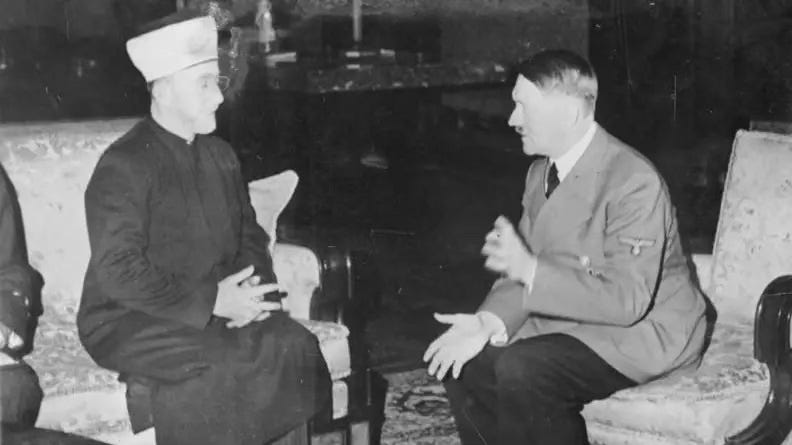
Archival material newly unsealed in Belgrade casts a harsh spotlight on collaboration between Nazi Germany and Islamist leadership during the Second World War. Hidden for decades in Yugoslavia’s national archives, a slim investigative file on Mohammed Amin al-Husseini, the Grand Mufti of Jerusalem, confirms both the scale of his operational role in Nazi Europe and the political suppression that later ensured the case would never be pursued.
The file is not thin because evidence was lacking. It is thin because the investigation was stopped.
The documents reinforce a historical continuum stretching from the Mufti’s wartime collaboration with Nazi Germany to the postwar survival of Nazi capital networks that later financed the emergence of Palestinian terror organizations. This is precisely the through-line Patricia Posner and I documented in our 2024 joint investigation published by the Jewish Chronicle, Revealed: Nazi Financial Fixer Who Funded Palestinian Terror. In that exposé we traced how François Genoud, a Swiss Nazi financier, preserved Hitler’s political and financial legacy and redirected looted Nazi assets into Middle Eastern militant causes in the late 1960s and early 1970s.
The Belgrade materials focus heavily on al-Husseini’s activities in Nazi-occupied Yugoslavia, particularly Bosnia and Herzegovina. Far from acting merely as a political intermediary or propagandist, the Mufti pushed aggressively for operational control. He helped facilitate the creation of multiple Waffen-SS divisions composed of local Muslims, units that went on to commit mass atrocities against Jews and Serbs, including village burnings, executions, rape, and systematic terror.
What emerges from the archive is not only violence, but design.
Documents assembled by Yugoslav investigators before their work was halted reveal how deliberately the alliance between the Nazi leadership and the Mufti was constructed. A wartime memorandum authored by a senior German official responsible for Muslim minority affairs in occupied territories records extensive coordination between Nazi authorities and al-Husseini aimed at mobilizing Muslim populations for the Nazi war effort.
The Mufti was not simply endorsing Third Reich objectives. He was shaping policy. He advocated embedding religious authorities directly within German military units, arguing that imams should be used to indoctrinate and motivate Muslim soldiers serving in both the Wehrmacht and the Waffen-SS. He pushed for the creation of formal training institutions designed to fuse political Islam with National Socialist ideology, producing cadres capable of spreading both doctrines in tandem.
This was not theoretical. A similar religious training model had already been implemented under his direction in Bosnia. Graduates of that system were deployed across the Balkans, reinforcing Nazi control and participating directly in atrocities against civilian populations. The Belgrade files confirm that the fusion of Islamism and Nazism was neither accidental nor rhetorical. It was institutionalized.
The archives also expose another dimension of the alliance that resonates powerfully with what followed in the postwar period: money.
Yugoslav investigators assembled extensive financial documentation detailing stipends, reimbursements, and expense claims submitted by the Mufti to Nazi authorities. These records depict a figure who treated collaboration as a paid enterprise, demanding compensation for nearly every activity, from major operational costs to trivial personal expenditures. Monthly payments from the Germans reached extraordinary levels, supplemented by additional funds in foreign currency, and were substantial enough that some Nazi officials privately complained about the scale of his demands.
This financial paper trail traces the Mufti’s movements across Europe and documents his interactions with senior Nazi officials in locations far removed from the Middle East. It also illustrates how money expanded his reach, allowing him to operate as a transnational actor rather than simply a regional agitator.
Al-Husseini was not alone in receiving German funding. Other Arab collaborators were similarly financed, but he occupied a singular position within the Nazi hierarchy. While others acted as national representatives, the Mufti portrayed himself as the embodiment of a pan-Islamic movement. That self-conception granted him exceptional access to senior Nazi leadership and enabled him to function as a central recruiter, propagandist, and organizer across multiple theaters of war.
After the war, Yugoslavia’s liberated government formally classified al-Husseini as a war criminal and sought his extradition through a United Nations process. That effort collapsed under intense diplomatic pressure from across the Arab world. The investigation was quietly shelved. Accountability was abandoned.
This failure helps explain what followed.
Our 2024 investigation demonstrated how François Genoud became the financial executor of the Third Reich’s afterlife. As custodian of Nazi estates and stolen assets, Genoud ensured that capital accumulated through genocide did not disappear in 1945. Instead, it was preserved, laundered, and redirected to shelter fugitive Nazi war criminals and later to bankroll postwar anti-Israel extremists, primarily Palestinian militant organizations that emerged in the late 1960s.
The Belgrade archives do not rewrite that history. They validate it.
They reveal that monetized antisemitism was already normalized during the war itself. The pairing of ideological extermination with financial extraction did not begin with Genoud. He inherited a model that figures like al-Husseini had already helped establish.
Taken together, these documents confirm that the Nazi–Muslim partnership was not incidental, symbolic, or confined to rhetoric. It was bureaucratic, contractual, operationally violent, and financially sustained. Its suppression after the war allowed both ideology and capital to survive intact.
History did not break cleanly in 1945. It mutated, adapted, and went underground.
The Belgrade files demonstrate how political expediency eclipsed justice, enabling figures like al-Husseini to evade accountability and allowing financiers like Genoud to convert genocide into a renewable funding model for terror.
This is not simply archival news. It is a reminder that unfinished justice has consequences, and that much of today’s violence rests on foundations laid, ignored, and deliberately obscured generations ago.


Thanks for posting this. I've been commenting about this relationship for years and how the modern Palestinian (& Muslim Brotherhood) movement is doomed due to its origin and as the last vestige of the Third Reich's "Final Solution to the Jewish Problem".
Wow, great investigative journalism Gerald and Trisha!!!!!⭐️⭐️⭐️⭐️⭐️ There is confirmation through these files. “The Belgrade files confirm that the fusion of Islamism and Nazism was neither accidental nor rhetorical. It was institutionalized…The Belgrade archives do not rewrite that history. They validate it.”