
Censorship 1.0 vs. Censorship 2.0
A brief observation on how information control has evolved—from erasing stories to shaping what people believe about them.
Twelve years ago, there was a moment that now feels like a relic from another era.
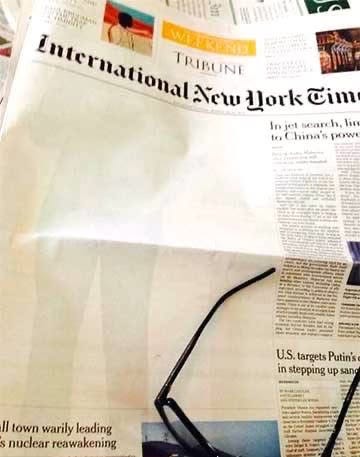
The international print edition of The New York Times in Pakistan ran with a conspicuous blank space where a major story should have appeared. The article—detailing how elements within Pakistan had helped Osama bin Laden evade capture—had been removed by local authorities.
The absence was the story.
It was censorship in its most literal form: remove the text, leave the void. A visible act of suppression, that even at the time, felt like something already outdated.
Because the story had not been erased. Anyone with an internet connection could read it. Subscribers already were. The information still moved—freely, globally, and irreversibly.
As a journalist, I thought that moment captured a turning point.
For most of modern history, censorship was about controlling distribution. Governments did not need to persuade—they only needed to block access. Control the printing presses, the broadcast licenses, the physical circulation, and you controlled what people knew.
The internet broke that model.
But censorship didn’t disappear. It evolved.
It remains most overt in authoritarian systems. China, North Korea, and Iran and other information dictatorships still attempt to control digital flows outright—utilizing aggressive censorship technologies to shape both history and current events.
But the more interesting—and in some ways more consequential—shift is happening elsewhere. In Western democracies, Censorship 2.0 is more far more subtle. Those seeking to influence public opinion understand that blunt suppression often backfires. It draws more attention to the story that it would have received on its own.
So instead they shape narratives, omitting key facts, amplifying some voices while burying others, framing the story to fit the conclusion they want.
The modern equivalent of controlling the printing press is controlling the algorithm.
I have written extensively over the past few years about these modern forms of censorship, including piece such as The Assault on Freedom of Speech; Big Brother, UK Style; How The Word Police Affect the News You Get; Muzzling the Whistleblower; Pseudonyms for Safety; and Sensitivity Language Police Strike Again.
As noted in those articles, voices that challenge the prevailing narrative are suppressed in many ways. Sometimes it is explicit—a visit from the police over so-called “non-violent hate speech,” or the loss of a job for expressing views deemed “objectionable.”
We saw it when people were fired for saying “All Lives Matter” after George Floyd. We saw it again when some pregnant healthcare workers raised concerns about Covid vaccines and lost their jobs.
Other times, it is far more subtle: reduced visibility, deplatforming, or other quiet forms of digital marginalization. The goal is no longer to create a blank space. It is to fill the space so completely that the original truth becomes harder to find.
The challenge for the public today is no longer access to information. It is navigating an overwhelming abundance of it—separating signal from noise and fact from interpretation and narrative.
This is far more complex than confronting a blank space in a newspaper and searching for the missing story. The complexity today is because so much effort goes into making censorship invisible.
That blank space in Pakistan twelve years ago was a sign that the old system was already failing. But it also marked the beginning of something else. A world in which information cannot easily be erased—but can still be controlled. A world in which manipulation can be more effective than suppression. And one thing is clear: The battle is no longer over whether a story exists—but over what people believe it means.


"A brief observation on how information control has evolved—from erasing stories to shaping what people believe about them." I think this comment is more about the hypotheses proposed by 20th-century researchers Walter Lippmann and Ed Bernays.
https://unbekoming.substack.com/p/tyranny-without-fear
https://hxlibraries.substack.com/p/when-collegiality-becomes-censorship
Mr. Posner wrote: "The battle is no longer over whether a story exists—but over what people believe it means."
In my mind, this is true about the Save Act. The right thinks it means stopping widespread voter fraud. The left thinks it means preventing legal citizens––who vote Democrat––from voting.