
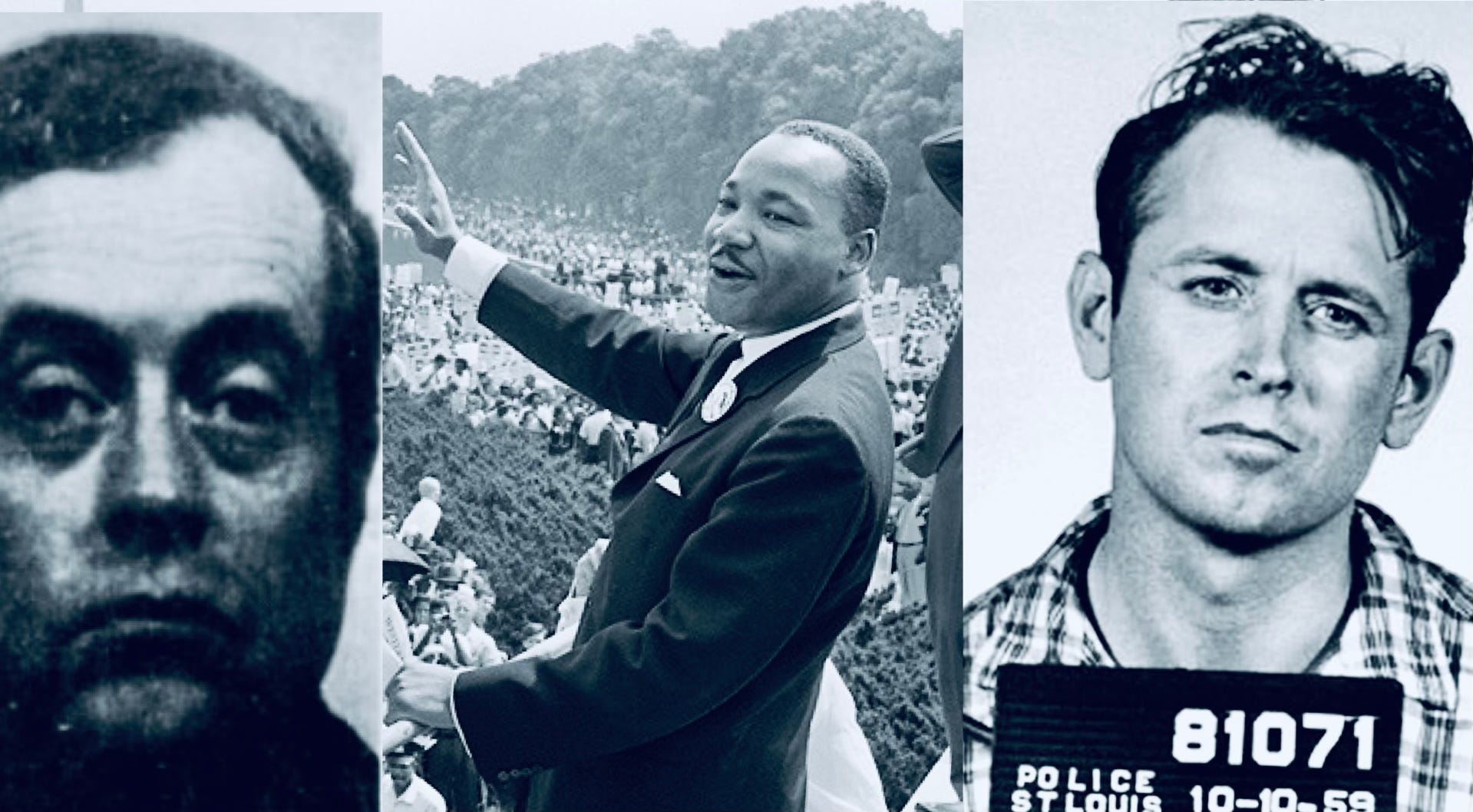
A Murder Bounty, James Earl Ray, and a Motive Called Money
Fresh claims from a dying St. Louis career criminal strengthen the case that cash, not ideology, might have been behind the assassination of Martin Luther King Jr.
When I wrote Killing the Dream in 1998, one of the most unsettling threads about the possible motive for James Earl Ray—the assassin of Martin Luther King, Jr— ran through a small circle of St. Louis criminals and segregationist businessmen. At the center was a low-level hood named Russell G. Byers and a reported $50,000 bounty to kill King. In its reexamination of the King assassination in the late 1970s, the House Select Committee had given credence that such a bounty existed.
A new Slate article by Nina Gilden Seavey revisits Byers just before his death at ninety-four and adds a critically important claim to the record: that Byers lied to the House Select Committee on Assassinations in 1978 on whether he told anyone about that bounty before King’s murder.
The background
The House Select Committee had uncovered Byers’ account of a 1966–67 offer to kill King. As Byers told it, he was approached by John Kauffmann, a St. Louis real-estate and motel operator with underworld ties, and driven to the home of John Sutherland, a wealthy Imperial, Missouri lawyer and ardent segregationist.
Inside a study decorated with Confederate memorabilia, Sutherland – wearing a Confederate colonel’s hat – offered Byers $50,000 to kill, or arrange to kill, Martin Luther King. The money, Sutherland said, came from a wealthy secret Southern organization he would not name. Byers claimed he was not interested and walked away from the murder bounty.
Both Kauffmann and Sutherland were dead by the time the committee examined the story. Even so, investigators dug into local, state, and federal files and interviewed dozens of people around all three men. Two attorneys confirmed that Byers had told them about Sutherland’s offer, and the committee ultimately concluded that, in its words, “The Byers allegation was essentially truthful.”
The question I raised in 1998 in Killing the Dream was the one that matters: Did word of that St. Louis bounty ever reach James Earl Ray? The circumstantial links were troubling.
Kauffmann was convicted in 1967 of manufacturing and selling more than a million amphetamine pills. Trial testimony revealed that an accomplice smuggled some of those drugs into the Missouri State Penitentiary at Jefferson City, where Ray was dealing and using amphetamines.
Inside that same prison block was Byers’ brother-in-law, John Paul Spica, a contract killer serving a life sentence and doing his time in the same cell block as Ray. Spica worked in the prison hospital.
Ray pushed a food cart in that hospital in late 1966 and early 1967, the same period when Sutherland’s offer was made. By Ray’s own later account, he got to know Spica there and considered him a connected St. Louis mob figure.
Spica’s prison doctor, Hugh Maxey, was close to Kauffmann and provided inmates to him on a work-release program. There were even unproven allegations that Maxey had been involved with Kauffmann in distributing amphetamines in the prison. Prison records show Maxey was in contact with Ray.
None of that circumstantial evidence proved that Ray heard about the bounty. But another inmate, Donald Lee Mitchell, told the FBI in May 1968 – only five months after the assassination – that shortly before Mitchell’s release, that Ray had boasted of a plan to collect $50,000 for killing King, arranged by friends in St. Louis. Ray invited Mitchell to join him. The amount and the city matched Sutherland’s offer. At the time, the Sutherland bounty was not public.
For me, that was a strong possibility that Ray had at least plugged into a real pipeline in which someone from St. Louis was offering serious money for King’s murder. It suggested a small-scale conspiracy rooted in money and racist politics, not in the sprawling government plots that have dominated the public imagination.
What is new in the Slate piece
Seavey’s Slate article adds a crucial twist to the Byers timeline. In his HSCA testimony, Byers said he did not tell anyone about the bounty until after King was assassinated. The first people he confided in, he claimed, were his lawyers, years later. He spoke vaguely about an FBI informant he might have told around 1973, which is why he claimed a memo ended up in his FBI file.
Seavey tracked Byers down in 2025 and recorded a “pre-interview” with him as part of her ongoing research into the King assassination and what she calls the “right-wing criminal underworld in St. Louis.” In that taped conversation, Byers told her that he did in fact tell someone about the bounty immediately – not years later. According to her reporting, he said he went straight from Kauffmann’s offer to an antique dealer on Maryland Avenue who he knew was a federal informant. When that man asked him to take on a contract killing in Chicago, Byers replied that he did not kill people and added that he had just been offered money to kill King.
Byers insisted to Seavey that this conversation took place “five minutes after the offer was made,” that the informant told the FBI right away, and that it was the bureau’s failure to act that left vulnerable to such a plot.
Seavey connects Byer’s new account to a May 8, 1968, FBI memo from Birmingham, in which a former Ray cellmate recalled Ray saying that businessmen had offered a large sum to kill King, describing it as coming from a “businessmen’s association.” That language tracks closely with what Sutherland had reportedly told Byers about a secret Southern organization raising the money. Seavey has been wrestling with that memo for years; paired with Byers’ new story, it reinforces the possibility that Ray knew about a bounty on King well before April 1968.
If Byers is telling the truth now, he lied to Congress in 1978 when he swore that no one heard about the bounty before the assassination. And if the informant really did tell the FBI in the late 1960s, the bureau’s failure to follow up on that lead is even more damning than we thought.
How much does this move the story?
Byers was a lifelong criminal who never spent a day in prison despite a long indictment record. In Seavey’s account, as their talks went on he also began pressing for payment – $75,000 – in exchange for a filmed interview, and she refused. He was ninety-three when she spoke to him. Any historian or investigative reporter treats his late-in-life statements with caution.
But one thing matters here: Byers’ revised story lines up with the motive that always made the most sense for James Earl Ray and his brothers. The Rays were drifters and small-time criminals. They gravitated to a St. Louis bar, the Grapevine Tavern, that quickly became a hub for ex-cons, pro-George Wallace activists, and racist working-class whites. It was exactly the kind of place where talk of a bounty on Martin Luther King Jr. could circulate.
In Killing the Dream, I argued that the most plausible scenario was not a federal plot or a grand intelligence operation, but a narrow conspiracy in which the Ray brothers saw a chance at a large payoff by killing a man they already despised, with leads and whispers coming through their St. Louis circle.
Seavey’s new reporting does not prove that scenario. It does, however, tighten the circumstantial chain:
Byers now says the bounty offer was in the ears of at least one FBI informant in St. Louis well before King’s murder.
Independent FBI documents already show Ray talking about a large payoff offered by businessmen before the assassination.
We have long-standing evidence that Ray’s drug and criminal network overlapped with the men behind the bounty and with the racist politics that made King a target.
Taken together, this strengthens the case that Ray and possibly his brothers were tempted and driven by money – the prospect of collecting on a bounty – far more than by ideology alone. That motive is ugly, but it is also depressingly ordinary.
What should happen next
On one point, I agree completely with Seavey: this should increase pressure to release the still-sealed HSCA files and the remaining FBI MURKIN records about King’s assassination. We need the full FBI interviews with the informant, the closed-door testimony of Russell Byers, John and Jerry Ray, and James Earl Ray, and the depositions and memoranda that have been locked away for decades.
If there was a successful conspiracy, it likely did not look like the elaborate fantasies that have filled television specials and late-night radio. It may have looked like what I described in Killing the Dream and what this new article suggests again in 2025: a half-million-dollar-equivalent bounty, whispered through a racist bar, carried by small-time criminals who suddenly saw a chance at big money.
That is not the conspiracy many people want. But if it is the truth, the King family and the public are entitled to it – and the remaining files are where we are most likely to find the last missing pieces.
PS As a bit of serendipity, on this day that the Slate article is published, it turns out that Open Road Media, the publisher of the digital edition of Killing the Dream, has all electronic versions on sale for $2.99. Here is a link to the Kindle.


Thank you for this excellent analysis ending with next steps. I read Ms Seavey’s article yesterday and concluded she had to have read your seminal Killing the Dream. She interviewed Russell Byers before he died this Oct. And tested his memory on his original testimony which she reported as consistent and has him on tape as a good reporter should try to always get. Byers lied in his testimony. All remaining documents should be released now instead of years from now. I get a feeling of de ja vu that the FBI bungled this case thus releasing the documents is delayed. Following the money so many years later with an update would really make a breakthrough in this case.
The question would remain who put up the $50,000.