


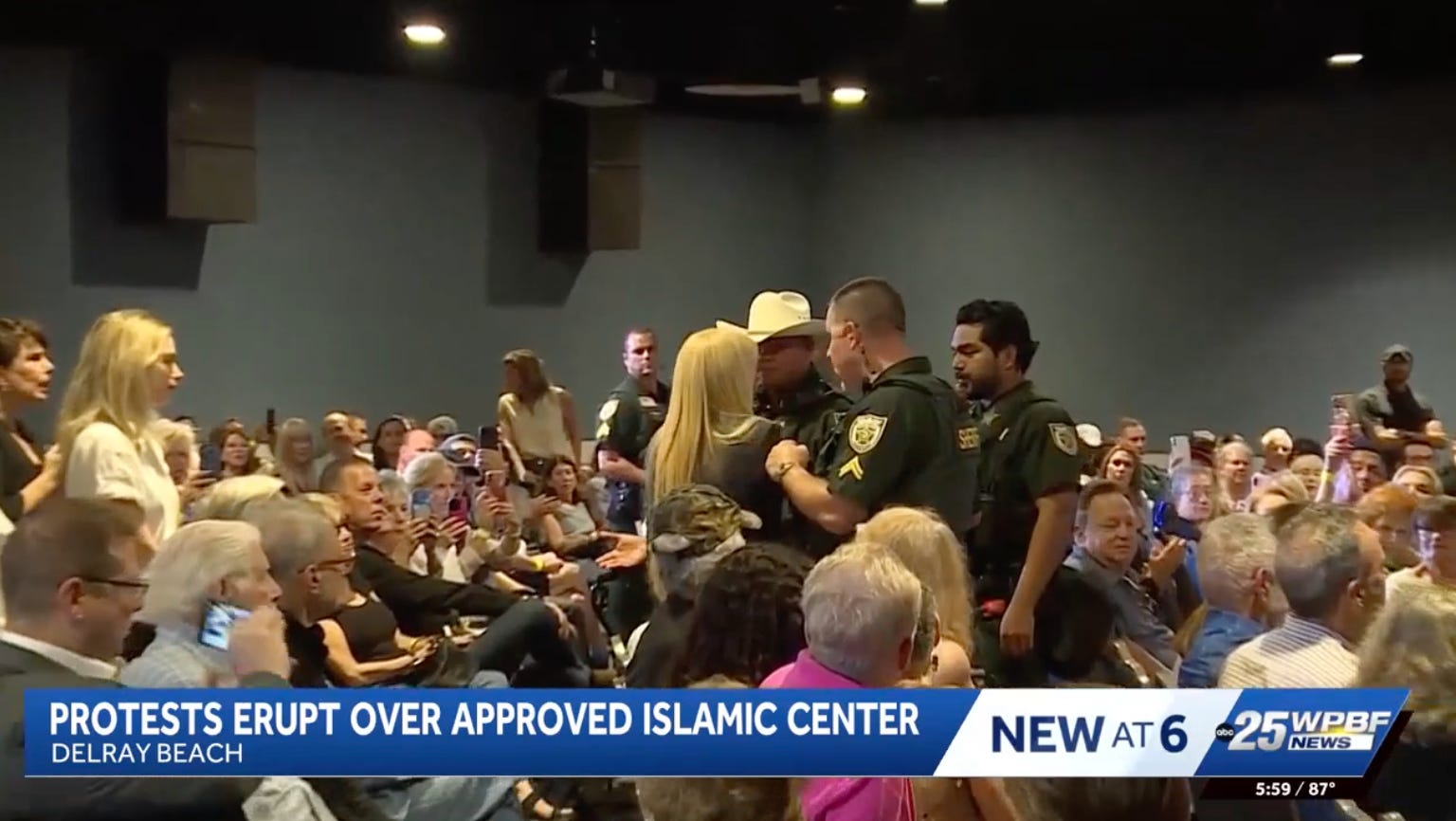
Earlier this month, a public meeting hosted by Palm Beach County in Delray Beach, Florida, drew a crowd larger than the 300-person room could hold. The subject was not a budget or a highway. It was an Islamic center planned on farmland west of town. Most of you have never heard of it, and there is no reason you would have. But what happened is a case study in how a quiet administrative shortcut can turn a routine land-use matter into a rumor mill with national reach. It also sent me back to something I had not thought about in years. Only in watching the opposition to this mosque did I see how the names and arguments swirling around it connect to reporting I first published in my 2003 New York Times bestseller, Why America Slept: The Failure to Prevent 9/11. That connection is real, and so are its limits, and I want to be careful about both.
What was approved, and how
The project sits on 15 acres off Lyons Road in Palm Beach County’s Agricultural Reserve, a stretch of protected farmland west of Delray Beach. Ten acres are for a Muslim school and daycare. Five are for a mosque. County records show two applicants for the project, the Islamic Center of Boca Raton and the Islamic Center of West Delray Beach. They filed a “place-of-worship” application in 2021.
The school and daycare went to the county commission and passed in 2023 on a 4-3 vote. The mosque never got that far. Under a process the county has used before, places of worship can be approved by staff, with no commission vote and no public hearing. So, the one part of the project most residents care about was decided without a single elected official putting a name to it or holding a public hearing to hear from the community.
To be fair, none of this was hidden. The applicants appear on county agendas. But a filing in a database is not a public hearing, and it is not the same as hearing from the applicants in a room full of neighbors. Meeting the technical requirement for noticing an agenda item and not otherwise publicizing it is one way that government officials can satisfy their legal obligation while still allowing the matter to fly under the radar.
The silence fills up
On October 2, residents packed a sometimes-raucous public meeting. Many asked who was behind the project and where the money was coming from. They were reasonable questions. A local television station, WPTV, reported that a source said the mosque’s president and members belong to the Islamic Center of Boca Raton and want a second location. But the answers were not given at a hearing, and into that gap came something much bigger.
An Instagram video featuring a local resident laid out the theory. It points to the North American Islamic Trust, or NAIT, which holds the property titles for Islamic centers in about 40 states. It cites a 1991 Muslim Brotherhood memo that, the speaker says, lays out a plan to destroy the country from within. And it asks whether NAIT, and through it terrorist-linked groups, could be behind the Delray Beach project.
Here is what holds up. NAIT is real, and it says it holds titles to Islamic centers and schools nationwide. Federal prosecutors named it an unindicted co-conspirator in 2007, and again at the 2008 Holy Land Foundation Hamas-financing trial. A federal judge declined to strike its name, finding ample evidence of its association with groups tied to Hamas. The 1991 memo is a real trial exhibit and does name NAIT as an allied organization. NAIT was never charged with any crime.
Most important for this story: in everything I reviewed, nothing yet connects NAIT to this project. The speaker on the Instagram video says, “we need to know.” That is a fair question. It is not an answer, and elected officials have been remiss in not providing one.
What I reported in 2003
The facts in this section come from my own reporting in “The Money Trail,” Chapter 12 of Why America Slept. It was about how terrorists moved their money. Where I add later developments in this piece, I say so and link the source.
Before September 11, Islamic charities and religious organizations in the United States drew little scrutiny from law enforcement. In the 1980s, Washington largely looked away from money raised for the CIA-backed Afghan mujahideen. When that war ended in 1989, Osama bin Laden tapped the same sources for his own campaign against the West. In 1999, the Clinton administration sent mid-level officials to the Gulf to ask about charities that might be aiding al Qaeda. Saudi Arabia and the Emirates refused to cooperate, and there was no serious follow-up from the administration.
The Holy Land Foundation was my case study, because it showed both how well terror financing worked and how rarely investigators cracked it. It began in Los Angeles in 1989 as the Occupied Land Fund, run by Hamas sympathizers. Its Arabic-language ads did not hide that the money was meant for more than schools and hospitals. By 1992, it had moved to Richardson, Texas, registered as a charity for refugees and the needy, and dropped the explicit calls for jihad. It then used mainstream tools: automatic bank withdrawals for donors, matching-gift programs with companies like Home Depot and American Express, online donations, even a sponsor-a-child program. In 2000 alone it raised $13 million.
The government had plenty of warning. Buck Revell, who ran the Dallas FBI’s inquiry in the early 1990s, told me that some agents had little doubt from the start about Holy Land’s connection to Hamas, and that the Bureau quickly found American Express records showing the foundation had paid for senior Hamas operatives to travel to fundraising events in the United States. But the FBI was in no rush to close it. Agents wanted to follow its key members in the hope of developing information that could prevent attacks, and Robert Blitzer, then chief of the Bureau’s counterterrorism unit, said shutting it down at that point probably would not have served the nation’s interest.
In 1993, the FBI had a Marriott near the Philadelphia airport under electronic surveillance when three of Holy Land’s leaders met with three Hamas figures to discuss violent ways to derail the Middle East peace process and to replace Yasir Arafat’s Palestinian Authority with a more radical regime. They also talked about how the American “democratic environment” let them carry out activities important to their cause. When the FBI later asked one of those leaders about the meeting, he denied ever being in Philadelphia. Shown American Express receipts, he said he did not recall such a meeting. A year later, FBI surveillance of a meeting in Oxford, Mississippi, picked up Hamas officials declaring that Holy Land had been selected as the group’s chief fundraiser in the United States. Agents again found American Express records, this time for eleven more fundraising trips by two Hamas operatives. One of them was the chief of Hamas’s military wing in Gaza, who urged a Los Angeles crowd of donors to kill Israelis. Asked by the FBI about such rhetoric, a Holy Land official replied that he thought they had freedom of speech here.
Israeli authorities raided the foundation’s West Bank office and found documents tying money from Texas to the relatives of suicide bombers and Hamas operatives. A Treasury proposal to freeze Holy Land’s assets was blocked by Attorney General Janet Reno, who thought the evidence was not strong enough. In 1998, the diary of Wadi el-Hage, a bin Laden confidant later convicted in the East Africa embassy bombings, referred to a “joint-venture” with Holy Land. Six days before 9/11, FBI agents raided InfoCom, a company run by relatives of Holy Land officials, but the Bush administration let Holy Land keep operating. The FBI did not close it until December 6, 2001. It took the Bureau nine years to shut Holy Land down.
Along the way, word of the FBI’s inquiries reached reporters, and a series of articles began raising questions about Holy Land’s links to terror. The foundation fought back hard. It hired public relations firms, gave $10,000 to the city of Fort Worth after a tornado struck to burnish its reputation, brought in the well-connected Washington law firm Akin Gump, and sued when The Dallas Morning News ran stinging stories about its ties to Hamas. In 1995, Congress had passed a law letting the president seize the assets of groups that aided terrorists. President Clinton used it to name Hamas a terror organization and freeze its U.S. assets. Holy Land was not mentioned, even though the law was drafted broadly enough to reach an organization whose funds merely benefited a terror group. As former FBI analyst Matt Levitt put it, you didn’t have to be buying bullets.
There was a reason for the FBI’s caution, and I think it still matters. According to Buck Revell, a major reason for the Bureau’s inaction was the caution of pre-9/11 Washington about aggressively pursuing probes that might involve political or religious advocacy. Many senior Justice Department officials remembered the congressional investigations of the 1970s that exposed illegal FBI tactics, including spying, blackmail and even sabotage, against leftist political and religious groups. The Bureau had also fared badly in trying to link other groups to terror. It charged that the Irish Northern Aid Committee, which raised money for Catholic widows and orphans in Northern Ireland, also ran guns for the IRA, but it was unable to make a case. In the 1980s it investigated CISPES, a group backing Salvadoran rebels, was again unable to make a case, and was sued by the group. After nearly a decade it settled, agreeing to pay $190,000 in legal fees and promising not to investigate solely on the basis of First Amendment activity. After 9/11 the pendulum swung hard the other way. Agents raided and seized the assets of some of the largest Muslim charities in the country, including Holy Land and, in Illinois, the Global Relief Foundation and the Benevolence International Foundation. In the first months, 168 charities and similar groups were closed or had their finances blocked.
What Delray Beach made me see
Three things connected for me as I read about the fight over this mosque.
First, the instagram video I mentioned before leans on exactly this history. Its speaker says they hold a tax return showing a donation around 2000 from the Global Relief Fund to the Islamic Center of Boca Raton. Global Relief Foundation is one of the charities I reported was raided after 9/11. I have not seen the document, so I cannot say whether it is genuine or what the donation was. A gift made before a charity was shut down does not tell us what anyone at the receiving end knew.
Second, the name at the center of the video’s theory, the North American Islamic Trust, does not appear in the pages I wrote. It entered the public record later, in 2007, and again at the 2008 Holy Land trial. Holy Land and five of its officials were convicted in November 2008.
Third, the residents’ fear is not invented from nothing. The money trail I reported was real, the failures were real, and the later trial put NAIT’s name in the record. Anyone who has read that history can see why neighbors feel uneasy when they hear that one trust holds the deeds to Islamic centers across the country.
But history about a sector is not evidence about an application. A county can ask who is behind a project and should make the answers public. It cannot lawfully deny a house of worship because of someone else’s record.
What a vote could and could not have done
A public vote would not necessarily have changed the outcome, and it is worth being clear about why. Under the federal Religious Land Use and Institutionalized Persons Act, a county generally cannot block a house of worship because of who its members are or what neighbors fear about their faith. Lawful grounds are neutral ones: traffic, drainage, noise, and the special rules that protect the Agricultural Reserve. A commissioner who voted no because of NAIT or the Muslim Brotherhood could be handing the applicants a lawsuit. However, noise is the clearest example of a question the county can lawfully ask. One resident at the meeting asked specifically, “Will there be an amplified call to prayer and will surrounding neighborhoods hear it five times a day? And if the answer is no, put that commitment into an enforceable condition.” I could find no response from the applicants, the county or commissioners. Separately, WPTV said it sent questions to the applicant’s representative, Brian Seymour of the Gunster law firm, and was still waiting for a reply.
But a hearing is not only a vote. It is where applicants state on the record who they are, who owns the land, how the project is financed, and what will be built. It is where county staff explain what the law lets them ask and what it does not. And it is where a resident who is worried about something specific can hear the answer from the people responsible, instead of from an instagram video.
Would that have settled every fear? No. Some people will not be satisfied by any answer. But the claims that spread here, about deeds, about a thirty-five-year-old memo, about secret funders, thrive precisely where there is no official record to point to. Silence did not protect the applicants. It left them instead to be defined by their loudest critics.
One rule for every house of worship
Palm Beach County has started to look at how houses of worship are approved. Commissioner Maria Sachs said changes would not reach projects already approved, and no code changes have been adopted. County staff are expected to report back.
Whatever the commission decides, the test should be simple. If staff-only approval is acceptable for a church, a synagogue and a mosque, keep it, and publish the applicants, the plans and the financing basics early. If the public deserves a hearing for one, it deserves one for all.
That is the lesson I take from Delray Beach, and it reaches well beyond south Florida. When officials skip the public step, they do not avoid the argument. They just make sure it happens later, angrier, and without the facts. The residents had fair questions and concerns, and local government has so far failed to answer them. The controversy over the mosque in Delray Beach is not going away.
If the public step is a good one, it should have applied before these events. But, because this relates to Muslims it should now have a more public process.
Very informative! 💯 — “The test should be simple. If staff-only approval is acceptable for a church, a synagogue and a mosque, keep it, and publish the applicants, the plans and the financing basics early. If the public deserves a hearing for one, it deserves one for all.
When officials skip the public step, they do not avoid the argument. They just make sure it happens later, angrier, and without the facts. The residents had fair questions and concerns, and local government has so far failed to answer them.”
Having dealt with similar land and property use situations for years with city government on comparable issues it’s all about process. Cheat the process and expect problems. Local government has clearly screwed this one up. Why?